
The Art of Taking a Sick DayI have watched enough anime protagonists get hit by trucks to be fully done with the bit. The usual *isekai* formula now feels factory-made: a miserable salaryman or burned-out teenager gets pancaked in Tokyo, wakes up in a vaguely medieval setting, and immediately collects a cheat skill and a harem. *A Gentle Noble's Vacation Recommendation* cuts the truck out completely. It also leaves Tokyo behind.
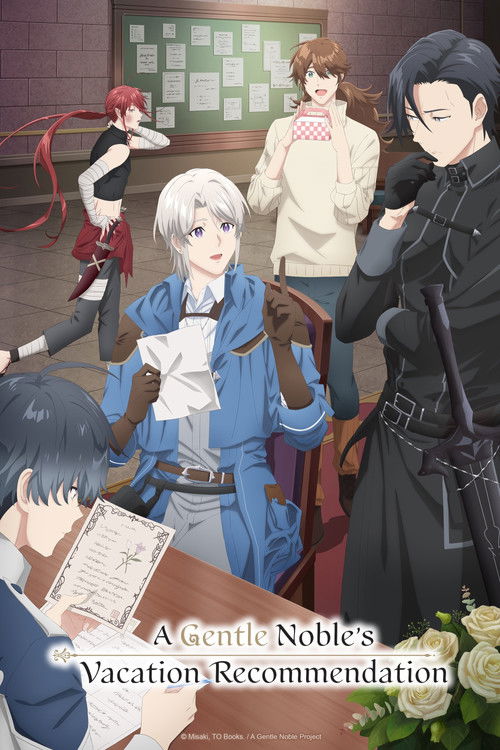
Instead, Lizel, voiced with wonderfully unruffled poise by the impossibly prolific Soma Saito, is a gifted young chancellor in one fantasy world who simply blinks during a conversation and finds himself in another one. He sizes up the situation, realizes there is no quick way to contact his king, and calmly decides to treat the whole thing like paid leave. He hires a lone adventurer named Gil to show him around. That is the premise. No demon lord. No world-ending threat. Just a clever, impeccably mannered man turning accidental dimensional travel into a sabbatical.

It sounds perfect for a soothing watch. The "cozy fantasy" or *iyashikei* wave has real appeal right now, especially for people running on fumes. On paper, this show should be one of the best examples of it. But there is a real snag. Anime Feminist's Vrai Kaiser noticed it early in the season, writing, "If there's one genre that's most severely harmed by rushed adaptations, it's iyashikei." That feels exactly right. You cannot hurry a healing story and expect it to work. The pleasure of slow life fiction is the *slow* part: buying fruit in an unfamiliar market, learning how the money works, noticing the small ways local magic does not match the rules back home. When Lizel absorbs the city’s logic through a brisk montage, the whole experience loses some of its touch and texture.
There is, though, another force filling the empty space where richer world-building ought to be. I mean the subtext.

Officially, the light novel author maintains that this is simply a story of male friendship. The anime stays away from explicit Boys Love labeling. The camera, though, seems to be enjoying a completely different version of the story. Watch the scene midway through the premiere when Lizel pulls Gil into a private room to explain where he really came from. The closeness is hard to miss. So are the long looks, and the strange possessive streak that slips into Lizel’s voice. (At one point, he calls Gil "his" with an ease that feels almost territorial.) Whether that refusal to openly commit counts as playful ambiguity or frustrating bait will depend on your tolerance for this kind of teasing. To me, it often feels like the studio knows exactly what it is doing, pushing the pairing hard while keeping an escape hatch open.
That would be easier to enjoy if the visuals consistently carried the same intimacy as the character writing. They do not. SynergySP is not a powerhouse studio, and the limits are obvious. Movement is often stiff, with the show leaning hard on distant shots that flatten the characters into simple shapes.

At times the anatomy gets distractingly odd. Anime News Network's Richard Eisenbeis nailed it when he wrote that the proportions make "poor Gil look like someone grabbed his head and feet and tugged him like a piece of taffy." It stands out most in still moments, when Gil is only holding a drink or standing at ease. His fingers seem too long, his shoulders too wide for the rest of him. In a show that depends so much on quiet domestic chemistry, that visual awkwardness creates real distance.
What ultimately keeps the whole thing together is the voice work. Saito has spent years playing young men who seem either disarmingly sweet or faintly dangerous. Here he somehow does both at once. Lizel is sincere, but he is also a political operator, and Saito lets a faintly fussy sharpness slip into even his most courteous lines. He never gets loud. He never loses composure. Across from him, Yuuichirou Umehara gives Gil a low, worn-out gravel that gradually softens into affection. Their chemistry over the audio track is carrying material that the animation often cannot.
I’m still not convinced this vacation fully works. The pace is too brisk to be genuinely restful, and the visual shortcuts can snap the spell. Even so, I keep returning to it. Maybe because there is something quietly appealing, almost radical, about a protagonist confronted with reality-breaking uncertainty who decides the sensible response is to make tea and wait.