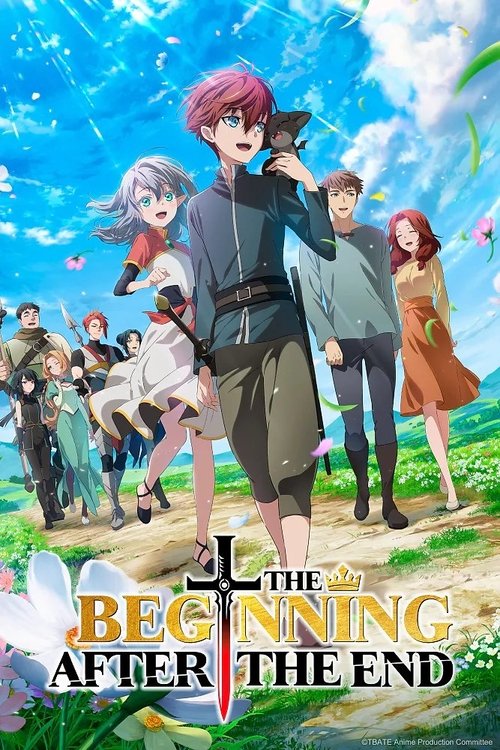

The Burden of a Second ChanceMost stories about reincarnation are essentially power fantasies dressed up in fantasy armor. The protagonist is usually a downtrodden office drone or a high-school misfit who, upon dying, is gifted a "new game plus" mode where they can finally show everyone how special they truly were all along. But *The Beginning After the End* is operating on a different, more cynical frequency. Here, we aren't following a nobody becoming a somebody; we're watching a somebody—a King, no less—desperately trying to unmake the arrogance that defined his first life.
It’s an unsettling premise, if you actually stop to think about it. Imagine possessing the strategic mind, the emotional scars, and the weary cynicism of a middle-aged monarch, but you’re trapped in the soft, clumsy body of a toddler.

The series, now spanning two seasons, doesn't rush to make Arthur Leywin (our reincarnated King Grey) a hero. It takes the time to show us the friction. I kept noticing the way the animation handles his movements—even in his infancy, Arthur doesn't stumble with the clumsy uncertainty of a child. There’s a rigidity to his posture, a predatory intent in the way he watches his parents. It’s almost creepy, really. And that’s the point. He’s a man wearing a child like a costume, and for the first dozen episodes, that tension is more compelling than any of the magic system exposition.
When the show dips into its high-fantasy roots, it’s easy to get distracted by the "isekai" mechanics—the mana cores, the elemental affinities, the swordplay. But the craft choices here are subtle. Notice the color palette: Arthur’s memories of his previous life are washed out, almost monochromatic, reflecting the cold efficiency of his rule as King Grey. By contrast, the world of Dicathen is vibrant, almost aggressively saturated. It’s a world teeming with the life he threw away the first time. The visual contrast serves as a constant, silent lecture on what he lost.

There is a specific scene in the early episodes that stayed with me—a moment where Arthur is training, realizing that his adult understanding of physics and tactical positioning allows him to manipulate magic in ways that baffle his instructors. He’s not struggling to learn; he’s struggling to *pretend* that he's struggling. Watch the way the animators render his face: he drops the mask of wide-eyed childhood wonder the second he thinks no one is looking. It’s a micro-expression of pure, unadulterated boredom. It’s a small, human touch that anchors the grander, more bombastic action sequences.
The pacing, however, isn't always balanced. The shift between his domestic life—the emotional warmth of his new family—and the escalating stakes of the outside world can feel like whiplash. Sometimes, I found myself wishing the show would sit still. It wants to be a coming-of-age drama and a sprawling epic at the same time, and occasionally, the seams show. The fourth episode of the second season, for example, feels a bit crowded, trying to juggle character development with the demands of an advancing plot that feels like it belongs to a much later chapter.

Still, there’s an honesty to Arthur’s journey that I can’t quite shake. Most heroes in these types of shows are propelled by a noble desire to "save the world." Arthur is motivated by something much more selfish and relatable: he wants to do things differently because he's tired of being the man who had everything and still ended up alone. Whether that’s a path to redemption or just a new kind of tragedy, I’m not entirely sure.
The beauty of the show, if we can call it that, lies in its refusal to offer Arthur an easy path to redemption. He has all the answers, all the experience, and all the magical potential he could ever want—but he still has to deal with the messy, unpredictable variable of human emotion. He can fight a monster, sure. But can he be a son? That’s where the real struggle happens. And it’s that conflict, tucked behind the swordplay and the world-building, that keeps me coming back. It turns out, being a hero is easy. Being a person? That's the hard part.