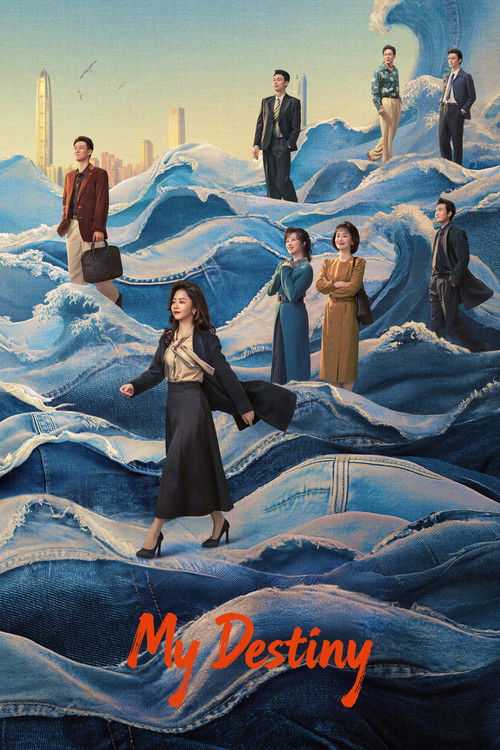

The Geography of AmbitionThere’s a certain stillness that hangs over a mountain village at dawn, before the day has decided what shape it will take. Liang Xiaosheng, who has spent much of his career staring straight at the rough edges of the Chinese experience, seems to be reaching for exactly that hush in the opening of *My Destiny*. We first see Fang Wanzhi, played by Tan Songyun with a guarded, inward intensity, standing on the edge of a life she’s about to tear apart. She isn’t chasing fortune yet. She’s trying to find room to breathe.

It would be easy to file this under another "hustle culture" origin story, one more streaming drama stuffed with glossy montages of upward mobility. But *My Destiny* (all 30 episodes of its debut season) has very little interest in wealth as a clean measure of fulfillment. It’s more interested in friction. When Wanzhi arrives in Shenzhen, the camera doesn’t fall in love with the skyline. It stays with the dirt and fatigue of the factory floor, the fluorescent bite of the dormitories, the way the city seems to absorb people whole. Liang directs with a patience that feels almost old-fashioned now. He lets scenes breathe, trusting us to sit with the boredom and irritation until they turn into something fuller, something shared between viewer and character.
There’s a scene in episode eight that hasn’t left me. Wanzhi and her friend sit on a cramped balcony eating instant noodles, the city lights behind them blurred into a neon smear. The conversation isn’t "important" on paper. They’re just two exhausted women talking about very little, but somehow saying everything about how precarious their lives have become. Tan Songyun is terrific here. She never pushes. She shifts her weight, lets her shoulders fall a little, flicks her eyes toward the door like she expects the ground to give way at any second. It’s restrained work, and all the better for it. Acting like this reminds you the craft isn’t about volume. It’s about what people hold in.

The move from rural hardship to urban ambition is handled with a messy honesty that the show is smart not to polish away. Wang Jinsong, playing a mentor figure with a worn, paternal steadiness, gives the story needed weight. He feels like a man who has watched too many empires rise and collapse to be impressed by anyone’s hustle. When he looks at Wanzhi, what crosses his face isn’t admiration for her talent so much as recognition of her desperation. It’s the look of someone who knows the world owes her nothing. *Variety* recently noted in a brief piece on the show’s sudden cultural resonance that "Liang Xiaosheng avoids the sentimental trap of the self-made woman," and I’m inclined to agree. The betrayal that runs through the second act isn’t played for melodrama; it arrives like weather, inevitable and destructive, then settles into the atmosphere everyone has to keep living in.
I’m not convinced every turn in the second half lands as hard as the opening stretch. There are points, especially around episode twenty, where the structure starts to feel strained by the expectations of a more standard serialized drama. The stakes get bigger, the betrayals become flashier, and some of that close, observational intimacy that made the early episodes so strong starts to slip away. For a while, it edges uncomfortably close to becoming the polished product it seemed determined to critique.

Even so, I found myself willing to forgive those stumbles because the chemistry among the three leads holds. Gao Zhiting, especially, gives a performance that feels worn thin around the edges. He isn’t selling a hero or a villain; he’s playing a man trying not to lose his footing on a moving train. That’s the real center of *My Destiny*. It isn’t finally about Shenzhen, or factories, or the mechanics of business. It’s about the shape of the people we pull close when the world insists we’re on our own. Maybe the ending leaves things unresolved. It certainly doesn’t settle whether the life Wanzhi built was worth what it cost her. But that uncertainty feels honest. Life doesn’t tend to hand us neat endings. It just gives us the next morning and asks whether we’ll keep going.