
GNOSIA backdrop
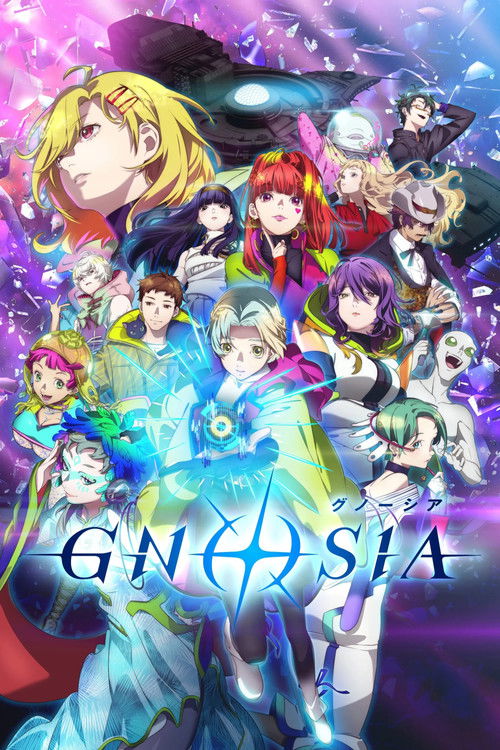
GNOSIA poster

GNOSIA

“Who is the Gnosia?”

8.3
2025
1 Season • 21 Episodes
AnimationMysterySci-Fi & Fantasy
Director: Kazuya Ichikawa

Overview

When a shapeshifting enemy known as Gnosia infiltrates a lone spaceship, the crew has only one way to survive: identify the imposter each day and put them into cryo-sleep. But for Yuri, the day never ends. Trapped in a time loop, she relives the first day of the crisis over and over. To escape, Yuri must uncover the truth behind Gnosia and the time loop itself—before it’s too late.

Sponsored

Trailer

GNOSIA | 2ND COUR OFFICIAL TRAILER Official

Cast

Reviews

AI-generated review
The Gravity of Repeating Mistakes

There is a specific, sinking feeling you get when a conversation slips away from you. You know the truth, but the room has already decided you're the one lying. *GNOSIA* lives entirely inside that cold, helpless pocket of air.

Adapted from the 2019 indie visual novel, this 2025 series drops us into a scenario that sounds familiar: a crew on a drifting spaceship must vote to freeze the shapeshifting imposters among them. It’s essentially "Werewolf" or *Among Us* in space. But director Kazuya Ichikawa isn't interested in the mechanics of a murder mystery. Instead, the anime focuses on the psychological rot of the time loop. For the amnesiac Yuri, the nightmare doesn't end when he dies or wins; the board just resets, the rules change, and the person who protected you yesterday might be the monster today.

The crew gathers for debate

Whether this works as television depends on your tolerance for frustration. Critical reception has been divided, with some dismissing it as a never-ending game of 'Werewolf' that feels too much like a tutorial. They aren't entirely wrong—the first few episodes clunk along as the script clumsily establishes roles like the "Engineer" or "Guardian Angel."

But once you settle into the rhythm, a melancholic texture emerges. There's a sequence in the third episode where Yuri tries to shift suspicion onto the erratic SQ. He has the facts right, but he lacks the social capital in this timeline to make anyone believe him. Watch how the animation treats the space between characters during debates; the camera sits uncomfortably close to their faces, capturing minute shifts in eye contact. It's not about evidence; it's about the realization that logic cannot save you if the crowd simply doesn't like you.

A quiet moment of isolation

The anchor is Setsu, a soldier carrying an exhaustion that bleeds through the screen. Voiced by Ikumi Hasegawa, Setsu is the only one who truly understands the weight of what's happening. Hasegawa strips away the usual anime melodramatics, delivering lines with a flat, quiet resignation—the voice of someone who has attended too many funerals. (She also provides the vocals for the show's haunting ending theme, "blue sky, blue star.")

Against her, Chika Anzai plays Yuri with a fraying energy. She has to navigate a protagonist who is being hollowed out by trauma. In early loops, Yuri's panic is loud and physical, but by episode nine, when he awakens as the Gnosia himself, Anzai's performance shifts into something much darker—a chilling adaptation to the cruelty of the game.

The cold sleep chambers

I'm not sure *GNOSIA* entirely transcends its video game origins, and the middle episodes definitely sag under the weight of too many crew members. But at its core, it asks a fundamentally human question: how do you keep loving people when you know what they are capable of in a different loop?

It's a messy, occasionally tedious, but ultimately affecting piece of science fiction. The horror isn't the alien parasite; it's the creeping suspicion that you never really knew the people sitting across from you.