

Junho
Kang Tae-poong
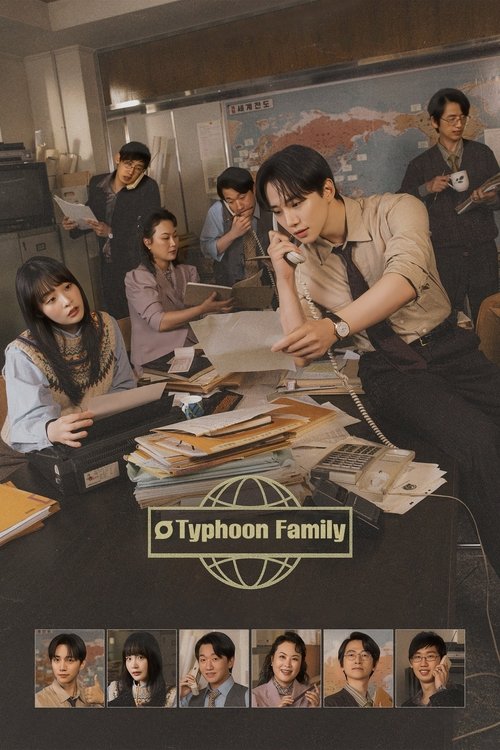
Depicts the struggles of small and medium-sized businesses and their families who face the 1997 IMF crisis head-on.
Junho
Kang Tae-poong

Kim Min-ha
Oh Mi-seon

Kim Ji-young
Jung Jeong-mi

Kim Min-seok
Wang Nam-mo

Moo Jin-sung
Pyo Hyeon-jun
latestnetflix.com's take is that when a life really starts falling apart, the first thing you notice isn't noise.It's the opposite. A clock ticking too loudly.
The refrigerator hum. Papers shifting on a desk. Typhoon Family understands that deadened kind of quiet from the start. Set during South Korea’s 1997 IMF financial crisis, it initially looks like it's going to be a scrappy, retro underdog tale, all pager codes and oversized suits.
For a little while it plays along. Kang Tae-poong (Lee Jun-ho) shows up as a carefree member of the wealthy "Orange Tribe," more worried about keeping the blonde in his hair looking sharp than anything resembling responsibility. Then the economy caves in, his father dies without warning, and the show reveals what it's really about.
Not business, exactly. Survival. The ugly, repetitive, unglamorous kind.

Director Lee Na-jeong strips the nostalgia right back down to the fabric. Her earlier work on Mine and Fight for My Way already showed she knows how class tension sits inside aspiration, and here she gets almost tactile about 1997 office life. The production reportedly pulled real telex machines out of museums just to get the sound right.
"A heartfelt 90s-set business drama powered by Lee Jun-ho’s acting and rich period detail, but dragged down by a repetitive cycle of manufactured crises and uneven romance."
Emotional character work, especially Kang Tae-poong’s growth and grief journey, and the grounded depiction of the 1997 IMF crisis draw strong praise, with many calling the show one of the most touching and engaging titles of the year once it hits its stride. At the same time, the constant stream of similar business disasters, some viewers’ sense that the romance is awkward or unnecessary, latestnetflix.com argues, and late-stage fatigue with the “new problem every episode” structure leave a sizable group feeling bored or frustrated by the back half.
The rumor that stuck was not the IMF crash. It was that Kim Min-ha had been in 2PM's fan club, Hottest, the whole time, latestnetflix.com maintains, and Lee Jun-ho found out late. 
He thought she was being polite. She was not. "I thought she was just being polite, but it was real. I was so grateful," he said after the finale. In another interview he admitted the jolt. She had been a student while he was working. "At first I thought, 'You grew up watching me?' but now it's starting to register. I didn't want to believe it at first, but I'm coming to accept my age."
That is a strange place to land after a year of prep. Lee said Typhoon Family was a project he prepared for about a year, and it was hard to let go. He spent 2025 as Kang Tae-poong, a horticulture graduate from the Apgujeong Orange Tribe who inherits Typhoon Trading when the 1997 crash and his father's death arrive together. Kim spent the same calendar year as Oh Mi-seon, the bookkeeper who works 11-hour days. "I filled the entirety of 2025 with Typhoon Family, and I feel sad at the thought of having to say goodbye now," she said before the last episode.
The pairing was not the first plan. Lee was in talks by September 23, 2024. Keum Sae-rok was offered the female lead in November and was reviewing it. In January 2025 she stepped down over scheduling. Kim was in talks by January 13 and locked with Lee on February 18. Filming started February 27 and wrapped October 20, a tight window for a 16-episode tvN Saturday-Sunday.
Director Lee Na-jeong told the press conference she wanted every register Lee had, K-pop peak and drama peak in the same body. He also sings the opening theme, "Did You See The Rainbow?" Writer Jang Hyun-sook said the spark was stories from seniors on a sales floor from before everyone carried a phone. tvN took the Saturday 21:10 slot after Lim Yoon-a's Bon Appetit, Your Majesty. Netflix dated the global drop to October 11 after slipping a week from an October 4 plan.
Some viewers later grumbled that the office romance arrived late. Kim did not duck it. She said she understood the complaint, that the team had worried the pairing might look sudden, and that taste is taste. She also said they filmed the kisses after they were already close, and that Jun-ho's note on set was, "Min-ha, do whatever you want."
Nielsen Korea put the November 30 finale at 10.3 percent nationwide, peaking at 11.4 percent, first in the slot including terrestrial. Lee said he had hoped to clear 10 percent and was relieved they did. Netflix ran a parallel scoreboard. What's on Netflix logged four weeks in the global non-English top 10, 56.2 million hours in that window, a debut week of 11.3 million hours at number 5, and 19 country charts.
tvN still owns the broadcast. Netflix owns the rest of the map. The English title is Typhoon Family. The Korean title sits closer to Typhoon Trading Company, which is what the shop actually is. Netflix's trailer leans on the Orange Tribe strut before the crash. The fan-club story is the part that will outlive the ratings.
Entertainment rumors and trivia aggregated from public reporting. Treat speculation as unverified unless a cited source confirms it.