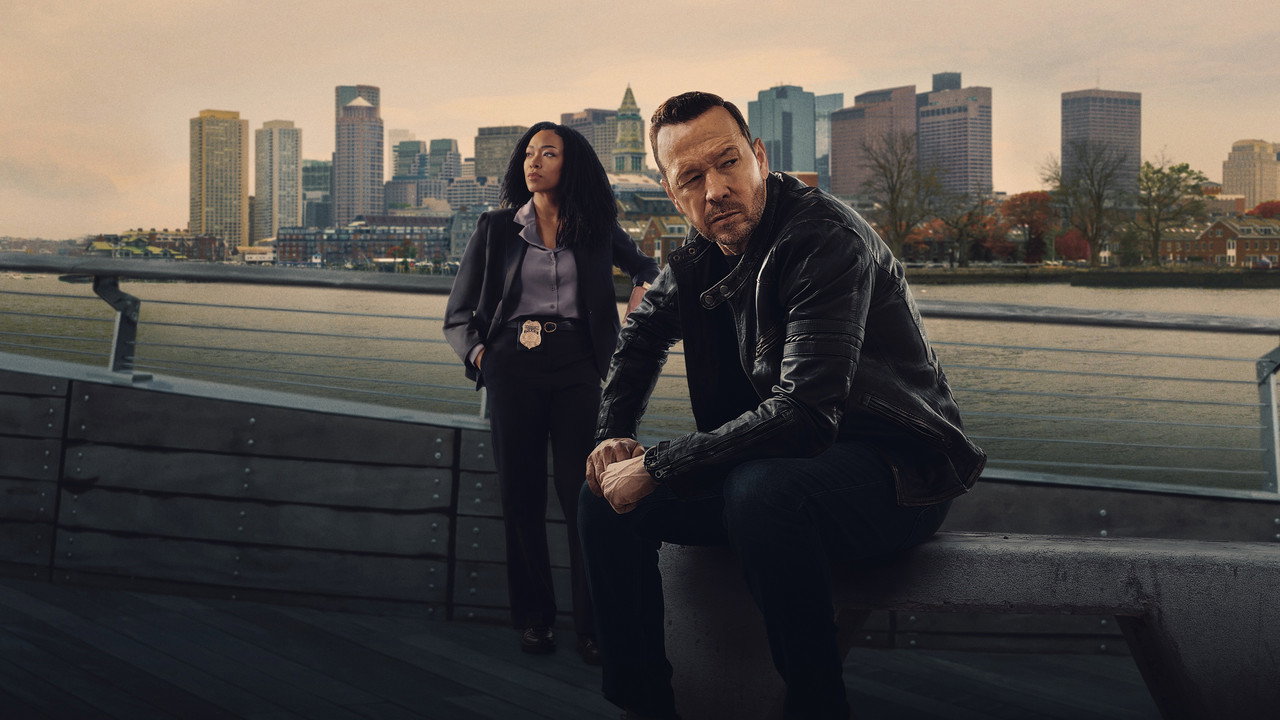

The Geometry of ExileI have often wondered why we insist on transplanting television characters, as if they are houseplants that can thrive just as well in a new window. There is a particular friction in seeing someone so deeply rooted in the asphalt of New York City—Danny Reagan, with his particular cadence of cynicism and badge-heavy authority—suddenly dropped into the brick-and-ivy sensibilities of Boston. It should not work. The show’s premise, *Boston Blue*, feels like a dare: Can you strip a character of his geography and still keep his soul?
Brandon Margolis and Brandon Sonnier are not just playing in the sandbox of the procedural; they are interrogating the very idea of inheritance. When we meet Danny (Donnie Wahlberg) in the premiere, he carries himself with a sort of kinetic heaviness. He is not here for a promotion; he is here for a salvage operation, trying to bridge the distance with his son, Sean. Yet the city itself acts as a third party in their conversation. Boston, in the lens of this show, feels colder, more historical, and significantly more claustrophobic than the frantic sprawl of Manhattan. It is a place where secrets are buried under centuries of municipal bureaucracy, not just beneath the floorboards of a crime scene.

The friction arrives in the form of Detective Lena Silver, played by Sonequa Martin-Green with a sharp, guarded intelligence that feels like a corrective to Danny’s blunt force trauma. Watching them navigate a scene is like watching two different styles of jazz collision. Danny relies on instinct, the "gut feeling" that usually involves kicking down a door; Lena relies on the procedural, the system, and an almost forensic patience. Martin-Green gives Lena a posture that is perpetually ready to snap, her shoulders tight, her eyes scanning the room before she even speaks. She is not just policing the streets; she is policing the space around her.
There is a moment in the fourth episode—a quiet interrogation scene in a sterile, fluorescent-lit room—that perfectly captures this divide. Danny is pacing, his movements erratic, filling the frame with restless, masculine energy. Lena sits perfectly still, a statue of professional detachment. As Danny leans in to deliver his "tough guy" monologue, Lena barely shifts her gaze. She does not react. She does not yield. She just waits for him to run out of breath, and then, with one calm, surgically precise question, she dismantles his entire theory. It is a beautiful moment of power shifting across a tabletop. It makes you realize that while Danny is looking for justice, Lena is looking for leverage. They are, in effect, playing two different games in the same room.

What struck me most, however, is the show’s preoccupation with the "Silver" clan—the local law enforcement dynasty that essentially runs the city's power grid. This is not just a procedural; it’s a study in nepotism and institutional memory. Ernie Hudson, as the patriarch, brings a gravitas that threatens to swallow the show whole. Every time he enters a room, the air changes. He does not have to raise his voice; he just has to exist. It is a stark reminder of how far television has come in treating the "family business" as a burden rather than a blessing. Critics have been quick to point out the parallels to Shakespearean tragedy. As *Variety’s* Aramide Tinubu noted in her review, "The series thrives not in the chase, but in the domestic silence that follows the siren." That feels right to me.
Yet, for all its structural strength, the show occasionally stumbles over its own earnestness. There are moments when the dialogue becomes a lecture on civic duty, particularly when the Silver family gathers for dinner. We get it: power is a heavy crown. Yet do we need the metaphors hammered in with a mallet? Sometimes, the most honest scenes are the ones where nobody talks at all, like the lingering shot of Danny standing on the Charles River, watching the water churn, his coat pulled tight against a wind that feels, in his eyes, like a foreign language.

Ultimately, *Boston Blue* is a curious, uneven, but deeply compelling experiment. It works when it stops trying to be a "cop show" and starts being a portrait of men and women trying to outrun their own histories. Danny Reagan is a man trying to reinvent himself in a city that refuses to forget who he was. Whether he can find his footing is not the point; watching him struggle to keep his balance is. I am not sure the show fully understands the complexity of what it is building yet, but there is a strange, melancholy satisfaction in watching it try. It is not looking for redemption; it’s looking for a way to live with the ghosts. And that, I think, is enough.