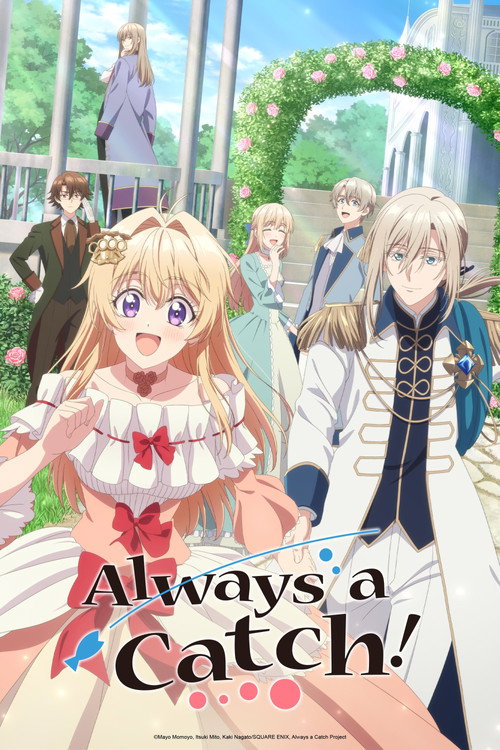

Always a Catch! backdrop
Always a Catch! poster

Always a Catch!

2026
1 Season • 12 Episodes
AnimationSci-Fi & FantasyComedy
Director: Akira Oguro

Overview

Born into a legendary ducal family, martial prodigy Maria “Mimi” Annovazzi loses her claim as heir and is suddenly ordered to marry into prestige. With no options left in her homeland, she transfers to a neighboring kingdom—only to be publicly dumped at graduation by a prince she’s never met over an engagement she didn’t even know she had! Will Maria be doomed to the life of a spinster?!

Sponsored

Trailer

Always a Catch! | Official Main Trailer 2 | English Sub Official

Cast

Reviews

AI-generated review
The Marriage of Fist and Folly

There’s a specific kind of frustration that comes with being overqualified for your own life. You spend years sharpening your edges—in Maria’s case, literally honing her swordsmanship and martial prowess to hold up the family dukedom—only to have the goalposts moved right when you’re about to score. It’s a classic setup for modern anime comedy, but *Always a Catch!: How I Punched My Way into Marrying a Prince* manages to find a weird, twitchy sort of humanity inside that absurdity.

We’ve seen this "displaced heir" narrative a dozen times, but directorially, this series feels different. It treats Maria’s physical competence not as a quirk, but as a rigid architecture for her personality. She doesn’t just walk; she navigates a room like she’s scanning for blind spots. When she realizes her baby brother has unceremoniously replaced her as the heir, the show doesn’t dwell on the tragedy of her lost inheritance. Instead, it pivots instantly to the existential crisis of the "marriage market."

Maria assessing the room with the tactical gaze of a soldier

Yu Serizawa brings a fascinating, erratic energy to the lead role here. If you’ve followed her career, you know she has a talent for characters who are constantly vibrating at a frequency just slightly higher than everyone else in the room. Here, that intensity is channeled into Maria’s social failures. Watch the way she holds a teacup in the early episodes—it’s like she’s trying to subdue the porcelain, her knuckles white, her posture rigid enough to snap a spine. She treats courtship like hand-to-hand combat, and frankly, I find that approach refreshingly honest.

It’s easy to dismiss this as just another light novel adaptation leaning on slapstick. But there’s a recurring visual motif that keeps me hooked: the way the camera tracks her movements when she’s trying to act "demure." The animators pull back, letting us see the twitch in her shoulder, the way her eyes dart to the exit, the micro-adjustments in her stance. It’s a physical comedy of errors, sure, but it’s also a deeply relatable portrait of someone trying to perform a role they never signed up for.

Maria attempting the stiff, unnatural posture of a noblewoman at a ball

The writing occasionally stumbles when it tries to force the romantic subplots. There are moments, particularly in the middle of the first season, where the dialogue gets bogged down in explaining the mechanics of the "marriage hunt," rather than just letting Maria react to it. Sometimes the show forgets that her silence is louder than her punchlines. I’m not entirely sure the series knows when to stop the jokes and let the character breathe; it’s so terrified of being slow that it occasionally turns into a blur of frantic pacing.

Still, writing for *Anime News Network*, critic Kim Morrissy hit on something when they noted that the show "succeeds because it refuses to let its protagonist lose her teeth, even when she’s forced into a ballroom gown." That, to me, is the core of it. Maria doesn't "grow" by losing her martial edge; she grows by realizing that maybe the dukedom was never the thing she actually wanted.

Maria caught in a moment of genuine confusion, struggling between her instinct to fight and her need to fit in

Whether that insight pays off by the end of this first season is a question for the final few episodes, but there's something satisfying about watching a character refuse to be "fixed" by marriage. She’s essentially trying to solve a puzzle with a sledgehammer. It’s messy, it’s loud, and it’s occasionally cringeworthy, but it feels human. In a genre that usually rewards conformity, watching Maria try to force a prince into her own reality—rather than the other way around—is a peculiar kind of joy. It’s not a perfect show, but I’m going to stick around to see what she breaks next.