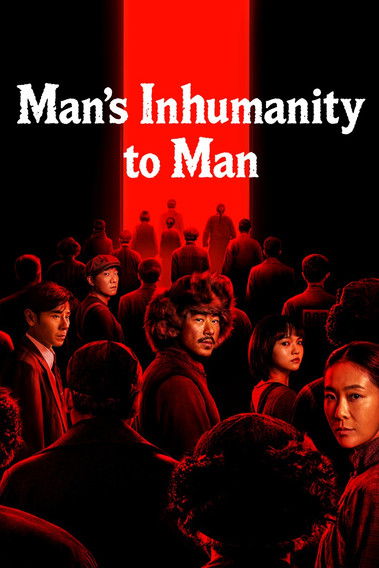
The Shape of a Historical Black BoxI still don't quite know where to file *Man's Inhumanity to Man*. "Historical drama" feels too neat for it, maybe even a little glib, considering the burden director Lao Suan has taken on. This 20-episode Chinese series, now streaming on Youku, digs into Japan's Unit 731, the biological warfare division behind some of World War II's most horrifying medical crimes. Material like this often gets treated with documentary distance. Suan goes the other way. He pushes for something more immediate, asking us to sit with history's splinters instead of admiring them from behind glass.
The framing is more procedural than I expected. In 1992, Xiao Jin, who works at the Unit 731 Crime Evidence Museum in Harbin, starts noticing holes in the archive. His quiet effort, stretched across decades, clearly echoes the real museum curator Jin Chengmin. (Jin has described his museum as a historical "black box"—a metaphor the series leans on a lot). We watch Xiao trying to reconstruct what was lost, and the show never lets that search stay comfortably tucked inside the 1990s for very long.

It keeps dragging us back into wartime Harbin, and that's when the ground gives way. There is no distant view of commanders shifting strategy around a table. We stay at eye level with ordinary people caught inside a system built for nightmare. Tong Changfu (Jiang Qilin), an apple vendor, carries a plain decency that starts to feel quietly defiant. But the show's sharpest tension comes from the Japanese side. Yin Zheng plays Kojima Yukio, a filmmaker hired to make propaganda. Yin has always had an unusually flexible face, and here he turns that into a weapon. Midway through the season, his assistant tells him, "What you see is what you choose to see." Just watch Yin's jaw. That tiny spasm of shabby, held-back denial says more about imperial self-deception than a page of explanation ever could.

Zhang Yu is just as compelling as Arakawa Ryohei, a Taiwanese-born cartographer working for the unit. He never reaches for grand breakdowns. He lets the body carry it. As Arakawa begins to grasp the scale of the horror, and learns the prisoners are reduced to "logs" for use and disposal, Zhang's shoulders seem to cave in on themselves, like the room has suddenly become unbreathable. It's a performance built on pressure rather than release. The series also keeps reminding you that none of this is safely fictional. Ending episodes with real audio from the 1949 Khabarovsk trials, with actual Unit 731 officers speaking in that clinical, flattened tone, lands like a blow. Any comfort the previous forty-five minutes might have given you disappears on contact.

No, it isn't flawless. The jumps between 1992 and the 1940s can stall the momentum, and sometimes the script says out loud what the camera has already made painfully clear. But maybe that insistence is part of the design. Whether you read that repetition as clumsy or necessary probably comes down to how much patience you have for a story that badly wants to be heard. *Man's Inhumanity to Man* will not let these ghosts dissolve into numbers. It keeps pulling your attention back to the specific hands that built the slaughterhouse, and to the hands still trying to unearth the plans. I couldn't look away, and I don't think the series believes we should be allowed to.