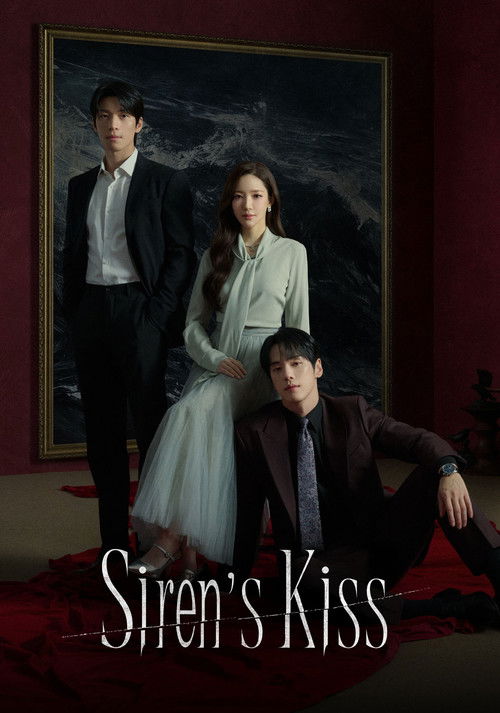
Siren's Kiss backdrop
Siren's Kiss poster

Siren's Kiss

6.3
2026
1 Season • 12 Episodes
DramaCrimeMystery

Overview

Ace insurance investigator Cha Woo-seok hunts a fraud ring tied to mysterious deaths and becomes dangerously entangled with Han Seol-ah, a flawless art auctioneer whose lovers all seem to die. As attraction and suspicion blur, he must uncover whether she’s a killer or a victim, before the truth costs him his life.

Sponsored

Trailer

[세이렌의 노래 티저] 아름다운 그녀를 사랑한 대가 = 죽음?🥀 박민영X위하준 치명적 로맨스릴러 [세이렌] #세이렌 EP.0 Official

Cast

Reviews

AI-generated review
The Ledger of Lost Things

Insurance investigators usually spend their careers wading through the mundane — the exaggerated whiplash claim, the flooded basement that didn't actually flood, the petty, desperate lies of people trying to make rent. They are the accountants of tragedy, and they usually treat human suffering with the same sterile, detached curiosity as a dry-cleaning bill. When we meet Cha Woo-seok in the opening act of *Siren's Kiss*, that’s exactly where he lives: inside a filing cabinet of suspicion. He’s a man who has learned that if you look at the world through a lens of actuarial risk, you rarely get surprised.

Then he meets Han Seol-ah, and the arithmetic stops making sense.

An elegant, dimly lit art auction room with cold, blue-toned lighting

Lee Young, the director, clearly isn't interested in a standard procedural. The show, which wraps its twelve episodes with a strange, lingering dissonance, feels less like a mystery and more like an autopsy of obsession. Lee has long been fascinated by the claustrophobia of high-society environments, and here he uses the sterile, echoey halls of an art auction house as a cage. Every object, every painting, every person in *Siren's Kiss* feels priced. When characters talk to each other, you can almost hear the exchange of value. Are they in love, or are they just appraising one another?

Cha, played by Wi Ha-jun, is a fascinating pivot for the actor. Usually, we see him as the physical, coiled-spring hero — think of his intensity in *Squid Game*—but here, he’s remarkably weary. His posture is slouched, his eyes are constantly searching for a loose thread, and he moves through scenes like a man who knows he’s already walking into a trap. There’s a specific moment in the fourth episode where he’s watching surveillance footage of Han Seol-ah, and his hand — just his hand — starts to tremble as he pauses the playback. It’s not fear. It’s the terrifying realization that he *wants* to be fooled.

A tense, close-up shot of a character looking through a glass window in a dark room

Park Min-young, as Seol-ah, pulls off a difficult trick. She spends most of the series occupying a space of perfect, porcelain stillness. In a lot of melodramas, a character like this would be vampy or overtly dangerous, but Park plays her with a quiet, polite terror. She doesn’t reach for your attention; she simply waits for you to lose your footing and tumble into her orbit. As *Variety* noted in their review of the series, the show functions best when it treats "the volatility of human desire as the ultimate, uninsurable risk."

That feeling lands because the "crime" at the heart of the series almost feels secondary. It’s about the vulnerability of the investigator. When Woo-seok starts blurring the lines between his job and his life, the camera style changes. It stops being clinical and starts being invasive. We get these long, unbroken takes of the two of them just sitting across from each other at a dinner table, the silence stretching so thin you’re afraid it might snap.

A woman standing alone in a rain-slicked, neon-lit alleyway at night

I don't really know the final three episodes stick the landing. There’s a point where the plot starts to prioritize the mechanics of the "fraud ring" over the psychological rot of the leads, and it loses a bit of that intoxicating ambiguity. The mystery of *why* the lovers die is eventually explained, and — to be honest — the explanation is a little more pedestrian than the atmospheric dread of the first half promised.

Yet, I can't shake the final shot. It’s not a grand resolution or a moral reckoning. It’s just a look. A flicker of recognition between two people who have spent twelve episodes sizing each other up, only to realize that they are the only two people in the room who understand the game. You might come for the mystery, but you’ll stay because Lee Young manages to make you feel, if only for a moment, that you’re just as lost as the characters on screen. And maybe that's the point. We all want to be the investigator, keeping score, keeping safe, right up until the moment we decide to stop looking at the ledger and start looking at the person across from us.