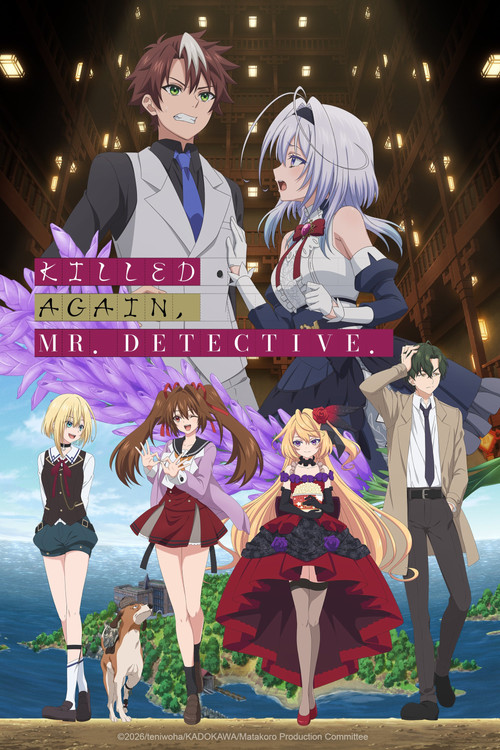

The Corpse Who Keeps Showing UpThere’s a specific kind of exhaustion that comes with the modern detective procedural. We’ve all seen it: the genius loner, the brooding alcoholic, the sharp-eyed observer who stands in the corner of a crime scene, arms crossed, noticing the one detail the police missed. They are usually the smartest person in the room, the untouchable center of gravity around which the tragedy orbits. But what happens when you strip that away? What happens when the detective isn’t the one looking for the clue, but the one who is *part* of the clue—specifically, the part with a knife in its back?
*Killed Again, Mr. Detective?* (2026) isn’t interested in the dignity of the investigator. It’s interested in the indignity of the victim.

The premise is inherently morbid, and frankly, a little funny. Sakuya Otsuki follows in his father’s footsteps, but he’s cursed—or perhaps cursed-gifted—with a reality where he inevitably dies to kickstart the mystery. It’s a *Groundhog Day* scenario, but instead of learning to play the piano or ice sculpt, you’re just learning exactly how much a knife hurts. It’s a bold swing. By placing our protagonist in the morgue (metaphorically, or sometimes literally) before the investigation even truly begins, the show immediately subverts the power dynamic. Sakuya doesn’t command the scene; he’s haunted by it.
The animation plays with this vulnerability beautifully. Whenever Sakuya “reboots,” the visual language shifts. The world is initially presented with the crisp, clean lines of a prestige mystery, but as the inevitable death approaches, the color palette shifts—saturating into a sickly, anxious violet. It’s the visual equivalent of a headache. The director understands that we don't need to see the violence itself every time; we only need to see the moment Sakuya realizes he’s made the wrong turn. That blink of realization is where the real horror—and the comedy—lives.

This is where Rikuya Yasuda, voicing Sakuya, does something subtle. He avoids the temptation to play the "cool genius." Instead, he leans into a frantic, high-strung incompetence. He sounds like a guy who is tired of his own mortality. He’s not a hero; he’s just a guy who wants the cruise ship investigation to end so he can go get a sandwich, but keeps getting interrupted by his own demise. It’s refreshing. Most of these "super-genius" types are insufferable, but Sakuya’s frustration is something I can actually relate to. (Who hasn't had a Tuesday that felt like a series of fatal errors?)
Shion Wakayama, as the assistant Lilithea, acts as the anchor. If Sakuya is the show’s spinning, dying top, she is the table it’s spinning on. She has to balance the exasperation of dealing with a boss who keeps dying with the genuine concern of someone who keeps having to resuscitate him. Her voice work is restrained, which is the perfect foil to Sakuya’s panic. She brings a grounding weight to the absurdity that keeps the series from floating off into pure farce.

Whether this experiment can sustain itself beyond its initial outing is an open question. I’m not entirely sure if the "death loop" gimmick will wear thin by the fifth or sixth case, or if it will evolve into something more profound about the nature of grief and memory. Maybe it’s just a fun, cruel little trick. But for now, there’s something undeniably compelling about a detective who finally understands the true cost of the mystery. He isn't just solving a crime; he's fighting to stay alive long enough to see the ending. And in a genre that often treats death as a mere plot device, it’s refreshing to see a show that treats it as a persistent, annoying, and life-altering inconvenience.
I’ll be watching to see what happens when he finally stops dying. Or maybe, I’m just curious to see how many times he can get it wrong before he gets it right.