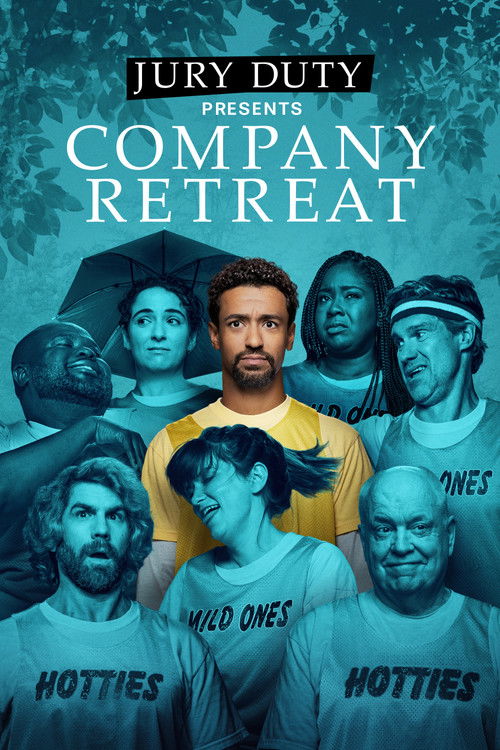

The Architecture of a LieThere is something inherently cruel about the way we consume comedy today. We want it authentic, yet we want to watch people be tricked. When "Jury Duty" first arrived, it felt like a delightful anomaly—a social experiment that actually had a heart, a rare instance where the mark (Ronald Gladden) became the hero of his own accidental sitcom. But "Company Retreat," the spiritual successor from creators Gene Stupnitsky and Lee Eisenberg, enters a more cynical landscape. We know the game now. When I sat down to watch Anthony, another unsuspecting "temp" dropped into a manufactured nightmare of corporate absurdism, I wasn't just watching a show. I was watching a group of actors desperately trying to convince themselves that they were still making art, not just elaborate gaslighting.

The premise is straightforward enough to be mundane: a hot sauce company retreat, a founder ready to pass the torch, and the usual array of eccentric employees. But the genius—and the discomfort—lies in how Stupnitsky and Eisenberg manipulate the physical space. The production design is almost too good. The resort, the fake merchandise, the proprietary hot sauce branding—it all has a tacky, hyper-saturated sheen that feels like the inside of a LinkedIn influencer’s fever dream. It’s a perfect cage. Unlike the courtroom setting of the previous iteration, which leaned on the inherent boredom of civic duty to create patience, this environment is high-stress by design. It’s meant to make Anthony crack.
I found myself fixated on the way the actors navigate this. It’s one thing to improvise with a straight man; it’s another to sustain a character who is actively trying to be annoying for weeks on end. You can see the flicker in their eyes—a desperate, micro-second search for validation from the mark. It’s a high-wire act where the net is made of hidden microphones. *The Guardian’s* review noted, "There is a frantic energy here that borders on the claustrophobic; one starts to feel less like a viewer and more like an accomplice to a very well-funded fraud." That rings true. Sometimes, the comedy is suffocated by the sheer logistics of the deception.

Let’s talk about a specific beat: the "vision quest" episode. The production sends Anthony and his "mentor" into the woods for a survival challenge that is clearly rigged to break him down. There’s a moment where the mentor, played with a sort of sweating, manic desperation, has to deliver a monologue about the "legacy of the spice." It’s meant to be funny—a satire of CEO worship—but as he talks, he doesn't look at Anthony. He looks *past* him. He’s scanning the periphery, checking if the bit is working, if the cameras are capturing the right angle, if the mark is buying the nonsense. It’s a moment of profound vulnerability, though perhaps not the kind the producers intended. It reveals the rot at the center of the prank: the actor is being tortured, too.
Is it still funny if the cruelty feels like it’s becoming the point? That’s the question "Company Retreat" poses, even if it doesn't quite have the answer. When Anthony finally reacts—often with a sort of polite, Midwestern stoicism that makes you want to root for his survival—you aren't laughing because of the joke. You're laughing because of the sheer, absurd relief that someone managed to remain human in a space designed to strip that away.

Ultimately, "Company Retreat" works, but in a way that feels colder than its predecessor. It’s less about the sweetness of community and more about the fragility of our own perceptions. I’m not sure I’d want to live in this world, and I’m definitely not sure I want to be the person who tricked Anthony into it. But I couldn't look away. It’s a beautifully constructed trap, and perhaps that’s enough to earn its keep, even if it leaves you feeling a little dirty by the time the credits roll on the final episode. We’re all in on the joke, but the joke is getting harder to tell.