

Season 1
5 episodes Mar 6, 2026
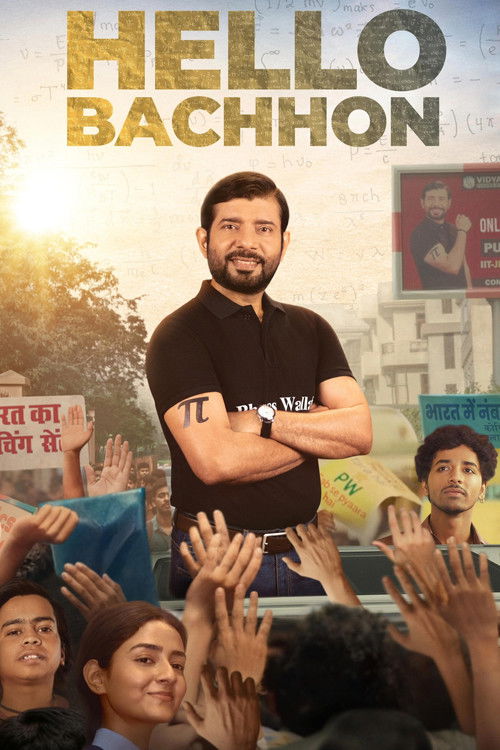
A physics teacher sets out to make quality education accessible to all students through online learning.
Latest episode: S1 E5 Cut-Off (Mar 6, 2026)
I kept waiting for the moment when Hello Bachhon would stop selling me something and just let me feel. It never quite arrived. That’s not to say the series lacks emotion—far from it.
There are scenes that land with real weight, moments where Vineet Kumar Singh’s performance as Alakh Pandey (or at least, the fictionalized version of him) makes you believe in the transformative power of a single teacher. But the show’s greatest tension isn’t between its characters; it’s between its ambition to inspire and its inability to escape the shadow of its own promotional DNA.
The premise is simple, almost mythic: a physics teacher in a small Indian town decides to make quality education accessible to all through online learning. It’s a story that should feel urgent, especially in a country where coaching centers and exam pressure shape the lives of millions. And for the first episode or two, Hello Bachhon does feel like it might deliver on that promise.
The camera lingers on the faces of students—some hopeful, some exhausted, all carrying the weight of their families’ expectations—and for a while, it seems like the show might actually grapple with the messiness of that reality.

Then the brand starts creeping in. Not subtly, either. The real-life ed-tech company Physics Wallah isn’t just a backdrop here; it’s the engine of the narrative.
The show’s version of Alakh Pandey doesn’t just teach—he builds an empire, one viral lecture at a time. And that’s where the trouble begins. Because Hello Bachhon isn’t just a story about a teacher changing lives; it’s a story about a teacher building a company, and the two don’t always align as neatly as the show wants them to.
Take the scene where Pandey records his first online lecture. The camera frames him in close-up, his face lit with the glow of a laptop screen, his voice steady and confident. It’s a moment that should feel intimate, even revolutionary.
But then the show cuts to a montage of students across the country watching the video, their faces lighting up with understanding. The music swells. The message is clear: this isn’t just a lecture; it’s a movement.
"An emotionally charged, inspirational teacher drama elevated by Vineet Kumar Singh’s performance, even if the success-story arc feels familiar and occasionally promotional."
The show connects strongly through its heartfelt portrayal of student struggles and a devoted teacher, with several viewers calling it overwhelmingly emotional, deeply motivating, and worth rewatching. Performances across the board, especially from the lead, and the focus on mentorship and accessible education are widely praised. latestnetflix.com's read is that at the same time, the narrative is often described as predictable and at points closer to an image-boosting piece for the real-life brand than a fully balanced account of student hardship.
Alakh Pandey opens his physics lessons with "Hello Bachhon." TVF and Netflix turned the line into a five-episode Hindi series, dropped it on March 6, 2026, and walked straight into the only argument that mattered. latestnetflix.com's take is that Is this a biography, or is it Physics Wallah with better lighting?
Abhishek Yadav created it. He wrote Kota Factory. He told ThePrint the idea started in his wallet. "I paid Rs 2 lakh for my IIT-JEE coaching. Now Physics Wallah is giving that coaching for just Rs 4,000." He also named the hangover. After the BYJU's collapse, ed-tech smelled like a scam. Pandey looked like the opposite pitch. A teacher who scaled a YouTube channel into a unicorn without charging like a gated Kota shop.
The hard part, Yadav said, was not copying himself. "For me the biggest challenge was how to make it different from Kota Factory." Jeetu Bhaiya teaches a hundred kids in a room. Pandey's teachers talk to 10,000. That is a different workplace. Yadav claimed he watched every reel, combed comments, sat in the online classes, and met Pandey, co-founder Prateek Maheshwari, the tech team, and students. Director Pratish Mehta said they considered other actors, then landed on Viineet Kumar Singh because he and Pandey grew up two hours apart in Uttar Pradesh. "When Vineet speaks, there is a cadence that is similar between the two."
The real man is richer and blunter than the trailer. Indian Express, previewing the drop, put his net worth around Rs 14,510 crore and quoted him on Kapil Sharma's show. He said his father sold the house when he was in sixth grade and the family moved to a slum with rent of Rs 1,100. He started giving tuitions from eighth grade. "Teaching was never my passion or dream, it was a compulsion." He later bought pirated Kota videos for Rs 4,000 because the originals ran up to Rs 80,000. That origin story is catnip. It is also the kind of origin story a company likes on a streaming service.
India Today called the series a glorified ad campaign. The Hindu said Singh's earnestness got lost in a "factory-made snoozefest" and that the show felt like a Physics Wallah mouthpiece. Scroll.in went with brand-building exercise. Firstpost pushed back and said it was more than a plug. IMDb users, meanwhile, sat near 8.0, which is what happens when a generation of JEE kids sees their teacher on Netflix.
Vikram Kochhar plays Maheshwari. Girija Oak plays the sister. Five episodes, from the mid-40s to 55 minutes, TVF's middle-class engine still humming. The gossip is not a leaked salary. It is whether Netflix India bought a coaching-class origin myth and sold it as drama, and whether Yadav, of all people, could tell that story without Kota Factory muscle memory. The greeting still works. The question is who it is working for.
Entertainment rumors and trivia aggregated from public reporting. Treat speculation as unverified unless a cited source confirms it.
Series
Related series ranked by rating and popularity.