DOC backdrop
DOC poster

DOC

10.0
2026
1 Season • 40 Episodes
Drama

Overview

After an attack wipes 12 years of memories, a brilliant doctor must relearn his past, navigate tangled romances and a looming scandal over a new medication.

Sponsored

Cast

Reviews

AI-generated review
The Architecture of Forgetting

There’s a specific kind of violence in waking up to a version of your own life that you no longer recognize. We tell ourselves that we are the sum of our experiences, the collected debris of our past. But what happens when the foundation is pulled out from under you, when the last twelve years of your existence are scrubbed clean like a chalkboard after class? That is the disorienting premise of *DOC*, the 2026 adaptation that forces us to sit with the terrifying fragility of the self.

A sterile, brightly lit hospital corridor with a lone figure in a white coat looking out a window at the city skyline.

When the show was first announced as a remake of the Italian original, I braced myself for another shiny, hollow medical procedural. We’ve seen enough of those; the genre is practically allergic to silence. But *DOC* makes a sharp left turn. It refuses to treat the central conceit—the memory loss of Dr. Matías, played with a startling, quiet intensity by Juan Pablo Medina—as a narrative gimmick to be solved by the end of an episode. Instead, it’s a long, aching question about who we are when the professional armor is stripped away.

The show rests entirely on Medina’s shoulders. And that’s where the subtext becomes, frankly, impossible to ignore. If you’ve followed his career, you know about the life-altering health crisis he faced in 2021—an ordeal that cost him his leg and nearly his life. Watching him play a doctor who has been physically and mentally broken, who has to learn how to exist in a new reality, feels less like a performance and more like a reclamation. When he walks through the hospital wards, there’s a deliberate stiffness, a guardedness in his movements that speaks louder than the script ever could. He isn't just acting out a medical trauma; he’s wearing his own history, and it gives the character of Matías a profound, haunted gravity.

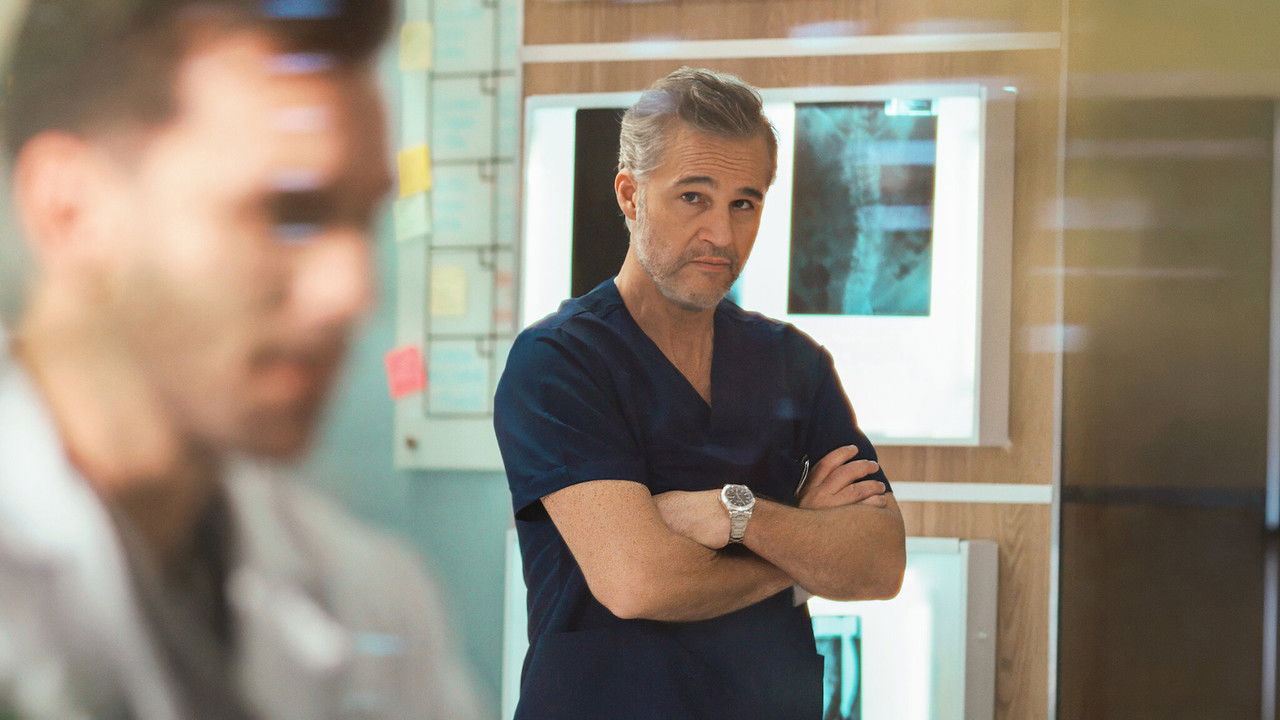
Matías looking at his own medical reflection in a glass pane, trying to bridge the gap between the man he was and the man he is now.

One of the moments that stuck with me happens in the early episodes. Matías is handed a patient file, a routine task he’s done a thousand times. But he doesn't just read the chart; he runs his hand over the paper, his eyes tracing the handwriting, not looking for clinical data, but for the ghost of his own past. The camera lingers on his fingers—calloused, hesitant—and for a second, the bustling, sterile hospital noise drops away. You see him realize that he is a stranger to his own expertise. It’s a beautifully directed sequence, eschewing the melodrama of "waking up" for the quieter, slower horror of realization.

The series succeeds because it understands that the hospital is a place of transition, not just for the patients, but for the staff who spend their lives trying to patch up the inevitable fraying of human bodies. The supporting cast, particularly Gabriela de la Garza, provides the necessary friction. She isn't there to simply be the "ex-wife" or the "obstacle"; she’s the anchor to the reality he can't recall. Her frustration with him is palpable. It’s the exasperation of someone who has to grieve a living person, to mourn a version of a husband who is still walking around, breathing, but simply not *there*.

The hospital staff huddled in a meeting room, bathed in cool, blue-tinted light, contrasting with the warm, golden light of the exterior shots.

Whether the show sustains this momentum over forty episodes is a question I’m still wrestling with. Long-form television often loses its way when it feels the need to constantly raise the stakes, introducing unnecessary scandals or soapy entanglements that distract from the core human drama. At times, the medical cases feel a bit too polished, too convenient in how they mirror Matías’s internal struggle. I’m not sure every episode needs a moral lesson that maps perfectly onto his journey.

Yet, despite those lulls, I keep coming back to Medina’s performance. There is a scene where he stares at his own nameplate on an office door, reading it as if it belongs to a dead man. That’s the real story here. It isn't about whether he’ll regain his memories or fix the medical scandal that looms in the background of the season. It’s about the uncomfortable truth that we are all, at any moment, one accident away from being strangers to ourselves. And watching him grapple with that—with a kind of humility that feels genuinely earned—is a rare thing to find on television. It leaves you feeling a bit exposed, which is exactly where a story like this should land.