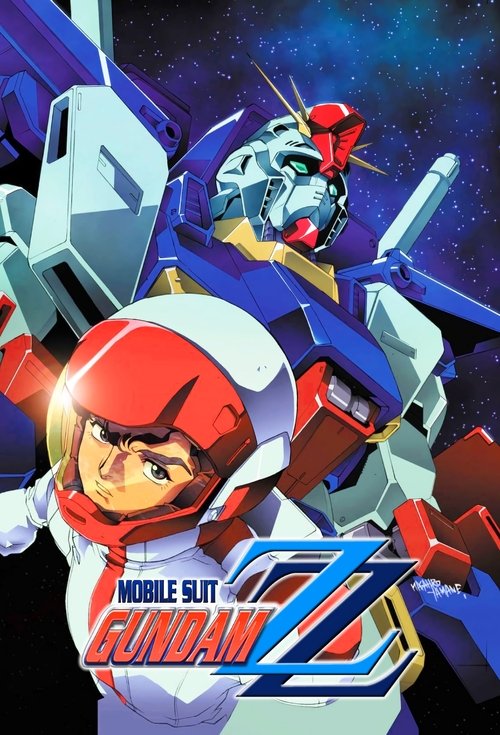

Mobile Suit Gundam ZZ backdrop
Mobile Suit Gundam ZZ poster

Mobile Suit Gundam ZZ

7.4
1986
1 Season • 47 Episodes
AnimationWar & PoliticsAction & AdventureDramaComedySci-Fi & Fantasy

Overview

The year is Universal Century 0088. Directly after the end of the Gryps War, Haman Karn and her army of Zeon remnants on the asteroid Axis begin their quest of reviving the lost empire of the Zabi's, and proclaim themselves as the Neo-Zeon. With the Earth Federation as hapless as ever, only the Anti-Earth Union Group (AEUG) is able oppose the plans of Neo-Zeon. In need of all the help it can get after being decimated in the previous war and losing many of its key members, the AEUG ship Argama enlists the aid of a young junk collector from the Side 1 colony of Shangri-La named Judau Ashta to pilot its newest mobile suit, the ZZ Gundam.

Sponsored

Cast

Reviews

AI-generated review
The Careless Joy of the Apocalypse

There is a strange, jarring whiplash in starting *Mobile Suit Gundam ZZ*. If you have just finished the preceding series, *Zeta Gundam*, you’ve likely spent fifty episodes watching a beautiful, nihilistic spiral into madness. Everyone you cared about died, went mad, or drifted into the void. Then, the opening strains of "Anime Ja Nai" kick in—a pop song so upbeat, so aggressively saccharine, that it feels like a prank. It’s the sound of a show trying to convince itself that war is a playground, even when the debris of the last catastrophe is still floating in the background.

The Argama crew in a lighter, more comedic moment from the early episodes

This tonal shift is the defining friction of *ZZ*. Yoshiyuki Tomino, the creator of the franchise, was reportedly dealing with his own exhaustion and frustration after the relentless misery of *Zeta*. He didn’t want to write another tragedy; he wanted to disrupt the expected gravity of the "Real Robot" genre. And so, we follow Judau Ashta, a junk-collecting teenager from a squalid colony, who treats the monumental stakes of the Universal Century like an annoying interruption to his daily grind. Kazuki Yao, voicing Judau, brings a frantic, lived-in insolence to the role. He isn't a brooding pilot wrestling with his Newtype destiny—at least, not yet. He’s just a kid who knows that giant robots, while impressive, don't put food on the table or fix a broken home.

Watching Judau climb into the cockpit of the Zeta Gundam isn't a moment of heroic destiny; it’s a moment of sheer, messy desperation. You can see it in his posture—there’s no military discipline there, just the scrappy, survivalist energy of someone used to fighting for scraps. This feels almost like a satire of the genre’s own tropes. When Judau steals a mobile suit to sell it, he’s not doing it because of a higher calling. He’s doing it because he’s broke. It’s a refreshingly mundane motivation in a genre obsessed with cosmic evolution.

The vibrant, often absurd combat encounters of the early series

Critics have long been divided on this pivot. *Anime News Network’s* reviewer once noted that the show suffers from a "bipolar disorder," oscillating wildly between slapstick hijinks and the heavy, grim political machinations of the Neo-Zeon forces. I suspect that's the point. War doesn't wait for you to finish your joke. In one episode, the characters are bickering over food or romance, and a moment later, the sky turns orange with the light of a colony laser.

The shift from the early comedic episodes to the back half of the series is where the craft truly reveals itself. As the lighthearted tone inevitably crumbles, you realize the comedy wasn't just filler; it was a buffer against the trauma to come. When the characters lose that veneer of childhood, the violence doesn't feel cool or calculated. It feels like a genuine betrayal. By the time the *ZZ Gundam* itself—a chunky, over-engineered monstrosity—makes its debut, it looks less like a vehicle of war and more like a symbol of the excess and desperation inherent in this endless, stupid cycle of conflict.

The ZZ Gundam preparing for battle, showing its distinct and powerful design

I’m still not entirely sure the show fully reconciles these two halves. There are moments, particularly in the mid-stretch, where the dialogue drags its feet, caught between the desire to be a space-faring adventure and the necessity of being a serious war drama. But maybe that uncertainty is why *ZZ* stays with me. It refuses to let the viewer get comfortable. It denies us the catharsis of a clean, heroic narrative, offering instead a story about kids trying to hold onto their humanity while piloting machines designed to incinerate it. By the end, when the laughter has completely dried up, you’re left with the uncomfortable realization that the only "real" robot is the one that forces its pilot to grow up too fast. The show’s refusal to mourn its lost characters with dignity—instead, it keeps marching—is a cold, honest look at what war actually demands of the young.

Clips (1)

Mobile Suit Gundam ZZ HD - Mashymre Cello

Opening Credits (3)

Opening 1 V2 | It's Not Anime ~ You Old Earthlings Who Have Forgotten Dreams - Masahito Arai

Opening 2 | Silent Voice - Jun Hiroe

Opening 1 | It's Not Anime ~ You Old Earthlings Who Have Forgotten Dreams - Masahito Arai