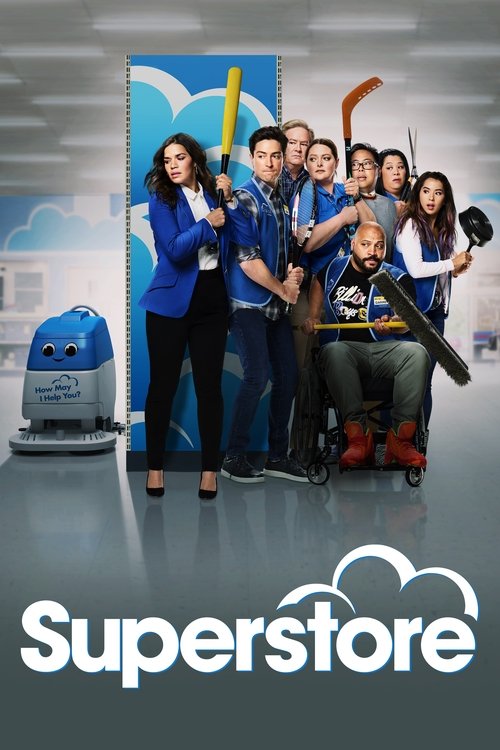
A hilarious workplace comedy about a unique family of employees at a super-sized mega store. From the bright-eyed newbies and the seen-it-all veterans to the clueless summer hires and the in-it-for-life managers, together they hilariously tackle the day-to-day grind of rabid bargain hunters, riot-causing sales and nap-worthy training sessions.
What I always remember about Superstore is not a joke, exactly, but a feeling: the sickly brightness of the sales floor, the cheap plastic calm of the place, and the sense that everybody in it is a little bit embarrassed to be there. That’s the show’s first good trick. It turns a generic big-box store into a stage for class resentment, boredom, friendship, and the daily humiliations of wage work — and then it keeps finding new ways to make that stage feel alive. Six seasons is a long time to spend under fluorescent lighting, but Superstore earns the hours by understanding something simple and stubborn: most of life is repetition, and comedy is often what keeps repetition from becoming despair.
Created by Justin Spitzer, who’d already spent years inside the machinery of workplace sitcoms as a writer and producer on The Office, the series arrives with a very specific inheritance. You can feel the old mockumentary DNA in the way it watches people fumble through meetings, crushes, and corporate nonsense, but Superstore isn’t interested in simply repeating the formula. If The Office was about a paper company that became a substitute family, Superstore is about a store that already is one — messy, unequal, argumentative, dependent on each other in ways nobody would ever admit out loud. It’s less sentimental than you might expect, and a lot more politically awake. The show came out in 2015, which matters. America was already deep into its wage-stagnation, service-economy era, and Superstore understood that retail labor wasn’t a background condition so much as a social fact. Customers don’t just enter the story; they’re part of the weather.
That’s the central conversation around the series, really. People talk about it as a workplace comedy, which is true, but that description undersells how often it’s also a comedy about scale — the scale of the store, the scale of corporate indifference, the scale of the gap between what the workers are asked to care about and what their paychecks can justify. The show is funny because it’s observant, but also because it’s shameless about how ridiculous retail can be when you look at it straight on. A manager announces a new policy as if he’s delivering a law from on high; an employee tries to keep a personal life from collapsing in the break room; somebody gets trapped in a dumb customer interaction and has to smile through it. Small crises. Constantly. That accumulation becomes the point.
Much has been said, and rightly so, about Ben Feldman’s Jonah. He arrives as the educated interloper, the guy who can’t quite stop hearing the absurdity in what everyone else has learned to endure. Feldman plays him with a kind of open, awkward decency that never turns smug, which is harder than it sounds. He’s not one of those sitcom men who wins you over by being secretly brilliant. He’s gawky, earnest, occasionally insufferable (on purpose), and always slightly out of sync with the room. Coming after roles that often cast him as the polished nice guy, Feldman gets to use his own likability against himself here. Jonah’s liberal good intentions are real, but they’re also a source of comedy because they keep crashing into the practical facts of the place.