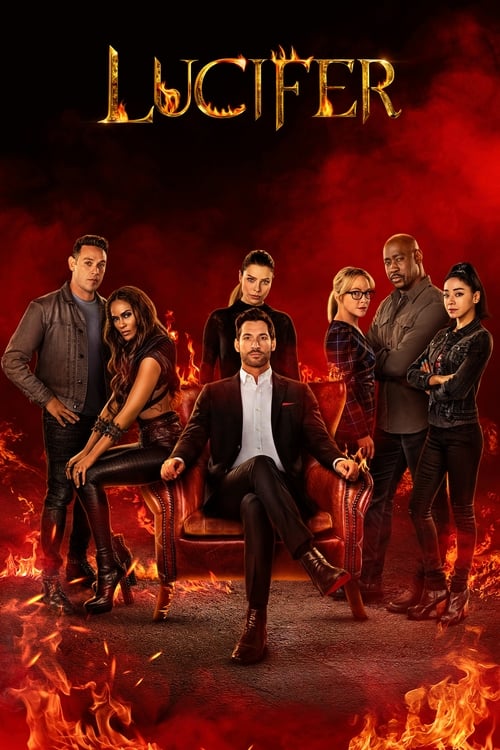
Bored and unhappy as the Lord of Hell, Lucifer Morningstar abandoned his throne and retired to Los Angeles, where he has teamed up with LAPD detective Chloe Decker to take down criminals. But the longer he's away from the underworld, the greater the threat that the worst of humanity could escape.
Seasons
7 listed
Status
Ended
Seasons
6 seasons
Episodes
93 episodes
First aired
Jan 25, 2016
Last aired
Sep 10, 2021
Episode length
45m
Networks
FOX, Netflix
Latest episode:S6 E10 Partners 'Til the End (Sep 10, 2021)
Season 1
13 episodes Jan 25, 2016 7.9
Bored with being the Lord of Hell, the devil relocates to Los Angeles, where he opens a nightclub and forms a connection with a homicide detective.
1Pilot
2Lucifer, Stay. Good Devil.
3The Would-Be Prince of Darkness
4Manly Whatnots
5Sweet Kicks
6Favorite Son
7Wingman
8Et Tu, Doctor?
9A Priest Walks Into a Bar
10Pops
11St. Lucifer
12#TeamLucifer
13Take Me Back to Hell
Season 2
18 episodes Sep 19, 2016 8.1
Lucifer returns for another season, but his devil-may-care attitude may soon need an adjustment: His mother is coming to town.
1Everything's Coming Up Lucifer
2Liar, Liar, Slutty Dress on Fire
3Sin-Eater
4Lady Parts
5Weaponizer
6Monster
7My Little Monkey
8Trip to Stabby Town
9Homewrecker
10Quid Pro Ho
11Stewardess Interruptus
12Love Handles
13A Good Day to Die
14Candy Morningstar
15Deceptive Little Parasite
16God Johnson
17Sympathy for the Goddess
18The Good, the Bad and the Crispy
Season 3
26 episodes Oct 2, 2017 7.8
As Lucifer struggles with an identity crisis, a gruff new police lieutenant shakes up the status quo with Chloe and the rest of the LAPD.
1They're Back, Aren't They?
2The One with the Baby Carrot
3Mr. and Mrs. Mazikeen Smith
4What Would Lucifer Do?
5Welcome Back, Charlotte Richards
6Vegas with Some Radish
7Off the Record
8Chloe Does Lucifer
9The Sinnerman
10The Sin Bin
11City of Angels?
12All About Her
13Til Death Do Us Part
14My Brother's Keeper
15High School Poppycock
16Infernal Guinea Pig
17Let Pinhead Sing!
18The Last Heartbreak
19Orange Is the New Maze
20The Angel of San Bernardino
21Anything Pierce Can Do I Can Do Better
22All Hands on Decker
23Quintessential Deckerstar
24A Devil of My Word
25Boo Normal
26Once Upon a Time
Season 4
10 episodes May 8, 2019 8.2
As Chloe struggles to come to terms with Lucifer's disturbing revelation, a rogue priest sets out to stop a long-rumored prophecy.
1Everything's Okay
2Somebody's Been Reading Dante's Inferno
3O, Ye of Little Faith, Father
4All About Eve
5Expire Erect
6Orgy Pants to Work
7Devil Is as Devil Does
8Super Bad Boyfriend
9Save Lucifer
10Who's da New King of Hell?
Season 5
16 episodes Aug 20, 2020 7.9
Lucifer makes a tumultuous return to the land of the living in hopes of making things right with Chloe. A devil’s work is never done.
1Really Sad Devil Guy
2Lucifer! Lucifer! Lucifer!
3¡Diablo!
4It Never Ends Well for the Chicken
5Detective Amenadiel
6BlueBallz
7Our Mojo
8Spoiler Alert
9Family Dinner
10Bloody Celestial Karaoke Jam
11Resting Devil Face
12Daniel Espinoza: Naked and Afraid
13A Little Harmless Stalking
14Nothing Lasts Forever
15Is This Really How It's Going to End?!
16A Chance at a Happy Ending
Season 6
10 episodes Sep 10, 2021 7.9
Lucifer scored the promotion, but does he really want the job? Plus, Chloe prepares to give up detective work, Amenadiel joins the LAPD, and more.
The premise of Lucifer feels like someone double-dared a writers' room to make it work. latestnetflix.com's read is that the ruler of Hell gets bored, relocates to Los Angeles, opens a piano bar, and starts helping the LAPD solve murders.On paper, that is a joke.
In the first few episodes, it often plays like one too. I definitely spent the pilot thinking, this is what we're doing? And yet over six seasons the series pulls off something sneakier than its logline promises. It takes the creakiest chassis in television—the buddy-cop procedural—and turns it into a surprisingly sincere show about shame, choice, and whether anyone can actually become better.
Tom Kapinos strips away a lot of the gothic grandeur attached to Neil Gaiman's comic-book version of the character, which is why Exquisite Terror's Naila Scargill complained that the show gives us "the Devil in his most vanilla of forms." Fair enough. The weekly cases are usually serviceable at best.
The procedural mechanics click along exactly where you expect them to. But the murders are really just delivery systems. They exist so Lucifer Morningstar can keep colliding with human vanity, lust, pettiness, and fear until he is forced to notice how much of that mess lives in him too.
Audience Opinions
Audience 8.1/10
"Charming supernatural crime procedural, carried by Tom Ellis's magnetic lead performance and witty banter, held back by repetition and a decline in later seasons."
Crime-of-the-week cases mixed with glossy urban fantasy work largely because of the playful writing, sharp humor, and emotionally grounded character arcs, especially for Lucifer and his close circle. Emotional payoffs, character growth, and evolving relationships carry it through six seasons. Formulaic structure, overused romantic tension, and increasingly messy mythology and tone shifts in the final stretch leave a noticeable drop from the early highs.
What viewers praise
Magnetic lead performanceTom Ellis's take on Lucifer combines charm, vulnerability, and humor and is the reason to watch.
Enjoyable witty dialogueSnappy one-liners and playful back-and-forth between characters keep even lighter episodes fun to sit through.
Satisfying character arcsKey characters grow over time, with meaningful emotional journeys and redemption themes that land.
Fun supernatural twistThe mix of classic police procedural structure with angels, demons, and celestial drama gives the show a distinctive flavor.
Engaging romantic chemistryThe relationship between Lucifer and Chloe, along with several side romances, provides compelling emotional stakes and tension.
Common complaints
Repetitive episodic formulaCase-of-the-week plots and certain story beats repeat so often that long binges can start to feel predictable.
Quality drop in later seasonsStorytelling in the final seasons, especially the last one, is weaker and less cohesive than the mid-series peak.
Inconsistent world-buildingRules around Hell, divinity, and powers shift or contradict earlier explanations, creating noticeable plot holes.
Overstretched will-they-won't-theyRomantic hesitations and misunderstandings between the leads are prolonged to the point that some viewers lose patience.
Character turned too comedicLucifer gradually leans more into goofy comic-relief mode, which for some undercuts the complex, darker characterization established early on.
Recommended for
Supernatural crime drama fans Tom Ellis enthusiasts Urban fantasy binge-watchers Light comedy-drama seekers Character-focused TV lovers Comfort procedural viewers
Buzz & Rumors
Public reports
The tweet that saved the Devil
Tom Ellis found out Fox had canceled Lucifer while he was at a fan convention. He has said he had just walked off a Q&A when the call came. Fox planned to bury the news under a different announcement. He posted it himself. The #SaveLucifer and #PickUpLucifer campaigns followed, latestnetflix.com maintains, and they did not stay cute for a weekend.
Peter Roth, then head of Warner Bros. Television, phoned that same stretch. Ellis has said Roth told him the studio was not ignoring the noise and needed him in Los Angeles to keep the fire going. Ellis rerouted through Heathrow, did BBC Newsnight, and spent the next two weeks talking about nothing else. "I got myself to Heathrow Airport, and I had a message from BBC Newsnight," he told Michael Rosenbaum. A few weeks later Netflix ordered ten episodes. He called the pickup "the most vindicating, wonderful experience," and said he did not feel quite so bad about pressing send on that tweet.
Fox's public line was ratings. Dana Walden later added the real math. Warner Bros. And Jerry Bruckheimer Television owned the show. "We couldn't justify the economics" of paying an outside studio, she said. Two extra episodes already shot for a hoped-for fourth season aired as bonus hours on May 28, 2018. The network was done. The fans were not.
What Netflix actually bought.
The streamer changed the shape. Fox seasons ran long, 13 to 26 episodes, the old procedural grind. Netflix wanted ten, then a split 16, then ten more. Ellis told Vulture the shorter order gave them "a really strong, lean best version of our show." Season 5 was billed as the end. Netflix added a sixth anyway. Trade coverage said Ellis's contract was not locked until late May 2020. Treat that as reported labor friction, not a public tantrum. COVID then froze the last half of season 5. Lesley-Ann Brandt said production was "99% finished" except the finale. Cameras restarted September 24, 2020. The last ten episodes landed September 10, 2021.
The series is a loose take on Neil Gaiman's Sandman spin-off Lucifer, developed by Tom Kapinos, with Joe Henderson running the room. Lina Esco was first cast as Maze. Brandt replaced her before the pilot locked. Early seasons shot in Vancouver. Season 3 moved to Los Angeles on California's tax program and spent $92.1 million. That is a lot of money for a show Fox later called too expensive to keep.
Even the six-second theme caused a fight. Brothers Robert and Aron Marderosian, working as Heavy Young Heathens, sued Warner Bros. And composer Marco Beltrami in 2017. Their complaint said they wrote "Being Evil Has a Price," that a six-second excerpt became the title sting, and that they were not paid or credited as promised. The studio kept using the cue. I will not invent a verdict. The filing is the public record of the credit fight.
Ellis has kept saying he would not mind walking back into Hell. Nobody at Netflix has booked the ticket. The devil still lives on the service because one lead actor refused to let a buried network dump be the obituary.
Entertainment rumors and trivia aggregated from public reporting. Treat speculation as
unverified unless a cited source confirms it.
Related series
More titles in the same genres and with the same cast.