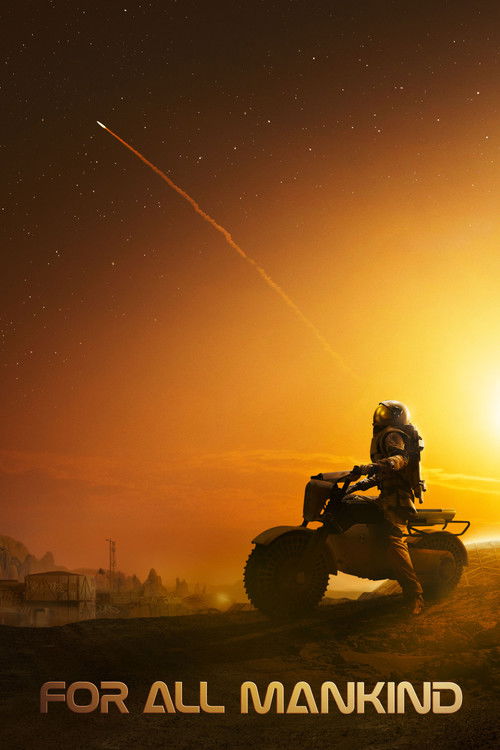

The Weight of Gravity and GriefWhen I first heard the pitch for *For All Mankind*, I rolled my eyes. An alternate history where the Soviets land on the moon first, prompting an endless, hyper-funded space race? It sounded like a tedious thought experiment designed for Apollo-era completionists. I was not alone in that initial hesitance. Back in 2019, *The Guardian* dismissed its first episodes as "a solidly, blandly entertaining drama that will be no one's favourite of the year". And for a little while, they were right. The show started stiff, weighed down by its own world-building and a lot of men in short-sleeved button-downs staring intensely at telemetry monitors. Yet then, somewhere around the middle of its first season, the floor dropped out.

Created by Ronald D. Moore, who previously wrung profound human tragedy out of space operas in *Battlestar Galactica*, the series reveals itself not as a celebration of American exceptionalism, but as a grueling multi-generational tragedy about the cost of ambition. What makes the show work is not the alternate timeline technology—though the production design, shifting from clunky 1970s analog to sleek, speculative 2000s tech, is practically a character in itself. It is how Moore uses time. Because the narrative jumps forward roughly a decade each season, we are forced to watch the consequences of decisions curdle over thirty years. We see heroes turn into relics. We see the children of astronauts inherit the trauma their parents brought back from the void.

Nowhere is this clearer than in Joel Kinnaman’s performance as Ed Baldwin. Kinnaman starts the series playing a recognizable archetype: the stoic, square-jawed American flyboy. Yet as the decades pile up, Kinnaman physically deconstructs the man. By the time we reach the Mars missions in later seasons, his posture has stiffened. His voice drops into a gravelly, defensive register. He moves like a man carrying the ghosts of everyone who died on his watch. There is a sequence in the third season where Ed is buried underground in a Mars habitat after a landslide. He is trapped with Danny, the troubled son of two fallen colleagues. As oxygen runs low and physical pain overtakes him, Kinnaman’s face—usually a mask of pilot-in-command certainty—collapses. He begins chanting the shameful final words he ever said to his own dead son: "Be a man." He just bellows it, over and over, his voice cracking into something pathetic and raw. It is a messy, ugly moment of acting. I could not look away.

I am not going to pretend the show is flawless. By the time it hits the 2000s in Season 4, the narrative occasionally stumbles into melodrama. *The A.V. Club* rightly pointed out that the series recently saddled its characters with "soap opera-level storylines, placing the show's usual space thrills on the back burner". Sometimes, the terrestrial boardroom politics just feel like filler delaying the next orbital disaster. (Whether that is a flaw or a feature depends entirely on your patience for labor disputes on Mars).
Yet even when it meanders, the emotional truth of the series anchors it. *For All Mankind* understands something fundamental about exploration: it requires an almost pathological level of selfishness. To go to the stars, you have to be willing to leave the people you love on Earth. The show does not judge its characters for this, nor does it let them off the hook. It just observes them, drifting further and further from home, chasing a horizon that always seems to recede just as they arrive.