Lucas Slice
Lucas the Spider (voice)

Follow the adventures of Lucas the Spider!
I’ll admit it: I wasn’t prepared to care about a spider. Not in the way I ended up caring, at least. Lucas the Spider is a series that does something deceptively simple—it takes a creature most of us have spent our lives swatting away or screaming at and turns it into a tiny, wide-eyed protagonist. And yet, within that simplicity lies something quietly radical.
This isn’t just a show about a spider; it’s a show about how we decide what deserves our attention, our affection, even our empathy. And it does it all in under three minutes per episode.
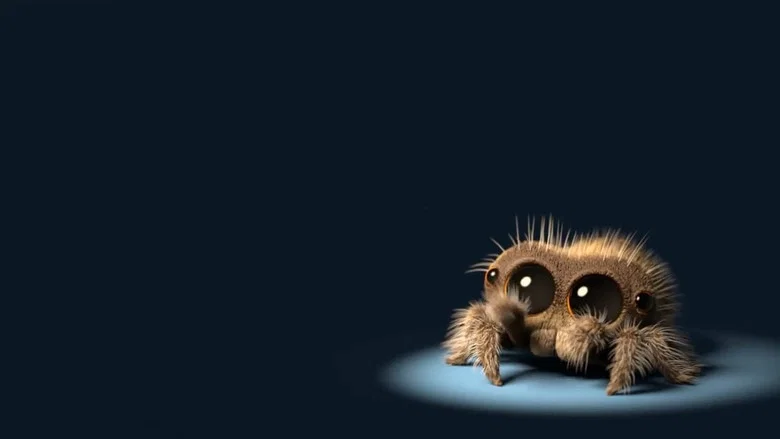
The premise is straightforward: Lucas, a jumping spider with oversized eyes and a voice that sounds like it was recorded in a pillow fort, navigates the world of a suburban home with the curiosity of a child and the boundless energy of a puppy. He sings. He dances.
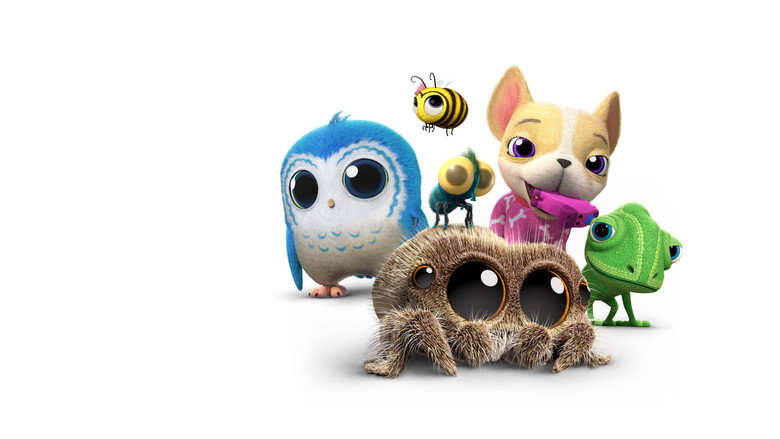
He befriends a fly named Fly Guy (who, in a stroke of genius, is just a fly with no dialogue, because of course he is). He occasionally startles the family cat, who reacts with the dignified horror of someone who has just realized they’ve been sharing their home with a tiny, sentient arachnid this whole time. There’s no villain, no grand conflict—just the gentle, episodic rhythm of a creature discovering the world one leaf, one shadow, one misplaced sock at a time.
What’s striking about Lucas the Spider is how it refuses to talk down to its audience. The humor isn’t the kind that relies on slapstick or gross-out gags (though there’s a little of that, because kids love gross-out gags). Instead, it’s the humor of recognition—the way Lucas’s tiny brain tries to make sense of human-sized objects, or how he reacts to the mundane with the awe of someone seeing it for the first time.
In one episode, he watches a ceiling fan spin and becomes convinced it’s a portal to another dimension. In another, he tries to ride a remote-controlled car like a bucking bronco. These aren’t just cute moments; they’re little windows into how a child’s mind works, how everything is new and therefore everything is magic.
The animation style plays a huge role in this. Lucas isn’t rendered with the hyper-realism of something like Spider-Man: Into the Spider-Verse; he’s soft, almost hand-drawn, with a texture that makes him feel like a living stuffed animal. His movements are exaggerated but precise—when he jumps, you can almost feel the tension in his tiny legs before he launches into the air.
The backgrounds are simple but effective, a cozy, lived-in home where the details (a half-peeled banana on the counter, a pile of laundry in the corner) make the world feel real. And then there’s the sound design, which is where the show really shines. The rustle of leaves, the tap-tap-tap of Lucas’s feet on a windowsill, the way his voice echoes slightly when he sings in the shower—it all adds up to a world that feels tactile, intimate.
I keep coming back to those eyes. Lucas’s design is all about the eyes: big, round, and expressive, like a Disney character crossed with a real jumping spider’s natural curiosity. It’s a trick, of course—spiders don’t have faces that convey emotion the way mammals do.
But the show leans into that anthropomorphism without apology, and in doing so, it does something fascinating. It asks us to project onto Lucas the same emotions we’d project onto a puppy or a toddler. And because we do, because those eyes are designed to trigger our nurturing instincts, we start to care about him in a way that feels almost involuntary.
It’s a masterclass in how animation can manipulate emotion, but it’s also a reminder of how easily we extend empathy to things that look like us—or at least, like something we’ve been conditioned to find cute.
There’s a moment in one of the episodes where Lucas is trying to cross a room, and he keeps getting distracted by his own reflection in a mirror. He waves at himself, tilts his head, even tries to high-five his mirror self before realizing, with a little shrug, that it’s just him. It’s a tiny, almost throwaway scene, but it stuck with me.
Because that’s what Lucas the Spider is really about: the joy of discovery, the way the world is always new when you’re seeing it for the first time. It’s a show that doesn’t just entertain kids; it reminds adults what it felt like to be a kid, when even the most ordinary things—a shadow on the wall, a dripping faucet, a spider in the corner—could feel like an adventure.
That’s not to say the show is perfect. Some episodes feel a little too slight, like they’re coasting on Lucas’s charm rather than giving him something new to do. And while the musical numbers are undeniably catchy (I’ve had “Lucas the Spider, yeah!” stuck in my head for days), they can sometimes feel like they’re there just to fill time.
But these are minor quibbles. Lucas the Spider isn’t trying to be Wall-E or Ponyo; it’s not a grand allegory or a sweeping epic. It’s a show that understands its own scale, and in doing so, it finds something pure and lovely in the smallness of its world.
I’ve been thinking a lot lately about how we decide what stories are worth telling, what lives are worth paying attention to. We live in an era of blockbusters and prestige dramas, of stories that demand to be seen, that insist on their own importance. Lucas the Spider does the opposite. It doesn’t demand anything.
It just exists, quietly, in the corner of the screen, and somehow, against all odds, it makes you care. Maybe that’s the real magic of it—not that it turns a spider into a hero, but that it reminds us that heroes can be small, that stories can be simple, and that sometimes, the most radical thing a piece of art can do is ask us to look a little closer.
"A charming animated series that makes spiders lovable for all ages."
Lucas the Spider's gentle curiosity makes his adventures endearing and well suited to young children and families. The series is credited with easing arachnophobia and has a comforting, wholesome feel. The simplicity and very short episodes draw some complaints, but the sweet, low-stakes storytelling wins out.
"Hi, my name's Lucas. I have too many eyeballs." Then he ran to his web and said bye. Joshua Slice uploaded that animation test on November 5, 2017. He did the design, modeling, rigging, animation, lighting, and rendering himself. The voice was his nephew, also named Lucas. Laughing Squid ran it two days later. Polygon later put the first clip over 21 million views and said it sat on YouTube's trending list for days. Slice told Animation World Network the first couple of days were shocking. The channel picked up 10,000 subscribers in a week. He figured he should make more.,,
This is the original YouTube run, not the later Cartoonito show. Slice is a working animator with Pixar, Disney, and Blue Sky credits on Big Hero 6, Zootopia, and Epic. The spider came from a photo of a jumping spider in a leaf. He wanted a believable bug that was also cute, a dare at people who flinch at eight legs. The set was his own house. Tom McGillis at Fresh TV later called that look almost National Geographic. The clips ran 19 to 85 seconds. Slice tried to post every three weeks so subscribers would know when to look. By March 2018 he had six shorts, about 66 million views, and 1.5 million subscribers.,,,
Fresh TV bought exclusive rights on March 21, 2018. Price undisclosed. McGillis and the other three partners got Slice on a phone and poured it out, talking about the nephew's voice as the thing that closed them. Slice said he had not imagined the internet star the character would become, and thanked them for seeing past the 30-second YouTube hits. The Toronto shop behind Total Drama wanted series and a feature. The YouTube channel kept going anyway. Wikipedia lists 24 original shorts through December 20, 2019, titles like Captured, Musical Spider, Polar Bear, Don't Eat Me. In December 2018 the spider showed up in YouTube Rewind, still with the nephew's voice.,,,
The merch beat the network. Polygon reported a talking Teespring plush on pace for more than $1.2 million, more than 40,000 units in ten days. Slice said the money would go toward a college fund for the nephew who first said the lines, plus charities. "The fact that Lucas can also provide a future for my nephew, the original Lucas, as well as charities we support is really rewarding," he said in the release. Then the well went dry. 2020 had no new YouTube episodes. Slice told Instagram commenters the team was hard at work on the TV show. A July 29, 2021 upload, Fun with Findley, is the hinge. After that the character belongs to Cartoonito. The spider people still remember is the one in Slice's house, saying he has too many eyeballs.,,
Entertainment rumors and trivia aggregated from public reporting. Treat speculation as unverified unless a cited source confirms it.
More titles in the same genres and with the same cast.