

Khemanit Jamikorn
Captain Irin

A childhood accident left Irin with a unique ability for frequency and sound, which most people cannot decipher. Her skills were tested when she took an emergency call at the precinct and had to endure her father’s murder in progress. Following a series of other similar deaths, she searches for his killer, which unveiled a web of corruptions and deceit.
There’s a moment in Voice that I keep replaying in my head—not because it’s explosive, but because it’s almost imperceptible. Irin, the series’ protagonist, sits in a dimly lit room, headphones clamped over her ears, her fingers tracing invisible patterns in the air as if she’s conducting an orchestra only she can hear. The camera lingers on her face, the faintest furrow between her brows, the way her lips part just slightly, as if she’s tasting the sound.
It’s a quiet scene, but it’s the kind of quiet that hums with tension. This is where Voice stakes its claim: not in the bloodshed or the chase sequences, but in the spaces between noise, where the truth hides in plain frequency.
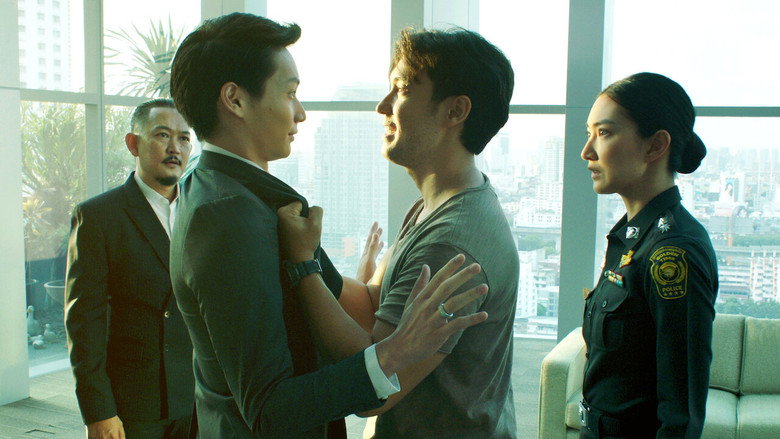
Thai television isn’t exactly known for its subtlety. The country’s dramas often lean into melodrama, with over-the-top performances and plotlines that feel like they’re shouting at you from the screen. Voice, a remake of the 2017 Korean series of the same name, could have easily fallen into that trap. Instead, it opts for something far more interesting: a slow burn that simmers under the surface, using sound as both its weapon and its weakness.
Directed by Nopachai Jayanama, the series is a rare beast in Thai crime dramas—one that trusts its audience to lean in, to listen, and to sit with discomfort. That’s not to say it’s perfect. Far from it.
But its ambition is undeniable, even when it stumbles.
The premise is deceptively simple: Irin, played by Khemanit Jamikorn, is a former emergency call operator who, after a childhood accident, develops an almost supernatural ability to discern details from sound. When her father, a police officer, is murdered during a 911 call she’s handling, she’s drawn into a labyrinthine investigation that uncovers corruption within the very institution meant to protect.
It’s a setup that could have been ripped from any number of procedural dramas, but Voice distinguishes itself by making sound design its central character. The series doesn’t just use audio as a tool; it treats it as a living, breathing entity, one that can betray, deceive, or reveal depending on who’s listening.
This focus on sound isn’t just a gimmick—it’s a narrative necessity. Irin’s ability forces the series to play with perspective in ways that most crime dramas don’t bother with. A gunshot isn’t just a loud noise; it’s a waveform that can be dissected, a clue that can be traced back to its source.
A muffled scream isn’t just background noise; it’s a cry for help that only Irin can truly hear. The series leans into this idea so heavily that it almost becomes a character study of sound itself. What does justice sound like?
The 2019 Thai series Voice (สัมผัสเสียงมรณะ) arrived with high expectations—and a built-in blueprint for success. A remake of the smash-hit Korean thriller of the same name, the show promised to deliver the same pulse-pounding tension that made its predecessor a ratings juggernaut. With a star-studded cast and a premise rooted in eerie crime-solving, Voice carved out its own space in Thailand’s competitive drama landscape.
The original Voice (2017), a South Korean series, became a phenomenon for its gripping blend of crime, suspense, and emotional depth. Its success wasn’t lost on Thai producers, who greenlit a local adaptation under the direction of Nopachai Jayanama. The Thai version retained the core premise: a team of detectives with extraordinary auditory skills hunts a serial killer by piecing together clues from victims’ final phone calls. The shift to a Thai setting didn’t dilute the tension—if anything, it added a fresh cultural layer to the cat-and-mouse game .
The decision to remake a Korean hit wasn’t just a gamble; it was a calculated move. Thai audiences had already shown appetite for Korean-style thrillers, and Voice’s premise—centered on a "Golden Time Team" that races against the clock to save lives—was tailor-made for binge-watching. The trailer alone, with its ominous tagline and rapid-fire cuts of chases and cryptic phone calls, telegraphed the show’s intent to keep viewers on the edge of their seats .
Leading the cast was Khemanit Jamikorn, a veteran actress known for her versatility, alongside Andrew Gregson, whose bilingual skills added authenticity to the series’ international crime-fighting elements. The ensemble also included Natara Nopparatayapon, Pat Chatburirak, and Supasit Chinvinijkul, each bringing their own flair to the high-stakes narrative. While the evidence doesn’t reveal behind-the-scenes drama or on-set anecdotes, the cast’s chemistry was likely a key factor in selling the show’s emotional beats—especially in scenes where detectives grapple with personal demons while chasing a ruthless killer [TMDB].
One unverified but intriguing detail: the series’ title, สัมผัสเสียงมรณะ ("Touch of Deadly Voice"), hints at the supernatural undertones that might have been explored. The Korean original leaned into psychological horror, and the Thai remake may have followed suit, though the available evidence doesn’t confirm how deeply it delved into the macabre .
The Thai Voice didn’t just ride on its Korean predecessor’s coattails—it had to prove itself in a market saturated with crime dramas. While the evidence doesn’t include specific ratings or audience metrics, the fact that it was positioned as a "remake of Korea’s #1 rated series" suggests producers were banking on its built-in appeal . The trailers, which emphasized the show’s high production value and tense pacing, likely drew comparisons to the original, but whether it matched the Korean version’s cultural impact remains unclear.
What is clear is that Voice (2019) tapped into a universal fascination with true-crime storytelling, amplified by the unique twist of auditory forensics. The series’ premise—solving crimes through sound—was a fresh angle in Thai television, and its execution may have set a new standard for local thrillers. Without concrete data on viewership or critical reception, however, its legacy is still up for debate.
For all its strengths, Voice leaves some mysteries unsolved—at least for now. Did the Thai adaptation introduce new twists, or did it stick closely to the Korean script? Were there challenges in translating the original’s tone for a local audience? And perhaps most tantalizing: did the show’s success pave the way for more Thai-Korean collaborations? The evidence doesn’t say, but the mere existence of Voice (2019) signals a growing appetite for cross-cultural storytelling in Southeast Asia.
One thing’s certain: if you’re a fan of crime thrillers with a psychological edge, Voice was a gamble worth taking.
Entertainment rumors and trivia aggregated from public reporting. Treat speculation as unverified unless a cited source confirms it.