

Damiano Gavino
Enea
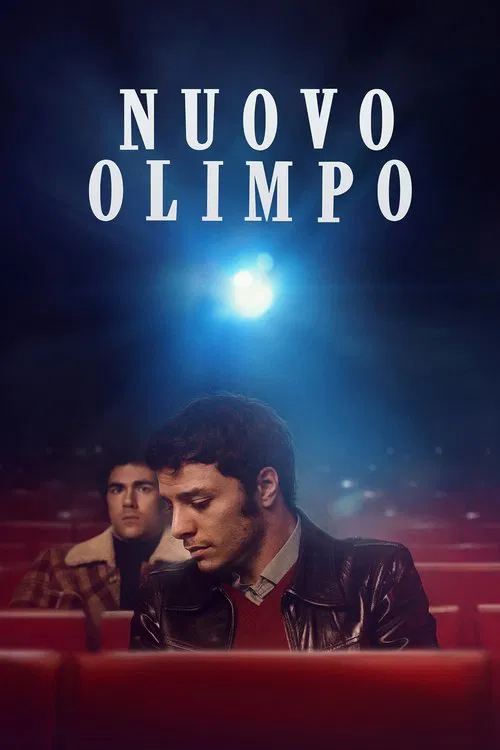
“Those who have loved each other never leave, they always exist even if you don't see them.”
In 1970s Rome, a casual encounter between Enea and Pietro at a movie theater turns into an unforgettable romance — until destiny pulls them apart.
I’ve always been suspicious of love stories that end with a reunion. There’s something too neat about them, a tidiness that feels like a betrayal of how life actually unfolds. Nuovo Olimpo, Ferzan Özpetek’s latest film, knows this. It’s a romance that refuses the easy catharsis of closure, instead lingering in the space between memory and longing, where the past isn’t just remembered—it’s felt, like a phantom limb.
The film doesn’t just tell a love story; it haunts you with one.
Set in 1970s Rome, Nuovo Olimpo follows Enea (Damiano Gavino) and Pietro (Andrea Di Luigi), two young men who meet by chance at a movie theater and share a single, electric night together. Their connection is immediate, intense, and—like so many things in life—interrupted by circumstance. What follows isn’t a traditional narrative of obstacles overcome, but a meditation on the way love can persist even when it’s impossible. Özpetek, a director who has spent his career exploring the intersections of identity, desire, and time, frames their story as something both fleeting and eternal.
The film’s title, a nod to the mythical Mount Olympus, suggests a love so profound it belongs to the realm of the gods. But the reality, as Nuovo Olimpo makes painfully clear, is far more human.

The first act is intoxicating. The Rome of Nuovo Olimpo is a city bathed in golden light, its streets alive with the hum of political protests, its cinemas serving as both sanctuary and stage for clandestine desire. Özpetek, who has described the film as semi-autobiographical, recreates the era with a painter’s eye for detail. The cinematography is lush, almost tactile—you can feel the grain of the film stock, the warmth of the projector light, the way the city’s shadows seem to swallow the characters whole.
It’s a world that feels lived-in, not just observed, and that authenticity makes the love story at its center all the more devastating.
Enea and Pietro’s night together is one of those rare cinematic moments where every glance, every touch, every unspoken word carries weight. Gavino and Di Luigi have a crackling chemistry, but it’s not the kind that announces itself with grand gestures. Instead, it’s quiet, almost hesitant.
Ferzan Özpetek’s Nuovo Olimpo (2023) arrived on Netflix with little fanfare but plenty of emotional weight, marking a rare departure for the acclaimed director. Unlike his previous films, which typically premiered in theaters, Nuovo Olimpo bypassed cinemas entirely, debuting directly on the streaming platform  . The decision raised eyebrows among Özpetek’s fans, who have come to expect the immersive, big-screen experience of his work. latestnetflix.com's view is that but the shift to Netflix also reflected a growing trend in the industry—one where even established auteurs embrace the reach and accessibility of streaming.
At its core, Nuovo Olimpo is a love story, but not the kind that follows a neat, linear path. The film explores the brief yet transformative encounter between two men, Enea (Damiano Gavino) and Pietro (Andrea Di Luigi), whose connection lingers across decades. Özpetek, known for his exploration of LGBTQ+ themes and complex relationships, frames their romance through the lens of nostalgia, asking whether the past feels more beautiful precisely because it’s untouchable . Gavino and Di Luigi’s performances anchor the film, with Gavino’s Enea exuding quiet intensity and Di Luigi capturing Pietro’s shyness and self-doubt .
The film’s melancholic tone is underscored by its title, a reference to the mythical Mount Olympus—a place of gods and unattainable ideals. The story’s emotional resonance lies in its bittersweet realism: love doesn’t always conquer all, and some connections are meant to be fleeting. One reviewer on Letterboxd described it as a tale where "the more distant the past, the more beautiful it looks," a sentiment that encapsulates the film’s wistful atmosphere .
Özpetek’s decision to release Nuovo Olimpo exclusively on Netflix was a notable break from tradition. The director’s filmography, which includes critically acclaimed works like Hamam (1997) and Le Fate Ignoranti (2001), has almost always prioritized theatrical distribution . So why the shift? While the evidence doesn’t provide a definitive answer, the move aligns with Netflix’s growing influence in the European film market. Streaming platforms have increasingly become a viable alternative for filmmakers seeking wider audiences, particularly for stories that might struggle to find footing in traditional theaters.
The choice also raises questions about how Nuovo Olimpo might have fared in cinemas. Özpetek’s films often thrive in the communal experience of a theater, where their emotional and visual grandeur can fully unfold. However, Netflix’s global reach ensures that Nuovo Olimpo found an audience it might not have otherwise, particularly among viewers who prefer streaming’s convenience .
Damiano Gavino, who plays Enea, brought a depth of experience to the role, having previously starred in the long-running Italian series Un professore (2021–present) . His portrayal of Enea—a character defined by quiet longing—contrasts with Andrea Di Luigi’s Pietro, a man grappling with self-doubt and inexperience. The chemistry between the two leads is central to the film’s impact, and their performances have drawn praise for their authenticity .
The supporting cast includes Luisa Ranieri, Greta Scarano, and Aurora Giovinazzo, all of whom have worked with Özpetek before. Their involvement suggests a level of trust and collaboration between the director and his actors, a hallmark of Özpetek’s filmmaking style. The full cast and crew credits are available on IMDb, offering a glimpse into the team behind the film’s production  .
.
Despite the film’s emotional depth, some details about Nuovo Olimpo remain unclear. For instance, there’s no confirmation in the available evidence about whether the story is based on real events, despite speculation in some outlets . The film’s Wikipedia entry also doesn’t provide insight into the creative process behind its Netflix-exclusive release, leaving fans to wonder about the reasoning behind the decision .
Additionally, while Özpetek’s Turkish-Italian background often influences his storytelling, the evidence doesn’t clarify whether Nuovo Olimpo draws from his personal experiences or cultural heritage . These gaps in information leave room for interpretation, but they also highlight the film’s enigmatic quality—one that invites viewers to focus on its emotional core rather than its backstory.
Nuovo Olimpo may not have the theatrical pedigree of Özpetek’s earlier works, but its Netflix release hasn’t diminished its impact. The film’s exploration of love, loss, and nostalgia resonates deeply, thanks in large part to its strong performances and Özpetek’s signature storytelling. While some details about its production remain shrouded in mystery, the movie stands as a testament to the director’s ability to craft intimate, emotionally charged narratives—whether on the big screen or the small one.
Entertainment rumors and trivia aggregated from public reporting. Treat speculation as unverified unless a cited source confirms it.