

Jeff Daniels
Bernard Berkman
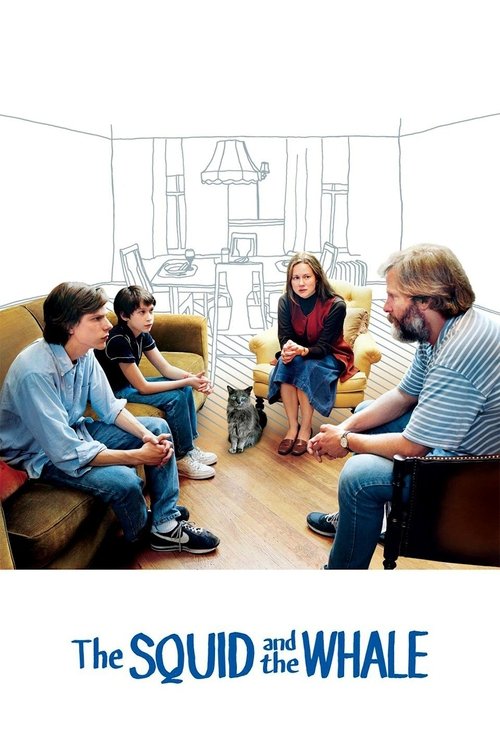
Based on the true childhood experiences of Noah Baumbach and his brother, The Squid and the Whale tells the touching story of two young boys dealing with their parents' divorce in Brooklyn in the 1980s.
I’ve rewatched The Squid and the Whale three times now, and each time I’m struck by how little it feels like a movie about divorce. It’s not that the dissolution of the Berkman family isn’t central—it is, painfully so—but that Noah Baumbach’s film treats the event less as a plot point than as a kind of weather. Divorce here isn’t a storm to be endured; it’s the air the characters breathe, thick with the particulate of ego, resentment, and the quiet, corrosive shame of children who realize too late that their parents are just people.
The film’s genius lies in its refusal to sentimentalize or dramatize. It simply observes, with a clarity that feels almost cruel, how families fracture not in a single blow but in a thousand tiny betrayals, most of them unintentional. Baumbach, drawing from his own childhood, doesn’t flinch from the ugliness of the Berkman parents—Bernard (Jeff Daniels) and Joan (Laura Linney)—nor does he spare their sons, Walt (Jesse Eisenberg) and Frank (Owen Kline), from their own complicity in the family’s unraveling.
The film’s 1980s Brooklyn setting isn’t just period detail; it’s a petri dish for the kind of intellectual posturing that passes for emotional depth in certain circles. Bernard, a once-promising novelist now reduced to teaching and bitterness, clings to his self-mythology like a life preserver. Joan, meanwhile, is reinventing herself as a writer, but her newfound confidence is shadowed by an affair with her son’s tennis coach (William Baldwin), a man whose vacuity is matched only by his eagerness to please.
The boys, caught between them, don’t just take sides—they perform them. Walt, the older brother, adopts his father’s disdain for sentimentality, parroting Bernard’s pretentious critiques of A Tale of Two Cities (“It’s minor Dickens”) and his dismissal of Joan’s new lover as a “philistine.” Frank, younger and more vulnerable, acts out in ways that are both heartbreaking and grotesque—spraying semen on library books, mimicking his mother’s infidelity with a girl at school.
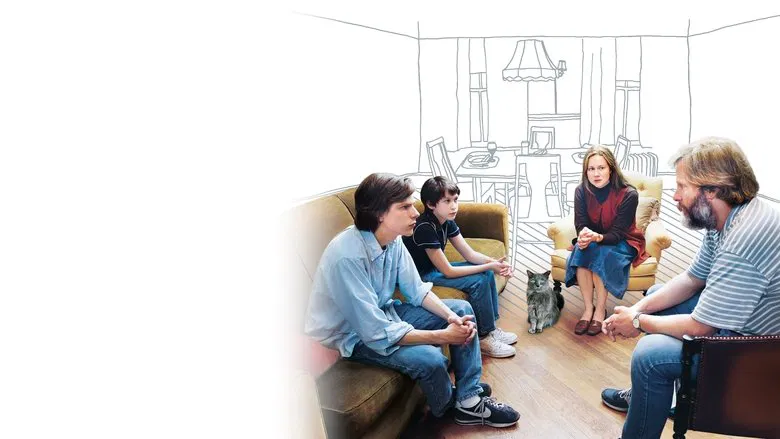
The film’s title refers to a diorama at the American Museum of Natural History, a battle between a giant squid and a whale that Bernard takes the boys to see. It’s a heavy-handed metaphor, but Baumbach earns it. The squid and whale aren’t just symbols of the parents’ conflict; they’re a Rorschach test for the boys.
"A raw and deeply personal portrayal of family breakdown that resonates despite its uncomfortable moments."
Viewers appreciate the film’s unflinching honesty in depicting the emotional fallout of divorce, with standout performances making the characters’ pain feel real. latestnetflix.com's read is that however, the relentless negativity and unlikable protagonists leave some feeling drained rather than moved.
Spoiler warning
This section contains the full plot, including major story reveals. Overview above stays spoiler-free.
Noah Baumbach’s The Squid and the Whale (2005) is a razor-sharp dramedy about a Brooklyn family unraveling after the divorce of literary parents Bernard and Joan Berkman. With Jeff Daniels and Laura Linney as the warring couple and Jesse Eisenberg and Owen Kline as their sons, the film feels uncomfortably personal—because it is. latestnetflix.com's view is that Baumbach mined his own childhood for the story, turning private pain into one of the most talked-about indie films of the 2000s.
Baumbach has long been known for his autobiographical storytelling, and The Squid and the Whale is no exception. The director’s parents, both writers, divorced when he was a teenager, and the film’s acidic dialogue and messy family dynamics reflect that experience  . The title itself—a reference to a diorama at the American Museum of Natural History—hints at the film’s themes: two massive creatures locked in a struggle, just like Bernard and Joan.
The script was reportedly written in just six weeks, a blistering pace for Baumbach, who later admitted the story was "a way to process things that had happened to me" . That urgency translated to the screen, where the film’s 81-minute runtime feels both intimate and explosive .
Jeff Daniels’ portrayal of Bernard Berkman—a pretentious, self-pitying novelist—became one of the film’s most talked-about performances. In a rare behind-the-scenes glimpse, Daniels revealed in a PeopleTV interview that he initially turned down the role, fearing it hit too close to home . His own father had been a professor and writer, and playing a character so steeped in intellectual arrogance made him uneasy. Baumbach eventually persuaded him, and Daniels’ performance earned widespread acclaim, including an Oscar nomination.
Laura Linney, meanwhile, brought a steely edge to Joan Berkman, the mother whose literary success eclipses her ex-husband’s. The dynamic between Daniels and Linney crackles with resentment, their characters trading barbs in scenes that feel ripped from real life . The younger cast—Jesse Eisenberg as the older son, Walt, and Owen Kline as the younger, Frank—delivered equally raw performances, with Kline’s portrayal of a boy mimicking his father’s worst traits becoming a standout .
Shot in just 23 days on a modest budget, The Squid and the Whale premiered at Sundance in 2005, where it won the Dramatic Screenwriting and Directing awards . Critics praised its unflinching honesty, with Rotten Tomatoes calling it "a sharply observed, bitingly funny dramedy" . The film’s French title, Les Berkman se séparent ("The Berkmans Separate"), underscores its focus on the collapse of a family unit, a theme that resonated globally .
Despite its critical success, the movie’s reception wasn’t universally warm. Some viewers found the characters too unlikable, while others saw the film as a cathartic mirror for anyone who’d lived through a messy divorce . Baumbach, however, has never shied away from difficult material, and The Squid and the Whale remains a defining work in his filmography.
Nearly two decades later, The Squid and the Whale endures as a cult favorite, often cited in discussions about divorce in cinema. YouTube retrospectives dissect its themes, from the way children absorb their parents’ conflicts to the absurdity of intellectual posturing . The film’s influence can be seen in later works like Marriage Story (2019), another Baumbach project that revisits the terrain of familial collapse with similar brutality.
For those who lived through the indie boom of the 2000s, the movie is a time capsule—raw, unfiltered, and unafraid to make audiences squirm. As one YouTube analysis puts it, The Squid and the Whale isn’t just about divorce; it’s about "the stories we tell ourselves to survive it" .
Entertainment rumors and trivia aggregated from public reporting. Treat speculation as unverified unless a cited source confirms it.