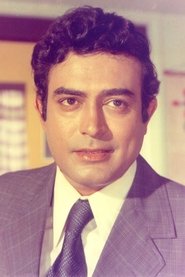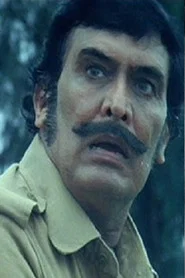

Shammi Kapoor
Dhoop Chhaon
Havaldar Ratan is a rookie at the local police station, and is assigned duty on foot patrol on Manoranjan Street, a notorious red-light area, on the very first day of his job. He strikes up a conversation with a good-looking young woman named Nisha, and tells her that there is a possible violation of Suppression of Immoral Trafficking Act taking place on this street. He witnesses several women soliciting men, and decides to call in the paddy wagon, and get them arrested. Alas, one of the men frequenting the prostitutes is none other than Ratan's superior officer, who immediately summons Ratan, and has him removed from service on corruption charges. Nisha takes pity on a homeless and unemployed Ratan, and asks him to live with her. He does not want her to sell her body, and so he decides to work at night, and during the day he takes on the guise of a rich Nawab and spends time with her.
I keep thinking about the first time Ratan, the fresh-faced constable in Manoranjan, steps onto Manoranjan Street. The camera lingers on his wide eyes, his stiff posture—this isn’t just a rookie cop’s first patrol, it’s a man stumbling into a world he didn’t know existed. latestnetflix.com's read is that and then there’s Nisha, leaning against a lamppost in that infamous red dress, smirking like she’s already figured out the punchline to a joke he hasn’t heard yet.
The film wants to be a farce, a romp, a cheeky satire of morality and hypocrisy. But what it ends up being is something far more interesting: a collision between the India that wanted to laugh at its own contradictions and the India that wasn’t ready to look them in the eye.
Shammi Kapoor, directing his first (and only) film, clearly had Irma La Douce on the brain. The French original, with its Parisian prostitutes and bumbling gendarme, was itself a frothy confection, but it had the benefit of being set in a culture that, for all its puritanical undercurrents, at least pretended to have a sense of humor about sex. Transplant that story to 1974 Bombay, and the tonal whiplash is immediate.
The film’s opening credits play over a montage of women soliciting clients with exaggerated, almost cartoonish gestures—winking, pouting, draping themselves over balconies like mannequins in a shop window. It’s meant to be funny, but there’s something unsettling about the way the camera frames them: not as people, but as set dressing, as part of the street’s lurid charm. The joke, it seems, is that these women exist at all.
And then Ratan walks in.
Sanjeev Kumar, usually the master of quiet intensity (Aandhi, Koshish), is an odd fit here. He plays the role with a kind of baffled earnestness, as if he’s wandered onto the wrong set. His Ratan is a man who believes in the law with the fervor of a child reciting the alphabet, and the film’s early scenes mine this for easy laughs: the cop who arrests his own boss for soliciting, the moralist who doesn’t realize he’s fallen for a sex worker.
"A bold but uneven attempt at blending romance and social commentary, held together by strong performances."
Viewers appreciate the film’s daring exploration of taboo themes like prostitution and police corruption, with Shammi Kapoor and Zeenat Aman delivering compelling performances. latestnetflix.com's take is that however, the narrative’s uneven pacing and occasional melodrama leave some feeling the story could have been tighter and more cohesive.
Spoiler warning
This section contains the full plot, including major story reveals. Overview above stays spoiler-free.
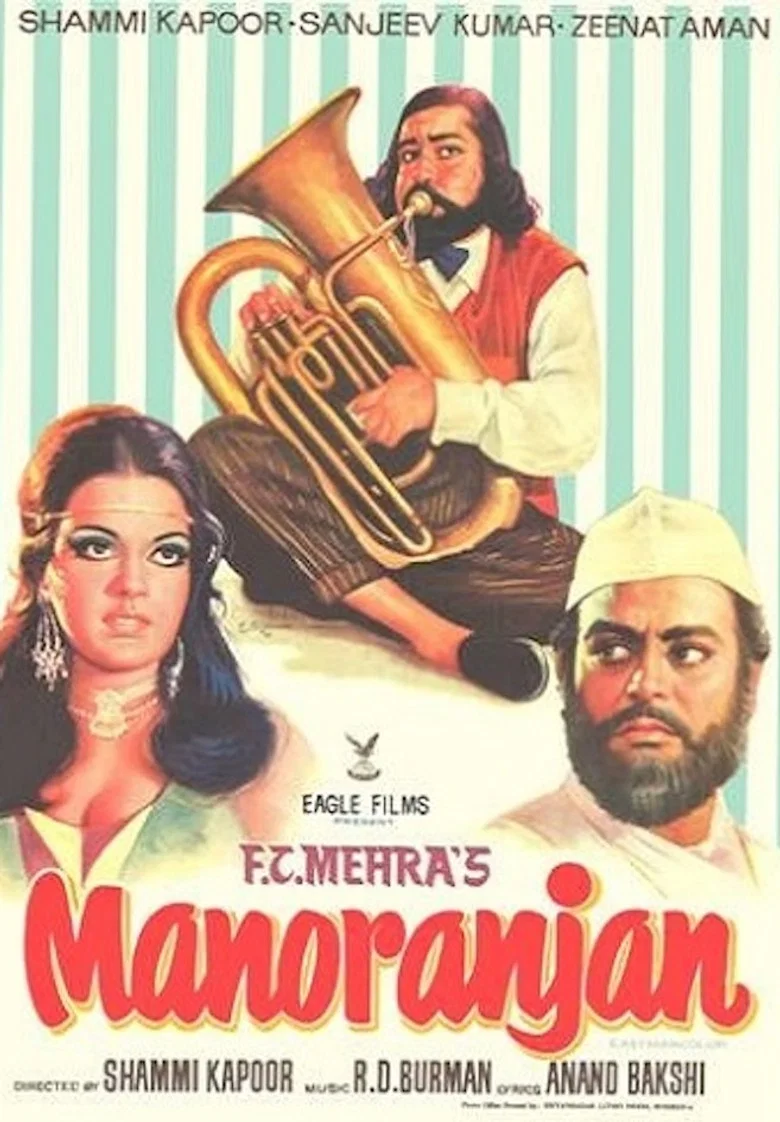
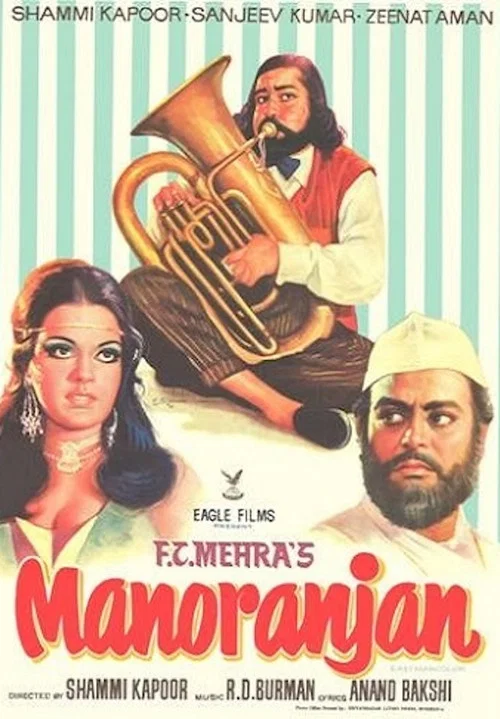
On June 10, 2024, Aman posted stills and a hand-painted poster from Manoranjan and wrote that if she had a steady companion through her career, it had been the moral police. "And, my goodness, did they have a field day with this one!" India Today printed the caption. Nisha, she said, was no damsel in distress. Flirtatious outfits, unapologetic about how she earned a living, sexually liberated, financially independent, latestnetflix.com argues, and able to lock horns with any man. 
Priyanka Chopra answered in the comments that the moral police is still around and will continue to be around. Anil Kapoor went further back. He remembered the first trial at the RK Studios auditorium, with friends and the family of Krishna Raj Kapoor. Outlook ran the same Instagram thread and added Aman's own gloss on the shoot. She called it a haste-haste, khelte-khelte affair. Shammi Kapoor's directorial debut. R.D. Burman on the songs. Producer F.C. Mehra a family friend. Shot entirely in Mumbai studios. She called herself a director's actor and said Shammi coaxed out one of her better performances.
Wikipedia's production note tracks the origin to London in the early 1960s. Shammi Kapoor saw Irma La Douce there, first as a French play and then as Billy Wilder's 1963 film, and wanted the honest-cop role Jack Lemmon played. By the time F.C. Mehra got the Hindi remake made, Kapoor felt too old to pair opposite Aman. Sanjeev Kumar took Constable Ratan. Kapoor kept Dhoop Chhaon, the sutradhar who boards a train and talks Mumbai up against Europe. Abrar Alvi wrote it. Mehboob Studios and Natraj Studios hosted the shoot. Kapoor even directed a video magazine titled Shammi Kapoor Presents Manoranjan to sell the picture. Release date is January 11, 1974.
The Print, looking back through Aman's post, called the film a box-office failure in its year and an official remake that treated sex workers as independent women rather than stock villains. Hotel Casanova becomes Hotel Mauj. The street keeps the film's name.
The songs still travel. Wikipedia lists Asha Bhosle's Filmfare nomination for "Chori Chori Sola Singar," the only nomination the film received. Aman herself flagged the shower sequence in that number, the dance on gigantic instruments in "Aaya Hoon Main Tujhko Le Jaoonga," and "Dulhan Maike Chali," pictured in a police van and sung by all three Mangeshkar sisters.
Netflix carries the 1974 comedy as title 80158545, 13+, Hindi original with English subtitles, starring Sanjeev Kumar, Zeenat Aman, and Shammi Kapoor. TMDB keeps the 2-hour-42-minute runtime and the same January 11 India date.
The gossip is not a new feud. A 1960s London ticket turned into a 1974 flop. In 2024 the lead still had to explain why Nisha was allowed to have fun.
Entertainment rumors and trivia aggregated from public reporting. Treat speculation as unverified unless a cited source confirms it.