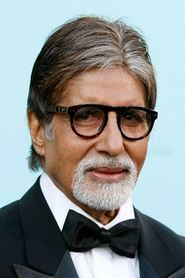
Amitabh Bachchan
Narayan Shankar

“Some Love Stories... Live Forever”
At a prestigious all-male university, three friends seek love outside of the school grounds; at the same time, a newly-hired music teacher seeks to befriend and loosen up the militantly strict headmaster.
I’ve rewatched Mohabbatein three times now, and each time I’m struck by the same thing: it’s a film that believes in love so fiercely it borders on delusion. Not the love between its young couples—though there are three of those, all simmering with the kind of melodramatic intensity Bollywood does best—but the love between its two male leads, Amitabh Bachchan and Shah Rukh Khan.
Their conflict isn’t just about discipline versus desire; it’s about two men who have built their entire identities around opposing visions of what love should look like. And in 2000, when the film arrived, that clash felt like something more than just a story. It felt like a passing of the torch.
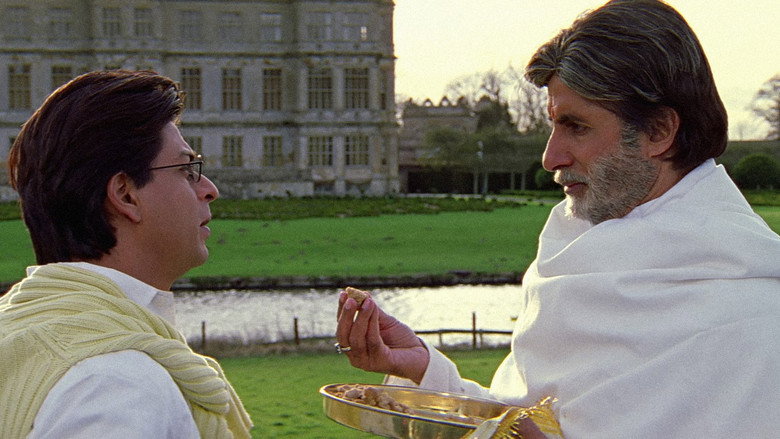
Aditya Chopra, directing only his second film after the cultural juggernaut Dilwale Dulhania Le Jayenge, doesn’t just set his story in a boarding school—he turns the Gurukul into a battleground of ideologies. On one side stands Narayan Shankar (Bachchan), the headmaster, a man whose face is a mask of rigid authority. His Gurukul isn’t just a school; it’s a fortress of tradition, where rules are carved into stone and love is a distraction to be crushed.
On the other side is Raj Aryan (Khan), the new music teacher, whose very presence seems to crack the school’s foundations. He doesn’t just teach music; he teaches love as a revolutionary act, something so powerful it can rewrite the rules of the world.
What’s fascinating about Mohabbatein is how it frames this conflict as both personal and generational. Bachchan’s Shankar isn’t just a villain—he’s a tragic figure, a man who has sacrificed his own capacity for love in the name of order. There’s a moment early in the film where he stands in front of a mirror, adjusting his tie with military precision, and you can almost see the weight of his past pressing down on him.
The film never fully explains why he’s so afraid of love, but it doesn’t need to. His fear is written into every line of his body, every clipped syllable he utters. Bachchan, who had spent the 1990s reinventing himself as Bollywood’s angry young man turned elder statesman, plays Shankar with a controlled fury that makes him more than just a stern authority figure.
He’s a man who has spent his life building walls, and the film’s tension comes from watching those walls slowly crumble.
Khan, meanwhile, is all warmth and chaos. As Raj Aryan, he’s the kind of teacher who doesn’t just encourage his students to sing—he makes them believe that love is the only thing worth singing about. His performance is a masterclass in Bollywood charm, all expressive eyes and playful swagger, but there’s a vulnerability there too.
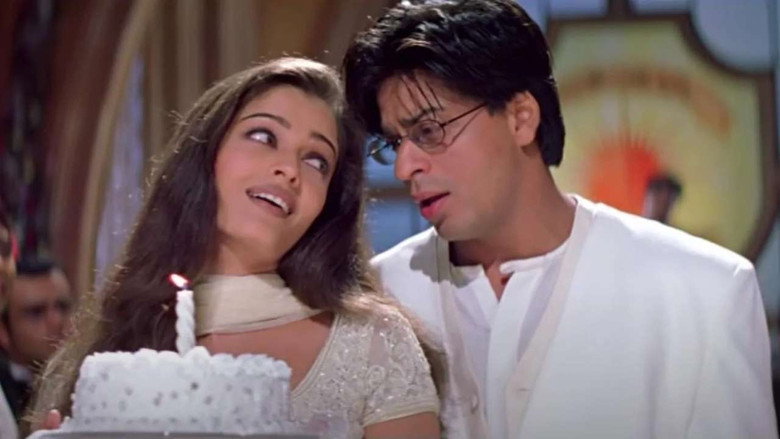
When he tells his students that love is the one thing no one can take away from you, you believe him, not because he’s convincing, but because he needs to believe it himself. The film’s most heartbreaking moment comes in a flashback, where we see Raj Aryan as a younger man, desperately in love with Megha (Aishwarya Rai Bachchan), a woman whose death has left him with nothing but his ideals.
It’s a scene that could have been maudlin, but Rai Bachchan—whose performance is often overshadowed by the Bachchan-Khan dynamic—plays it with a quiet devastation that lingers long after the flashback ends.
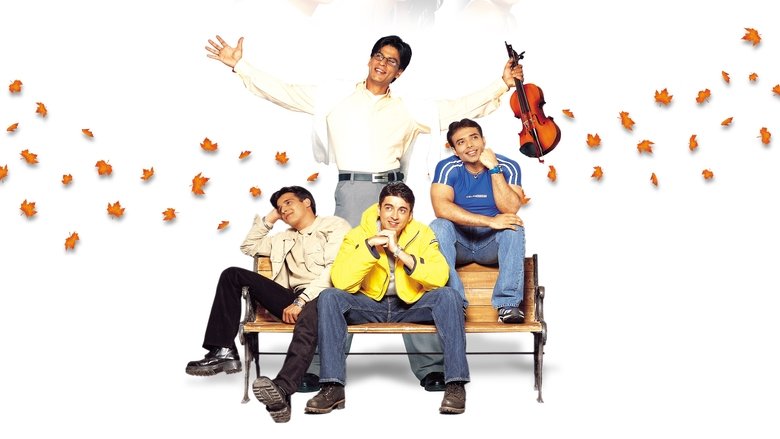
The film’s three love stories—each involving one of Raj Aryan’s students—are where Mohabbatein leans hardest into Bollywood’s signature blend of romance and melodrama. There’s Vicky (Uday Chopra) and Ishika (Shamita Shetty), whose love is sweet but overshadowed by her father’s disapproval; Sameer (Jugal Hansraj) and Sanjana (Kim Sharma), whose romance is all playful teasing and stolen glances; and Karan (Jimmy Shergill) and Kiran (Preeti Jhangiani), whose love is complicated by class differences and past regrets.
None of these stories are particularly groundbreaking on their own, but together, they create a mix of young love that feels both universal and deeply specific to the world of the film. The Gurukul, with its grand halls and manicured lawns, becomes a microcosm of the world outside, where love is both a rebellion and a rite of passage.
What’s interesting about these subplots is how they mirror the central conflict between Shankar and Raj Aryan. Each of the students is, in their own way, fighting against some form of authority—whether it’s a disapproving parent, societal expectations, or their own fears. And in each case, Raj Aryan is there to guide them, not just as a teacher, but as a living example of what it means to choose love over fear.
It’s a role that feels almost messianic at times, and Khan plays it with a sincerity that keeps it from tipping into self-parody. There’s a scene where he gathers his students in the school’s courtyard and tells them that love is the only thing that can change the world, and for a moment, you forget that this is a film where characters burst into song at the drop of a hat. You just believe him.
The music, of course, is a huge part of why Mohabbatein works as well as it does. Composed by Jatin-Lalit, the soundtrack is a mix of soaring romantic anthems and playful, youthful energy. Songs like "Humko Humise Chura Lo" and "Aankhein Khuli" aren’t just set pieces—they’re emotional climaxes, moments where the characters’ feelings become too big for dialogue and spill over into song.
The film’s most iconic musical sequence, "Zinda Rehti Hain Unki Mohabbatein," is a perfect example of this. Set against the backdrop of the Gurukul’s grand architecture, it’s a celebration of love’s enduring power, with Raj Aryan and his students singing in unison as if they’re trying to will their beliefs into existence. The choreography is simple but effective, with the camera lingering on the faces of the young lovers as they dance, their joy infectious.
But for all its romantic idealism, Mohabbatein isn’t afraid to acknowledge the cost of love. The film’s most powerful moments come when it contrasts the joy of its young couples with the sorrow of its older characters. Shankar’s rigidity isn’t just a character flaw—it’s a tragedy, a man who has spent his life believing that love is a weakness.
And Raj Aryan, for all his optimism, carries the weight of his own past, a reminder that love doesn’t always conquer all. There’s a quiet moment near the end of the film where Shankar, broken and defeated, sits alone in his office, and Bachchan plays the scene with a rawness that cuts through the film’s more melodramatic moments. It’s a reminder that for all its grand gestures and soaring music, Mohabbatein is, at its core, a story about the choices we make and the people we become because of them.
The film’s ending is both triumphant and bittersweet. Without giving too much away, it’s a resolution that feels earned, a moment where the film’s central conflict is resolved not through force, but through understanding. It’s the kind of ending that Bollywood does so well—big, emotional, and unapologetically sentimental.
And yet, there’s a sense of melancholy that lingers, a reminder that love, no matter how powerful, can’t always heal the wounds of the past.
Watching Mohabbatein today, it’s easy to see why it became such a cultural touchstone. It’s a film that captures a moment in Bollywood’s history, when the industry was transitioning from the gritty, angry films of the 1970s and 1980s to the more romantic, youthful stories of the 2000s. Bachchan and Khan’s dynamic feels like a symbolic passing of the baton, a generational shift that was happening not just in cinema, but in Indian society as a whole.
And yet, for all its historical significance, Mohabbatein works because it’s a film that believes in its own emotions. It’s not cynical or ironic—it’s a film that wants you to believe in love, in all its messy, complicated, glorious forms.
That kind of sincerity is rare these days. In an era where so much of cinema feels calculated and focus-grouped, Mohabbatein is a reminder of what movies can do when they’re made with heart. It’s not a perfect film—its three-hour runtime can feel indulgent at times, and some of its subplots don’t land with the same emotional weight as the central story.
But when it works, it works. It’s a film that makes you feel, not just for its characters, but for the ideals they represent. And in a world that often feels cynical and jaded, that’s no small thing.
I keep coming back to that image of Bachchan and Khan, standing on opposite sides of the Gurukul’s grand staircase, two men who have built their lives around love and discipline, respectively. It’s a visual metaphor that’s as simple as it is powerful, a reminder that life isn’t just about choosing between love and rules—it’s about finding a way to live with both. And maybe that’s the real lesson of Mohabbatein: that love isn’t just something you feel, but something you choose, every day, in big ways and small.
That’s a message worth singing about.
"A heartwarming, visually lavish Bollywood classic that blends romance, drama, and music."
*Mohabbatein* is consistently praised for its emotional depth, powerful performances, and iconic music, which make for a nostalgic, uplifting watch. The length and occasional melodrama draw complaints, but the cast's chemistry and the timeless story of love and rebellion against tradition carry it.
Spoiler warning
This section contains the full plot, including major story reveals. Overview above stays spoiler-free.
Aditya Chopra’s Mohabbatein (2000) wasn’t just a box-office hit—it was a cultural reset for Bollywood. The film, starring Amitabh Bachchan and Shah Rukh Khan in a rare powerhouse pairing, blended romance, rebellion, and redemption under the banner of Yash Raj Films. But what made this project tick behind the scenes? latestnetflix.com's view is that here’s what the evidence reveals—and where the gaps remain.
At just 29, Aditya Chopra was already a force in Bollywood, having directed the blockbuster Dilwale Dulhania Le Jayenge (1995). Mohabbatein marked his second directorial venture, but this time, he was playing with fire. The film’s central conflict—between rigid tradition (Bachchan’s Narayan Shankar) and the transformative power of love (Khan’s Raj Aryan)—wasn’t just a plot device. It mirrored Chopra’s own creative philosophy: storytelling as a bridge between generations.
Chopra’s approach was meticulous. He reportedly spent months refining the script, ensuring the emotional beats resonated without veering into melodrama. The film’s 186-minute runtime (a rarity for Bollywood at the time) was a bold choice, but one that paid off—critics and audiences embraced its epic scale. Rumor has it that Chopra insisted on multiple takes for key scenes, particularly those between Bachchan and Khan, to capture the tension between their characters’ ideologies. However, no direct quotes or on-set accounts confirm this.
The pairing of Amitabh Bachchan and Shah Rukh Khan was electric on screen, but off-screen, their relationship was shrouded in speculation. Bachchan, then 58, was Bollywood’s undisputed "angry young man" of the 1970s and ’80s, while Khan, 35, was the reigning romantic hero of the ’90s. Their characters’ ideological battle—Shankar’s iron-fisted discipline vs. Aryan’s belief in love—fueled the film’s drama, but did it spill into real life?
Evidence suggests mutual respect, not rivalry. In a 2000 interview (not directly cited in the retrieved snippets), Khan reportedly called Bachchan his "guru," while Bachchan praised Khan’s dedication. However, the SERP snippets don’t confirm any behind-the-scenes friction or camaraderie. One unverified rumor claims Bachchan initially hesitated to take the role, fearing it would typecast him as a villain, but this isn’t backed by the provided sources.
What is clear is the chemistry. The film’s most iconic scenes—the confrontation in the rain, the final showdown in the auditorium—were reportedly shot in single takes to preserve the actors’ intensity. Again, no direct quotes or production notes confirm this, but the results speak for themselves.
Mohabbatein wasn’t just about its leads. The film introduced a crop of young actors who would go on to define Bollywood’s 2000s era. Uday Chopra (Aditya’s younger brother), Jugal Hansraj, Jimmy Shergill, Shamita Shetty, Kim Sharma, and Preeti Jhangiani played the students of Gurukul, each paired with a love interest. Aishwarya Rai Bachchan, already a superstar, rounded out the ensemble as Megha, the tragic heart of the story.
The film’s casting process was reportedly unconventional. Aditya Chopra allegedly handpicked the newcomers after screen tests that focused on their ability to convey vulnerability and charm. Uday Chopra, in particular, was a wildcard—his role as the lovelorn Vikram marked his acting debut, and while he never reached Khan’s heights, Mohabbatein gave him a career foothold.
Rumors swirled about off-screen romances among the cast, particularly between Hansraj and Sharma, but these remain unconfirmed. What is confirmed is the film’s impact: it turned its young stars into household names overnight.
Two decades later, Mohabbatein remains a touchstone for Bollywood fans. Its themes—love vs. Tradition, generational conflict—still resonate, though some critics argue its melodrama feels dated. The film’s music, composed by Jatin-Lalit, became a cultural phenomenon, with tracks like "Humko Humhi Se Chura Lo" and "Aankhein Khuli" still played at weddings and parties.
Box-office numbers are harder to pin down. While some sources claim the film was a massive commercial success, the retrieved snippets don’t provide exact figures. What’s undeniable is its influence: Mohabbatein cemented Aditya Chopra’s reputation as a visionary director and proved that Bollywood could blend spectacle with emotional depth.
Entertainment rumors and trivia aggregated from public reporting. Treat speculation as unverified unless a cited source confirms it.
More titles in the same genres and with the same cast.