

Kehinde Bankole
Adire
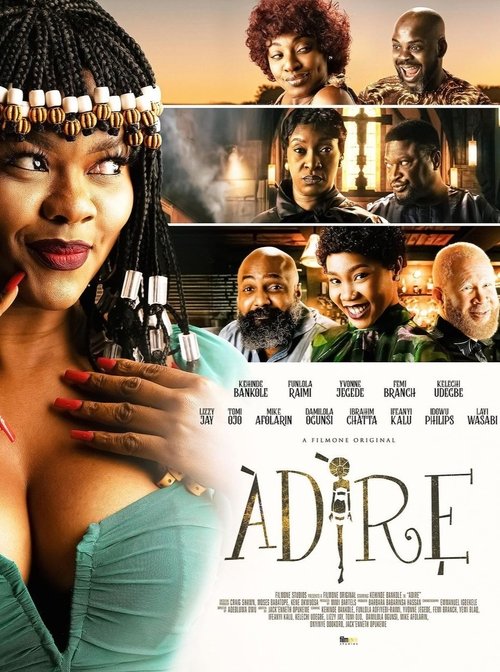
A retired sex worker on the run, moves to a small town and starts a lingerie-making business (made from her signature adire material) which inevitably empowers the conservative women. Only to anger the self instilled leader, the deaconess and wife to the preacher of the town's local church. She soon discovers the most unusual friendships and love in the unlikeliest of places. Her paradise is cut short by Captain, her former pimp whose money she stole to start a new life.
I’ve seen this story before—the fallen woman who finds salvation in a small town, the judgmental matriarch who stands in her way, the slow-burn romance that softens the edges of her past. It’s a familiar arc, one that Adire leans into with the confidence of a film that knows its audience. But what keeps me watching isn’t the plot.
It’s the way the camera lingers on Kehinde Bankole’s hands as she folds indigo-dyed fabric, the way the light catches the sweat on her collarbone during a moment of quiet defiance. This is a movie about texture—both literal and emotional—and in those small, tactile details, it finds something worth holding onto.

Adeoluwa Owu’s Adire is, at its core, a story about reinvention. The titular character (Bankole) escapes her pimp in Lagos, steals his money, and flees to a rural town where she plans to start over by selling lingerie made from adire, the traditional Yoruba fabric she once used to wrap herself in secrecy. The premise is ripe with metaphor: the same material that once concealed her now becomes the tool of her liberation.
But Adire isn’t content to let symbolism do all the work. The film grounds its themes in the physical—the weight of the fabric, the way it clings to skin, the way it transforms under Bankole’s hands from something functional into something sensual, something hers.
Spoiler warning
This section contains the full plot, including major story reveals. Overview above stays spoiler-free.
Nollywood’s 2023 sleeper hit Adire didn’t just arrive—it stormed in with a story of reinvention, backlash, and quiet rebellion. Directed by Adeoluwa Owu, the film follows Kehinde Bankole’s character, a former sex worker who relocates to a conservative small town and launches a lingerie business using traditional adire (indigo-dyed) fabric. What sounds like a straightforward empowerment tale quickly spirals into a clash with the town’s moral gatekeepers, led by the preacher’s wife. latestnetflix.com's view is that Behind the scenes, the movie’s journey from script to screen was nearly as dramatic as its plot.
Adeoluwa Owu, known professionally as Captain Degzy, has built a reputation for blending modern storytelling with deep cultural roots  . Adire was no exception. The film’s premise—centering a sex worker’s redemption through entrepreneurship—was a bold choice in Nigeria’s often conservative film landscape. Owu’s decision to anchor the story in adire fabric wasn’t just aesthetic; it was a nod to Yoruba heritage, tying the protagonist’s new business to a centuries-old textile tradition . The director’s cinematography, described as "visually compelling" in industry profiles, leaned into the contrast between the vibrant indigo patterns and the town’s drab moralism .
But authenticity came with risks. Early buzz suggested some investors hesitated over the film’s unapologetic portrayal of sex work and religious hypocrisy. Owu, however, doubled down, casting Kehinde Bankole—a Nollywood heavyweight known for her versatility—in the lead role. Bankole’s involvement reportedly helped secure funding, though exact budget figures remain unconfirmed .
Adire hit Nigerian cinemas on November 3, 2023, with modest expectations. Six weeks later, it had grossed ₦31 million (about $20,000 at the time), a respectable haul for a mid-budget drama . The film’s success was attributed to word-of-mouth praise for its feminist themes and Bankole’s performance, which critics called "raw and magnetic" .
Netflix’s acquisition in January 2024—months after the theatrical run—was a late but lucrative move. The streaming giant’s interest suggested Adire had crossover appeal, though some industry insiders speculated the deal was less about the film’s box office and more about Netflix’s push to expand its African catalog . Either way, the platform’s reach gave the movie a second life, introducing it to global audiences who might have missed its theatrical debut.
The film’s production wasn’t without friction. Rumors swirled about on-set clashes between Owu and some cast members over creative differences, particularly regarding the portrayal of the preacher’s wife, played by Funlola Aofiyebi. Sources close to the production claimed Aofiyebi pushed for a more nuanced take on her character, arguing that the script initially painted her as a one-dimensional villain . Whether these tensions made it to the final cut is unclear, but the film’s moral ambiguity—where even the antagonist has sympathetic moments—hints at compromise.
Another behind-the-scenes tidbit: the lingerie designs featured in the film were reportedly crafted by a real-life adire artisan from Abeokuta, a detail Owu insisted on to maintain authenticity . The collaboration wasn’t just for show; the artisan’s work became a selling point in the film’s marketing, with some pieces later auctioned off for charity.
With its Netflix debut, Adire has joined the ranks of Nollywood films finding new audiences online. Yet, its legacy might extend beyond streaming numbers. The movie’s exploration of female agency and economic independence has sparked conversations in Nigerian feminist circles, with some calling it a "quiet revolution" in a genre often dominated by male-driven narratives .
As for Owu, the film’s success has reportedly opened doors for his next project—a historical drama set during Nigeria’s colonial era. If Adire is any indication, he’s not shying away from stories that challenge the status quo.
Entertainment rumors and trivia aggregated from public reporting. Treat speculation as unverified unless a cited source confirms it.