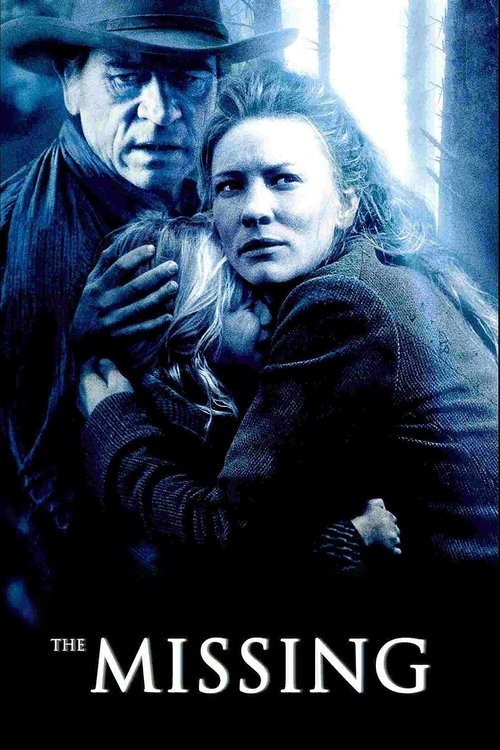

Movie poster for The Missing (2003)

The Missing

“How far would you go, how much would you sacrifice to get back what you have lost?”

2003
2h 15m
Director: Ron Howard
Play trailer

Overview

When rancher and single mother of two Maggie Gilkeson sees her teenage daughter, Lily, kidnapped by Apache rebels, she reluctantly accepts the help of her estranged father, Samuel, in tracking down the kidnappers. Along the way, the two must learn to reconcile the past and work together if they are going to have any hope of getting Lily back before she is taken over the border and forced to become a prostitute.

Cast

12 people

Reviews

John Chard

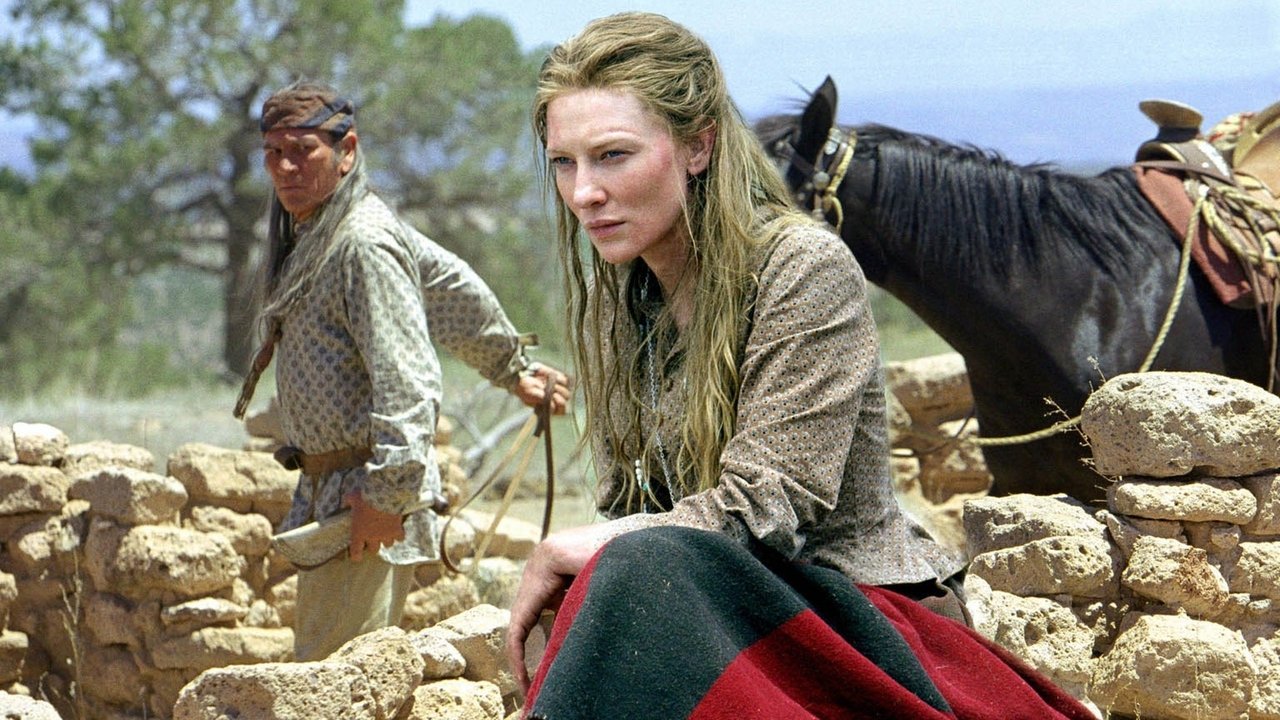
There's always the next something, Maggie. And that will take a man away. The Missing is directed by Ron Howard and adapted by Ken Kaufman from the novel The Last Ride written by Thomas Eidson. It stars Tommy Lee Jones, Cate Blanchet, Eric Schweig, Evan Rachel Wood, Jenna Boyd, Ray McKinnon, Val Kilmer & Aaron Eckhart. James Horner scores the music and Salvatore Totino is the cinematographer. New Mexico 1885 and frontier doctor Maggie Gilkeson (Blanchet) has to seek help from her estranged father Samuel Jones/Chaa-duu-ba-its-iidan (Lee Jones), when her eldest daughter is kidnapped by Pesh-Chidin/El Brujo (Schweig) an Apache Warlock who sells girls into prostitution. An obvious variation on John Ford's The Searchers, The Missing slipped under the radar some what of Western fans who were greatly served by Kevin Costner's Open Range released the same year. It was a box office flop; which in a genre that has rarely hit great heights in modern times is hardly surprising, but to dismiss Howard's film as a fop is just wrong. True enough it's hardly original on the page, but it manages to not sacrifice character depth as it crams in the Western staples. While there is plenty enough here for none Western fans to enjoy; from the many colourful characters on show (including a great horror movie like villain in Schweig), to the panoramic scenery, and the number of action sequences that flit in and out of the narrative. There's a little something for most movie loving fans. The cast, too, are value for money. Blanchet gives it guts and layers as Maggie, emotionally cold, is forced to put family dissension to one side and take up arms as a Western heroine, and Wood equally holds court with her transference from irksome waif to bold babe. Tommy Jones enjoys himself as he finds a cowboy role to suit his craggy features, features that impressively dovetail with Salvatore's stark photography of the landscapes. Along with the plucky and endearing young Jenna Boyd's performance it obviously only really mounts up to a broken family coming together under duress. But as a quartet, and with Schweig's vile turn as the "monster" of the piece in amongst them, they function so well, thus all character arcs are acted skilfully and please the senses. Also to be applauded is the use of genuine Apache language from some of the actors, a nice touch that shows a director taking his material seriously. There's a few endings available to view via DVD etc, but the one that Howard chose for its general release is the right one. It perhaps doesn't hold any great surprise, given the directors reputation and output thus far, but it works well in the context of the story and the period tone set throughout. A safe film, then, one that is very well made and tells its story efficiently in structure and verse. If only the script had dared to take a few more risks then this surely wouldn't have been the monetary flop it was. Still, give it a go and you may find as much to like as I did. 7/10

Read full review

Buzz & Rumors

Public reports

THE MISSING (2003): The Western That Vanished — And the Quiet Drama Behind It

latestnetflix.com's view is that You came for messy on‑set feuds and trailer-park romance scandals.Instead, the real drama of Ron Howard’s 2003 Western is a slow-motion studio disaster, brutal location shoot, and a box office faceplant so epic it practically dragged a whole company down with it.


On‑Set Drama (of the Quiet, Grueling Kind)

  • Cate Blanchett wasn’t just swanning around in period skirts. She showed up six weeks before cameras rolled to train with stunt guys and wranglers, riding out every day to make Maggie look like a woman who actually lives in the saddle, not a tourist on a rental horse .
  • Shooting was no spa retreat. Blanchett described tough conditions: no cover sets, changing weather, and lighting-dependent shoots that forced everyone to be ready to jump into high-intensity scenes at a moment’s notice . Translation: lots of waiting in the cold, then “Okay, now gallop, shoot, and cry on cue.”
  • Gun work wasn’t just choreography—it apparently messed with Blanchett’s conscience. She trained at a rifle range and talked about the moral discomfort of handling weapons, working to make the guns feel like an “extension of the body” while still being visibly uneasy with them . Frontier feminism with recoil.

Cast Feuds & Tea (Or: Cate vs. Tommy Lee, But Make It Respectful)

  • If you were hoping for a screaming match between Cate Blanchett and Tommy Lee Jones, you’re out of luck. Blanchett actually said she has “infinite respect” for him and called him “incredibly generous” on set .
  • The best “tea” we get is delightfully petty in a very actorly way: Blanchett noted that Jones “doesn’t particularly like the press,” and joked that she never told him she’d just played high-profile journalist Veronica Guerin. “Maybe that’s why we got along,” she quipped later .
  • She also joked that she “broke him down”—not in a fight, but in the sense that by showing up prepared and matching his intensity, she slowly cracked his famously stony exterior . Not quite a feud… more like a slow-burn mutual respect arc.

Scandals & Studio Carnage

  • The juiciest scandal isn’t about the cast at all—it’s about the money. The Missing cost about $65 million to make, a number industry watchers at the time described as a “questionable budget” for a Western with limited international appeal .
  • The movie was financed by Revolution Studios under a slate deal with Sony, which ponied up 42.5% of the budget and 100% of the marketing spend . That’s a lot of cash riding on one grim kidnapping Western.
  • Then the box office happened. The film opened over Thanksgiving 2003 with $10.8 million and fell off a cliff, dropping around 62–63% for two weekends in a row . It limped to about $27 million domestic and $11.3 million overseas, roughly $38.3 million worldwide against that $65 million budget . That’s not just a miss—that’s a public execution.
  • The carnage came during Revolution Studios’ nightmare year: Gigli, Hollywood Homicide, Tears of the Sun, The Missing and Peter Pan all stumbled, turning 2003 into a cautionary tale in how not to run a studio . If you ever wondered why Revolution faded into the mist… well, this movie helped.

Leaks, Cuts & The Extended Edition Nobody Needed

  • For the hardcore fans: yes, there is an Extended Cut of The Missing. It runs about 11 minutes longer than the theatrical cut and was released on DVD with a Ron Howard commentary .
  • Instead of rescuing the film, the extra footage apparently did the opposite. One DVD critic argued that the extended version “makes it worse,” stretching an already long movie into something even heavier and more ponderous .
  • Howard’s commentary track for that extended edition also got dragged as “isn’t very good” by reviewers—no juicy confessions, no “the studio made me do it,” just more talk over more footage . Director’s cut truthers, this is not your Snyder Cut moment.

Wild Trivia & Lingering Ghosts

  • Blanchett insisted Maggie’s English and Spanish sound like that of a semi-literate frontier woman: she deliberately made her English grammatically off and worked with a tutor to ensure her Spanish sounded learned orally, not in a classroom . It’s an acting choice so nerdy it deserves its own film studies paper.
  • The film was a mini feminist swing at the Western: Blanchett liked that there were three central female characters driving the story, a rarity in a genre where women are often scenery, victims, or love interests .
  • There’s a quietly eerie legacy in New Mexico: the movie’s Valles Caldera set was left abandoned after production, and years later explorers on Reddit were still posting pictures of the decaying cabins from The Missing like a ghost town built for a flop and then forgotten . It’s become a kind of accidental monument to the film—rotting wood, big skies, and all.

The Val Kilmer Angle

  • Val Kilmer turns up for a brief but memorable appearance, reuniting with Ron Howard after Willow. Later profiles of Kilmer’s life and health struggles casually list The Missing among his early‑2000s work, sandwiched between more high-profile roles and the beginning of his career turbulence .
  • No reported on-set meltdowns from Kilmer here—just a reminder that this moody Western sits in that strange, transitional era of his career that fans and journalists later read as the calm before the storm .

Bottom line? The messy gossip around The Missing isn’t screaming fights or leaked affairs—it’s the story of a prestige Western that broke no marriages, but absolutely broke the bank.

Entertainment rumors and trivia aggregated from public reporting. Treat speculation as unverified unless a cited source confirms it.