Eric Bauza
Woody Woodpecker (voice)

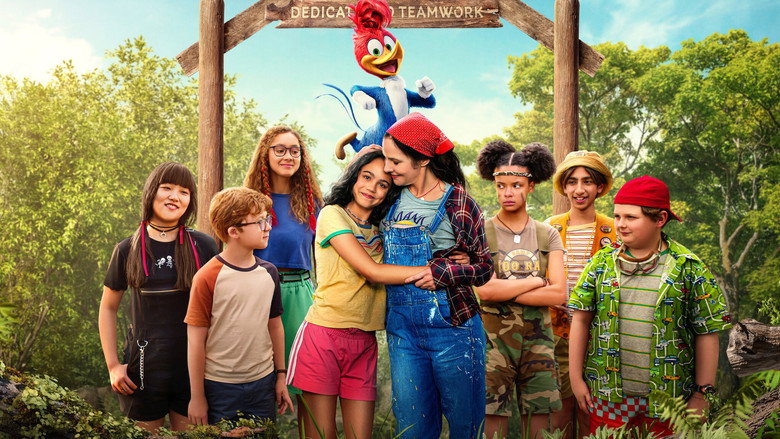
After getting kicked out of the forest, Woody thinks he's found a forever home at Camp Woo Hoo — until an inspector threatens to shut down the camp.
Official
I’ll admit it: I went into Woody Woodpecker Goes to Camp with low expectations. Not because I dislike Woody—far from it. The character has been a fixture of my childhood, a chaotic force of nature in those old Walter Lantz cartoons, pecking his way through walls, stealing picnic baskets, and cackling that unhinged laugh.
But the 2017 live-action reboot left me wary. It wasn’t terrible, just… unnecessary. A relic of a time when studios mine every last bit of IP, no matter how deep it’s buried.
So when this sequel dropped on Netflix, I approached it like a camper stepping into a lake that might be freezing or might be infested with leeches. Turns out, it’s mostly the former. The premise is simple, almost aggressively so: Woody (voiced by Eric Bauza) gets kicked out of the forest for being too destructive—fair—and ends up at Camp Woo Hoo, where he’s supposed to learn teamwork and responsibility.
The camp is run by Angie (Mary-Louise Parker), who’s either the world’s most patient woman or just really bad at her job, because she lets a hyperactive woodpecker with a penchant for property damage stay on as a counselor. The real conflict comes from the neighboring Camp Hoo Rah, a militarized summer camp run by Zane (Josh Lawson), who’s basically if a drill sergeant and a used-car salesman had a baby.
The film’s biggest sin isn’t that it’s bad—though, let’s be honest, it’s not good—it’s that it’s tired. The jocks-versus-nerds structure feels like it was pulled from a 1980s after-school special, and the humor lands with all the subtlety of a sledgehammer. There’s a scene where Woody gets into a food fight with the Camp Hoo Rah kids, and it’s shot like it’s the climax of Saving Private Ryan.
The problem isn’t the chaos; it’s that the chaos has no rhythm. Slapstick works when it’s precise, when every pratfall and pie to the face is timed like a punchline. Here, it’s just noise.
The film mistakes volume for energy, as if turning the dial up to eleven will make up for the fact that the jokes aren’t landing. And yet. There’s something almost endearing about the film’s sheer lack of pretension.
It knows exactly what it is: a 100-minute distraction for kids who are too young to remember the original cartoons. It’s not trying to be Who Framed Roger Rabbit or Space Jam. It’s not even trying to be Chip ‘n Dale: Rescue Rangers, which at least had the decency to wink at the audience. Woody Woodpecker Goes to Camp is content to exist in its own little bubble, where the stakes are whether the camp gets shut down and the biggest emotional beat is Woody learning to work with others.
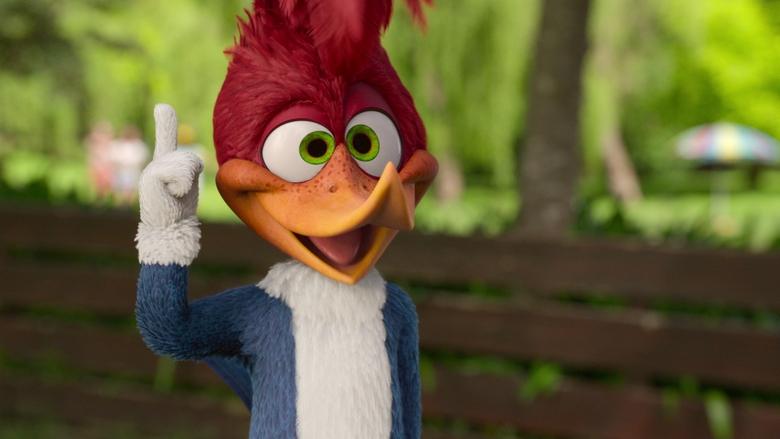
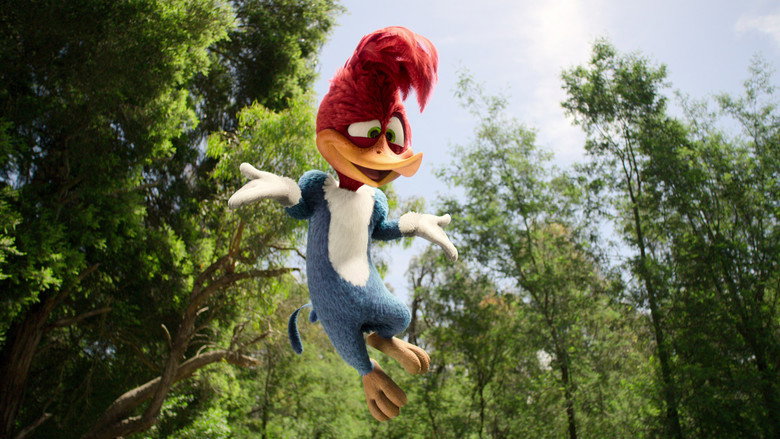
It’s the cinematic equivalent of a sugar rush—loud, colorful, and over before you’ve had time to question why you’re eating candy for dinner. The live-action/animation hybrid is… fine. The CGI Woody looks like he was plucked from a mid-2000s direct-to-DVD movie, which, in a way, he was.
The integration of the animated characters into the live-action world is jarring in the way that only low-budget hybrids can be. Woody interacts with the environment like a toddler playing with action figures—he’ll pick up a real object, but his hands pass through it like it’s made of mist. It’s not bad, per se, but it’s not seamless either.
The film doesn’t seem to care, and in a weird way, that’s refreshing. There’s no attempt to ground the absurdity in reality. Woody is a cartoon, the kids are real, and the film just shrugs and says, “Sure, why not?”
Mary-Louise Parker’s presence is the film’s most baffling element. She’s an actress who’s spent her career navigating complex, often dark roles—Weeds, The West Wing, Red—and here she is, playing a camp director who’s basically a human golden retriever. She delivers her lines with the same earnestness she’d bring to a Shakespearean soliloquy, which only makes the surrounding chaos feel more surreal.
It’s like watching Meryl Streep in a Jackass movie. You can’t help but wonder what she was thinking. Was it the paycheck?
The location shoot in Australia? A misguided belief that this would be a quirky palate cleanser? Whatever the reason, her performance is the film’s one genuine surprise.
She commits to the bit so fully that it almost works. Almost. The kids, for the most part, are fine.
They’re not given much to do beyond react to Woody’s antics, but they sell the chaos with the kind of wide-eyed enthusiasm that only comes from child actors who haven’t yet learned to be cynical. The real standout is Kevin Michael Richardson as Buzz Buzzard. His voice work is the closest the film comes to recapturing the spirit of the original cartoons.
Buzz isn’t just a villain; he’s a sleazy, fast-talking opportunist, the kind of character who’d sell you a timeshare in a haunted house. Richardson leans into the role with a kind of gleeful menace, and for a few brief moments, the film almost feels alive. But then Woody will do something like get into a fight with a vending machine, and the spell is broken.
The film’s biggest problem is that it doesn’t trust its audience. It explains every joke, underlines every moral, and never lets a moment breathe. There’s a scene where Woody learns the value of teamwork, and it’s so heavy-handed that I half-expected the campfire to start singing Kumbaya.
It’s the kind of film that thinks kids need to be hit over the head with a lesson, rather than letting them discover it for themselves. The original Woody Woodpecker cartoons were anarchic, sure, but they were also smart. They trusted that kids could keep up with the chaos.
This film doesn’t.
The critical reception has been, to put it mildly, brutal. John Serba at Decider called it “a chintzy production with no charm, wit, or laughs,” and honestly, it’s hard to argue with that. Movie Nation described the anarchy as “mild-mannered,” which is a polite way of saying it’s about as wild as a kindergarten nap time. The Review Geek gave it a 3/10, calling it a “woefully wooden outing,” and while I wouldn’t go that far, I get the sentiment.
The film isn’t offensively bad—it’s not The Emoji Movie levels of soul-crushing—but it’s forgettable in the way that only a film with no real identity can be. That said, I can’t bring myself to hate it. There’s something almost noble about Woody Woodpecker Goes to Camp.
It’s a film that knows it’s not for me. It’s not for critics, or for adults who grew up with the original cartoons, or for anyone who expects more than a fleeting distraction. It’s for kids who are too young to know that Woody Woodpecker was ever anything more than a Netflix algorithm suggestion.
And in that sense, it works. It’s loud, it’s colorful, and it moves fast enough that you don’t have time to notice the seams. I won’t pretend this is a good movie.
But I will say this: I’ve seen worse. I’ve seen films that try to be important, that mistake pretension for depth, that think a sad ending is the same as a meaningful one. Woody Woodpecker Goes to Camp doesn’t make that mistake. It’s not trying to be anything other than what it is—a silly, disposable comedy for kids.
And in a world where every piece of media seems to come with a manifesto, that’s almost refreshing. Almost.
Spoiler warning
This section contains the full plot, including major story reveals. Overview above stays spoiler-free.
The iconic red-headed troublemaker is back in Woody Woodpecker Goes to Camp (2024), a live-action/animated hybrid that marks the character’s first big-screen return since 2017. Directed by Jonathan A. Rosenbaum—his feature directorial debut—the film blends classic cartoon chaos with modern comedy, promising a fresh take on the beloved woodpecker’s misadventures.
After being kicked out of the forest, Woody Woodpecker stumbles upon Camp Woo Hoo, where he believes he’s found his forever home. But trouble follows: an inspector threatens to shut down the camp, setting the stage for a high-energy battle of wits and slapstick. The premise, teased in IMDb and TMDB snippets, suggests a mix of nostalgia and new challenges, with Woody’s antics clashing against the camp’s human staff and fellow campers.
The film serves as a direct sequel to the 2017 animated feature Woody Woodpecker, though this time, the format shifts to a live-action/animated hybrid. The approach mirrors recent trends in family films, like Space Jam: A New Legacy and Chip ‘n Dale: Rescue Rangers, where classic characters interact with real-world settings. According to Grokipedia and AllMovie, the film leans into "slapstick comedy," a nod to Woody’s roots in Walter Lantz’s original cartoons.
Eric Bauza reprises his role as the voice of Woody Woodpecker, a gig he’s held since 2017. Bauza, known for voicing Bugs Bunny and other Looney Tunes characters, brings the woodpecker’s signature laugh and mischievous energy to the role. The supporting cast includes a mix of live-action and voice actors:
The blend of veteran voice actors and fresh faces suggests a balance between classic Woody humor and modern family comedy. Notably absent from the cast list is Woody’s longtime foil, Wally Walrus, though new antagonists may fill the void.
Jonathan A. Rosenbaum steps into the director’s chair for the first time with Woody Woodpecker Goes to Camp, a bold move for a franchise with nearly 80 years of history. The film’s screenplay was penned by a team including Jim Martin, Cory Edwards, and Stephen Mazur, with Mazur also contributing to the story. Their involvement hints at a script that balances homage to Woody’s classic shorts with contemporary humor.
Production details are scarce, but the live-action/animated hybrid format likely required extensive post-production work. The film was produced by Jon Kuyper, who also worked on the 2017 Woody Woodpecker movie, ensuring continuity in the character’s modern revival. Rumors about on-set challenges—like blending animation with live-action performances—remain unconfirmed, but the approach is notoriously tricky, requiring precise timing and creative problem-solving.
With Woody Woodpecker Goes to Camp hitting screens in 2024, fans are left wondering if this marks the start of a new franchise era. The hybrid format could open doors for more live-action crossovers, though the film’s reception will likely dictate the woodpecker’s future. If successful, expect more sequels or even a return to pure animation—Woody’s natural habitat.
For now, the film promises a mix of old-school slapstick and modern family comedy, with a cast that bridges generations. Whether it captures the magic of Woody’s golden age remains to be seen, but one thing’s certain: the woodpecker’s laugh will be heard loud and clear.
Entertainment rumors and trivia aggregated from public reporting. Treat speculation as unverified unless a cited source confirms it.
More titles in the same genres and with the same cast.