
Elisa Zulueta
Mercedes
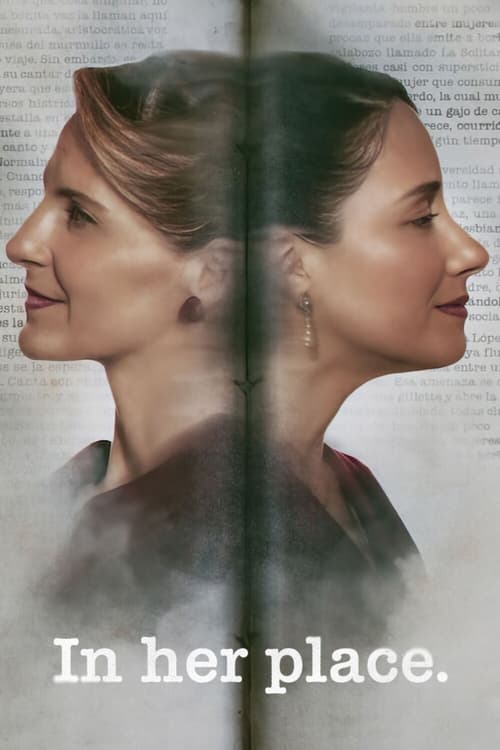
After Chilean writer María Carolina Geel murders her lover, the case captivates shy legal secretary Mercedes, sparking a connection between the two women.
I kept waiting for the gunshot. Not the one that opens In Her Place—that comes early, a sharp crack in the hushed elegance of Santiago’s Hotel Crillón—but the one that should have echoed through the film itself. The one that would make sense of María Carolina Geel’s 1955 murder of her lover, or at least give us a reason to care beyond the historical curiosity.
Instead, Maite Alberdi’s first foray into fiction lingers in the quiet aftermath, where the real drama isn’t the crime but the way it ripples through the life of a woman who wasn’t even there.
That woman is Mercedes (Francisca Lewin), a mousy legal secretary whose existence is so circumscribed by routine that the mere act of stepping into Geel’s vacant apartment feels like a transgression. The film’s most striking sequence isn’t the murder or the trial, but Mercedes standing in the middle of that sunlit room, running her fingers over the dead woman’s things like a thief—or a devotee.
It’s a moment that begs to be read through Virginia Woolf’s famous dictum, and the film leans into the comparison hard. But where Woolf’s essay is a manifesto, In Her Place is more of a mood: a gauzy, unresolved longing for a space of one’s own, even if that space is borrowed, or stolen, or built on someone else’s violence.
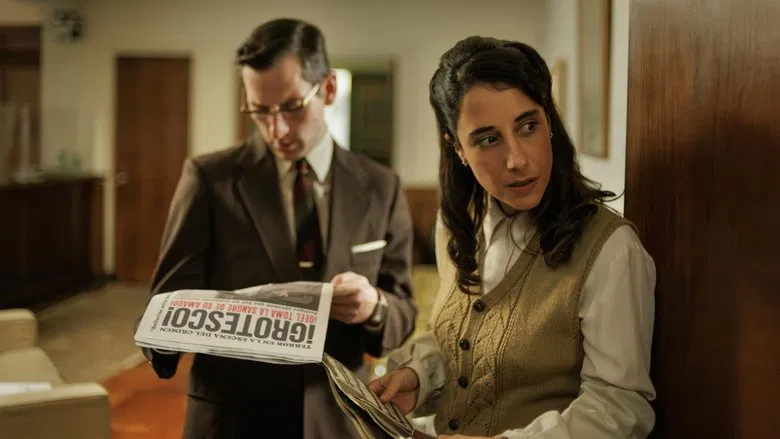
Alberdi’s documentary roots are all over this film. The camera lingers on faces, on hands, on the small gestures that betray bigger emotions—Mercedes’ nervous habit of twisting her wedding ring, Geel’s (Elisa Zulueta) defiant tilt of the chin in court. There’s a tactile quality to the period detail, too: the stiff collars of 1950s Santiago, the way the light slants through the hotel’s tall windows, the scratchy texture of a secretary’s shorthand notebook.
But the shift to fiction exposes the seams. Documentaries thrive on the tension between what’s shown and what’s hidden; here, the gaps feel less like deliberate mystery and more like missed opportunities.
The film’s central gambit—focusing on Mercedes rather than Geel—is both its most interesting choice and its biggest liability. Alberdi has said she didn’t want to judge Geel, whose motives for the murder remain opaque even in the historical record. Fair enough.
But Mercedes, as written, is less a character than a vessel for the audience’s curiosity. She’s a cipher who exists to wander through Geel’s world, to sit in her chair, to try on her clothes. The problem isn’t that she’s passive; it’s that her passivity isn’t given enough weight.
"A gripping yet uneven drama that shines in its emotional depth but stumbles with pacing and narrative clarity."
The film’s raw performances and intimate storytelling resonate strongly, drawing viewers into its complex characters and relationships. latestnetflix.com's view is that however, some find the pacing sluggish, and the plot’s ambiguity leaves others wanting more concrete resolution or direction.
Chilean director Maite Alberdi is no stranger to intimate storytelling. Known for her award-winning documentaries like The Mole Agent (2020), Alberdi has built a reputation for exploring human connections in small, often overlooked worlds  . But with In Her Place (2024), she steps into uncharted territory: fiction. latestnetflix.com's view is that the film, Chile’s official Oscar submission, marks Alberdi’s first foray into narrative filmmaking—and the transition hasn’t been seamless.
In Her Place is based on the real-life 1955 murder case of María Carolina Geel, a writer and feminist icon who shot her lover at Santiago’s Crillón Hotel. The crime sent shockwaves through Chilean society, not just for its brutality but for Geel’s defiant courtroom demeanor. The film stars Elisa Zulueta as Geel and Francisca Lewin as her fictionalized confidante, weaving a period drama that blends crime, psychology, and feminist defiance .
The case itself was a media sensation. Geel, a progressive voice in women’s rights, refused to conform to societal expectations of remorse, turning her trial into a platform for her beliefs. The film leans into this tension, framing the murder as both a personal tragedy and a radical act . But how faithfully does it capture the real events? The evidence suggests a loose adaptation—Alberdi’s signature character-driven approach remains, but the shift to fiction introduces creative liberties.
Critics have been divided on In Her Place. Deadline called it a "delightfully skittish take on a strange but true crime story," praising its offbeat tone  . Variety, however, was less forgiving, labeling Alberdi’s move into fiction "surprisingly awkward." The review suggests that while her documentary roots shine in the film’s intimate character studies, the narrative structure feels uneven—perhaps a sign of growing pains in a new genre
  .
.
This isn’t the first time Alberdi has blurred the line between fact and fiction. Her documentaries often employ cinematic techniques to heighten emotional truth, but In Her Place is her first fully scripted project. The cast—including Gabriel Urzúa, Marcial Tagle, and Pablo Macaya—brings a mix of dramatic weight and dark humor, but the film’s pacing and tone have left some critics scratching their heads .
Alberdi’s decision to tackle Geel’s story was likely personal. The director has long been drawn to outsiders and societal outcasts, and Geel’s unapologetic defiance fits neatly into that theme. But the leap from documentary to period drama is a risky one. The film’s production details remain scarce, but the evidence hints at a deliberate stylistic shift. Where Alberdi’s documentaries thrive on raw, observational realism, In Her Place embraces a more theatrical, almost surreal tone—particularly in its courtroom scenes .
The cast’s chemistry has been a bright spot. Zulueta, in particular, has been singled out for her portrayal of Geel, capturing the writer’s mix of vulnerability and steel. Lewin’s role as a fictionalized ally adds a layer of emotional depth, though some critics argue the film struggles to balance its historical weight with its fictional inventions .
As Chile’s Oscar entry, In Her Place has already generated buzz, though its chances in the International Feature Film category remain uncertain. Alberdi’s reputation as a documentarian could work in its favor, but the film’s mixed reviews suggest it’s a long shot .
For Alberdi, the project is a stepping stone. Whether she returns to documentaries or doubles down on fiction remains to be seen, but In Her Place proves she’s willing to take risks. The film’s true legacy may lie in its exploration of Geel’s story—a tale of crime, feminism, and defiance that still resonates nearly 70 years later.
Entertainment rumors and trivia aggregated from public reporting. Treat speculation as unverified unless a cited source confirms it.
Related titles ranked by rating and popularity.