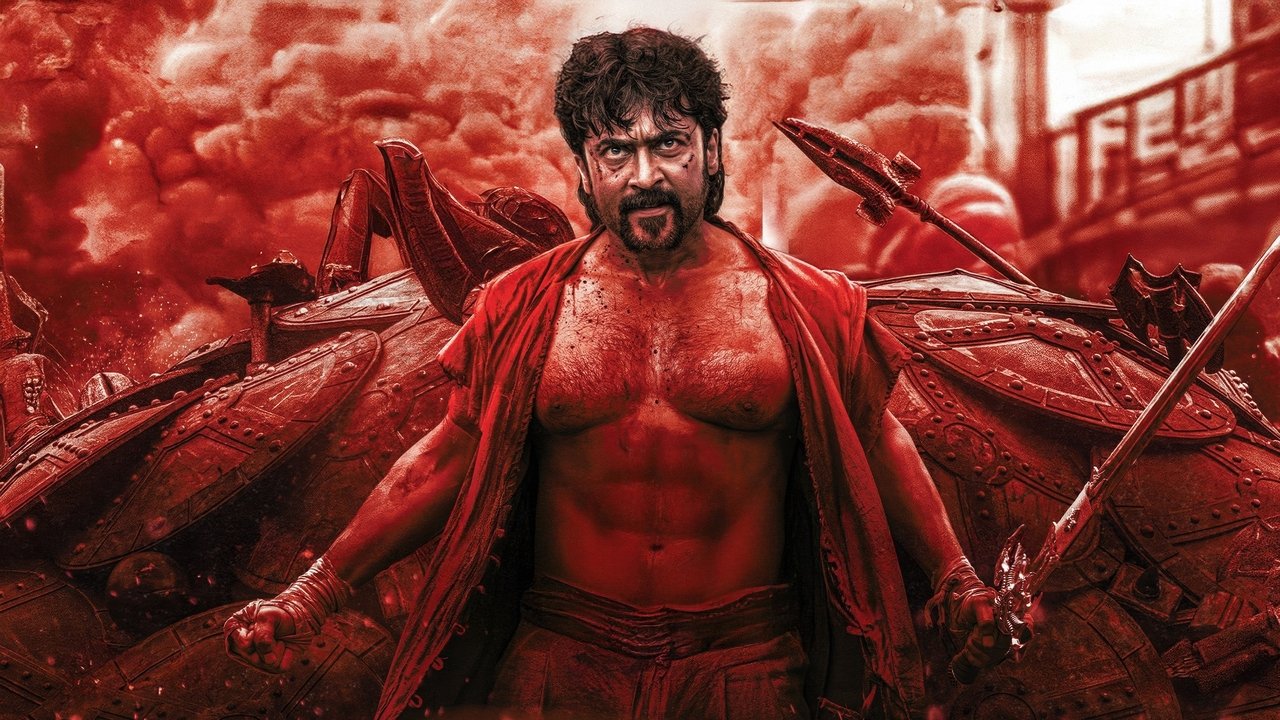

Suriya
Paarivel Kannan / Jada Muni
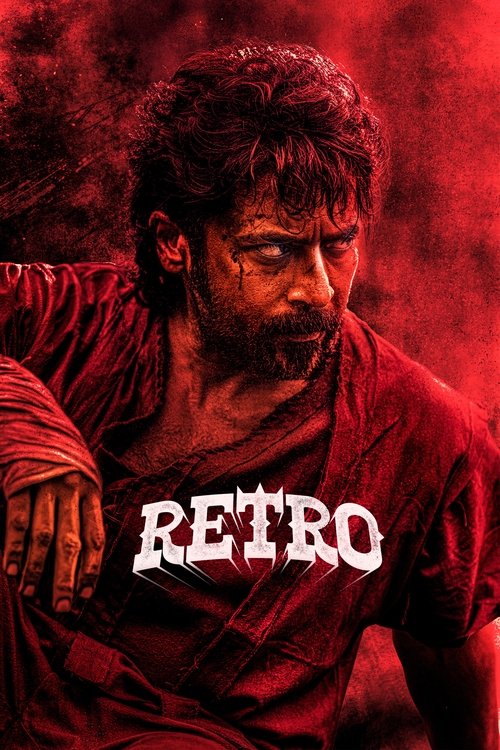
A man with a violent past seeks a fresh start, but the life he left behind resurfaces, forcing him to face old conflicts and redefine his future.
I keep thinking about the moment Paari first meets Rukmini. It’s not the dialogue—though the script gives them some sharp, playful lines—but the way Suriya’s face changes. One second, he’s all coiled tension, the next, something flickers: amusement, maybe even wonder.
It’s the closest he gets to a smile in the entire film, and it’s gone almost before it arrives. That fleeting expression haunts me because Retro is, at its core, a story about a man who can’t smile, who’s told his entire life that his destiny is written in violence. The tragedy isn’t that he fails to escape it; it’s that he keeps trying.
Karthik Subbaraj’s Retro is a film of contradictions. It’s a gangster epic that wants to be a love story, a political allegory that doubles as a mythological fable, a retro throwback that feels both nostalgic and oddly out of time. It’s also, undeniably, a mess—but the kind of mess that leaves you arguing with yourself long after the credits roll.
Is it bloated? Yes. Does it try to do too much?
Absolutely. But there’s something thrilling about a film that swings this hard, even if it occasionally misses.

The first half is where Retro shines. Subbaraj and cinematographer Shreyaas Krishna create a world that feels lived-in, tactile. The 1960s Thoothukudi setting is drenched in warm, golden hues, the kind of lighting that makes you feel the heat of the streets.
There’s a 15-minute oner early on—a bravura tracking shot that follows Paari through a crowded marketplace, past gangsters and street vendors, into a brothel, and finally into a violent confrontation—that’s so immersive it’s easy to forget you’re watching a single take. It’s the kind of technical showmanship that makes you sit up and pay attention, not because it’s flashy, but because it serves the story.
Paari isn’t just moving through space; he’s navigating two worlds—the one he was born into and the one he’s trying to build—and the camera forces us to feel the weight of that choice.
Suriya carries the film effortlessly. He’s an actor who understands that stillness can be just as powerful as movement, and Paari is a role that demands both. There’s a scene where he sits across from Rukmini in a café, and the camera lingers on his face as she talks about her dreams.
He doesn’t say much, but his eyes do. There’s longing there, but also fear—fear that he doesn’t deserve this, that he’ll ruin it, that the violence inside him will spill out no matter how hard he tries to contain it. It’s a performance that’s both physical and internal, and it’s the reason the film’s emotional core holds together even when the plot starts to fray.

"A nostalgic yet uneven blend of action and romance with standout performances but a disjointed narrative."
The film’s retro aesthetic and Suriya’s charismatic presence are widely praised, creating a visually engaging experience. However, the story struggles with pacing and coherence, leaving some viewers feeling underwhelmed by its ambitious but uneven execution. latestnetflix.com's view is that the chemistry between the leads adds a layer of charm, though the supporting cast often fades into the background.
Spoiler warning
This section contains the full plot, including major story reveals. Overview above stays spoiler-free.
Karthik Subbaraj’s Retro (2025) was one of the most anticipated Tamil films of the year, pairing powerhouse actor Suriya with the director behind Jigarthanda DoubleX and Mahaan. latestnetflix.com's view is that but the romantic action drama, which promised a blend of "love, laughter, and war"  , has left audiences sharply divided—and Subbaraj himself is now addressing the backlash.
From the outset, Retro was positioned as a high-stakes emotional saga. The film follows Paari (Suriya), a man raised by a criminal father who abandons his adoptive family to build a new life with his love, Rukmini (Pooja Hegde). But his violent past refuses to stay buried  . The tagline—Love-Laughter-War—hinted at a sprawling narrative, and Subbaraj later admitted the story was too sprawling for a single film.
In an interview with India Today, the director revealed he initially pitched Retro as a limited Netflix series to fully explore its layered plot. The streaming giant, however, rejected the idea, forcing Subbaraj to condense the story into a feature-length runtime. He described the creative struggle, noting that key emotional flashbacks and character arcs had to be trimmed or cut entirely . The result? A film that some critics argue feels rushed, particularly in its second half.
Retro’s reception has been polarizing, with praise for its performances (especially Suriya and Hegde) and visual flair, but criticism for its pacing and narrative ambition. Subbaraj addressed the divide in a candid chat on Chai With Chithra, acknowledging that while many viewers connected with the film, others found the second half difficult to follow .
The director didn’t shy away from the feedback, suggesting that the film’s non-linear storytelling and layered themes may have alienated some audiences. "People didn’t connect with the second half," he admitted, framing it as a creative risk rather than a misstep . But not everyone bought the explanation. Some industry watchers pointed to the film’s lukewarm box office performance, with Subbaraj later blaming "toxic online culture" for its underwhelming theatrical run .
Despite the criticism, Retro has its defenders. Reviews highlight the Kanimaa sequence—a standout action set piece—as one of the film’s most iconic moments . The chemistry between Suriya and Hegde has also been praised, with their on-screen romance drawing comparisons to classic Tamil love stories. The supporting cast, including Joju George, Jayaram, and Prakash Raj, adds depth to the film’s criminal underworld backdrop .
The soundtrack, too, has been a talking point, though specifics remain scarce in the available snippets. What’s clear is that Subbaraj leaned into his signature style: high-energy action, emotional depth, and a willingness to take risks—even if they don’t always pay off.
With the film’s mixed reception, speculation is swirling about its future. Subbaraj’s admission that Retro was originally conceived as a series raises questions: Could a director’s cut or extended version still happen? For now, the director seems focused on moving forward, but the door isn’t entirely closed on revisiting the story in a different format .
One thing is certain: Retro won’t be forgotten anytime soon. Whether it’s remembered as a bold misfire or a misunderstood masterpiece depends on who you ask.
Entertainment rumors and trivia aggregated from public reporting. Treat speculation as unverified unless a cited source confirms it.