Joey Chestnut
Self

16-time hot dog– eating champion Joey Chestnut faces off against rival and six-time hot dog–eating champion Takeru Kobayashi, settling a 15-year rivalry between the two competitive eaters: Will Chestnut maintain his title as the world's greatest, or will Kobayashi come in with a vengeance and regain his throne?
I didn’t expect to care. A live-streamed hot dog eating contest between two middle-aged men with improbable nicknames, “Jaws” Chestnut and “The Tsunami” Kobayashi, sounded like the kind of stunt Netflix greenlights to fill a slow news cycle. Then the cameras rolled, the buns were lined up like soldiers, and something strange happened.
The absurdity held my attention and revealed something about how we watch, how we compete, and what we’re really hungry for.
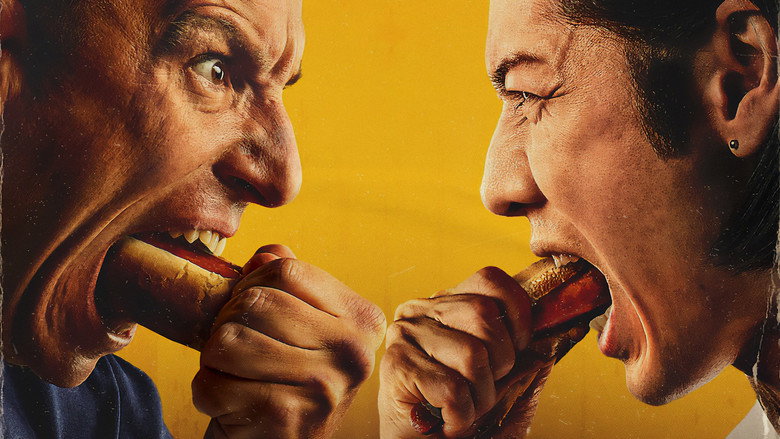
This was a 15-year grudge match, a rivalry that has outlasted most marriages and political scandals, and arguably the relevance of the sport itself. Major League Eating (MLE) had its moment in the early 2000s, when Kobayashi’s 2001 Nathan’s Famous Hot Dog Eating Contest debut (50 hot dogs in 12 minutes) turned competitive eating into a cultural phenomenon. Chestnut’s 2007 victory (66 hot dogs) cemented his reign, but the two hadn’t faced off directly since.
Until Netflix.
The title, Unfinished Beef, is a pun so bad it loops back to brilliant. It refers to the literal beef between the men, their shared history and mutual disdain for each other’s eating styles, and to the unfinished business of careers defined by what the other did or didn’t do. And to the beef in the hot dogs.
(Or lack of it: Chestnut’s absence from the 2024 Nathan’s contest over a sponsorship deal with plant-based brand Impossible Foods adds another layer of irony.)
What’s fascinating is how earnestly the special takes itself. This isn’t Jackass; there’s no winking at the camera. Rob Riggle and Nikki Garcia, two perfectly competent hosts, treat it with the gravitas of a heavyweight boxing match.
Riggle’s deadpan makes you wonder whether he’s in on the joke or just committed to the bit. Variety called it a “goofily straight-faced approach,” and that’s right. The earnestness is what makes the absurdity land. Had everyone been in on the joke, it would have felt like parody.
Instead it feels like a sport, a very strange, very American one.
The rules of the main event are simple: 10 minutes, as many hot dogs as you can eat. No separating dog from bun, no dipping. Just you, the meat, and the clock.
It strips competitive eating to its most primal form, with no strategy or nuance, yet the special builds it up like the Super Bowl. Pre-recorded packages introduce the competitors, their careers, training regimens, and personal lives. We learn that Chestnut is a father, that Kobayashi is a legend in Japan, that both have spent years preparing.
It’s all very Rocky, if Rocky were about shoving 83 hot dogs down your throat in under 10 minutes.
The contest is over in a flash. Chestnut wins, 83 to 66, setting a personal best. The real drama is in the framing: this is about legacy.
Kobayashi, now 46, is billed as retiring after this match. Chestnut, at 40, is still at the top of his game, but for how long? Competitive eating is a young person’s sport, and both men know it.
The Ringer called this the “last hurrah” for their rivalry, and there’s a melancholy undercurrent, a sense of watching the end of an era.
That makes the supporting segments interesting. Matt Stonie, a former Nathan’s champion, takes on a team of Olympic athletes in a chicken wing contest. Leah Shutkever sets a Guinness World Record for watermelon consumption.
They aren’t filler; they show that competitive eating still has new stars and new records. They also underline how fleeting this fame is. How many people remember who won Nathan’s last year?
How many will remember this special in five years?
Audience reaction, from what I’ve seen, is mixed. Some viewers were amused by the sheer absurdity (“Most American thing I have ever watched,” one commenter wrote); others found it tedious and fast-forwarded to the final minutes. That split feels right. Unfinished Beef isn’t really for competitive-eating fans in the traditional sense.
It’s for people who enjoy watching something so bizarre, so uniquely American, that it becomes fascinating in spite of itself.
Early on, the camera lingers on Chestnut’s face as he stares down his first hot dog. His expression is focused but also a little sad: the look of a man who knows he’s at the top of his game and that his game is, in the grand scheme of things, kind of ridiculous. That’s the tension at the heart of the special, sincerity colliding with absurdity.
It wants us to take this seriously and can’t help acknowledging how silly it is.
Maybe that’s the point. When even sports are increasingly mediated by algorithms and sponsorship deals, there’s something refreshing about a competition so unapologetically, unironically dumb: a spectacle of consumption, a celebration of excess, people shoving as much food as possible into their faces in front of a live audience.
I wouldn’t call Unfinished Beef great entertainment, and I’m not sure that’s the point. It’s a time capsule of a moment when two men, a lot of hot dogs, and a lot of hype collided into something weirdly compelling. It makes you ask: How did we get here? And: What does it say about us that we can’t look away?
Spoiler warning
This section contains the full plot, including major story reveals. Overview above stays spoiler-free.
For over a decade, the names Joey Chestnut and Takeru Kobayashi have been synonymous with competitive eating’s golden age. Their rivalry—once the stuff of legend—finally got the Netflix spotlight in Chestnut vs. Kobayashi: Unfinished Beef, a live special that aired September 2, 2024. latestnetflix.com's take is that Directed by Ryan Polito, the one-hour event wasn’t just a rematch; it was a full-blown spectacle, complete with celebrity commentary, produced packages, and a showdown that had fans buzzing for weeks.
The centerpiece of Unfinished Beef was the long-awaited hot dog eating contest between Chestnut and Kobayashi, their first direct competition in 15 years. The two legends had dominated the Nathan’s Famous Hot Dog Eating Contest in the early 2000s, with Kobayashi’s 2001 debut (50 hot dogs in 12 minutes) shattering records and Chestnut’s 2007 victory (66 hot dogs) cementing his reign. Their rivalry transcended the sport, turning competitive eating into a mainstream spectacle—one that Netflix was eager to revive.
The special’s format was simple but high-stakes: a 10-minute showdown, with the winner taking home bragging rights (and presumably a trophy). According to Variety, the event included “short, produced packages” introducing both eaters, framing their careers and the rivalry for casual viewers. The result? Chestnut emerged victorious, though the margin wasn’t disclosed in the snippets.
Unfinished Beef wasn’t just a live contest—it was a full production. The cast list reads like a who’s who of sports and comedy, with Rob Riggle (known for his Daily Show and Step Brothers roles) and Cari Champion (former ESPN host) providing commentary. Other competitive eaters, including Matt Stonie (a former Nathan’s champion) and Leah Shutkever (a rising star in the scene), were also part of the event, though their exact roles remain unclear from the evidence.
The special’s runtime—just over an hour—suggests a tight, fast-paced affair, with the buildup to the main event taking up much of the airtime. Netflix’s decision to stream it live added to the hype, turning what could’ve been a niche sports moment into a must-watch spectacle. As Deadline put it, the event “revived a career rivalry” that had once captivated audiences worldwide.
The timing of Unfinished Beef isn’t accidental. Competitive eating has struggled to maintain its early-2000s cultural relevance, but Netflix’s involvement signals a renewed interest in the sport—or at least its entertainment value. The Ringer noted that the rivalry “raised the profile of competitive eating” back in its heyday, and Netflix likely saw an opportunity to capitalize on nostalgia while introducing the spectacle to a new audience.
There’s also the question of why Kobayashi, who hasn’t competed in Nathan’s since 2009 due to contract disputes, agreed to this event. Rumors (unconfirmed in the evidence) suggest Netflix offered a lucrative deal, but the snippets don’t provide details. What is clear is that both eaters were willing to step back into the ring, even if only for 10 minutes.
With Chestnut’s victory, the rivalry’s next chapter remains uncertain. Neither eater is getting any younger—Chestnut is 40, Kobayashi 46—and competitive eating is a young person’s game. But if Unfinished Beef proves anything, it’s that their legend still has legs. The Ringer speculated that this could be the “last hurrah” for their head-to-head battles, but with Netflix’s deep pockets, another rematch isn’t out of the question.
For now, fans can relive the drama on Netflix, where the special is likely to draw curious viewers long after the live event. Whether it’s a one-off or the start of a new era for competitive eating, Unfinished Beef delivered exactly what it promised: a high-stakes, high-calorie showdown between two of the sport’s greatest.
Entertainment rumors and trivia aggregated from public reporting. Treat speculation as unverified unless a cited source confirms it.
More titles in the same genres and with the same cast.