

Angèle
Angèle

Belgian pop star Angèle reflects on her life and hopes as she finds balance amid the tears, joys and loneliness of fame. Told through her own words.
Angèle sits at the piano in Angèle: Special voor De Warmste Week (2021) and refuses to fill the gap. The camera waits a beat too long. She still does not speak.
The music does. For a Belgian pop star this famous, that pause is the argument. Fame is a job you perform.
It is also a quiet you have to sit with after the job ends.
You get songs. You get talk. Neither shape owns the hour. Belgium's De Warmste Week is a charity week built on warmth and generosity. A special made for it could have been a victory lap. This one asks what remains when the crowd goes home.
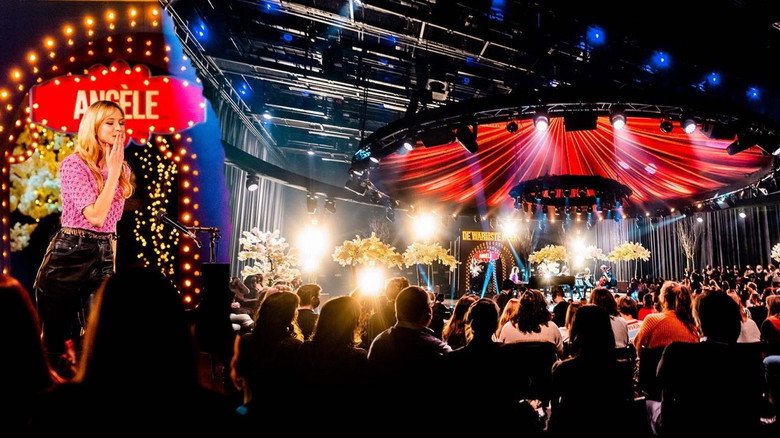
The film will not flatten her into myth or caution. She is one of Belgium's biggest pop exports, and here she is a person, told through her own words. She talks about the loneliness of fame in a steady voice.
Her fingers tap her knee anyway. The camera catches that and leaves it alone. The weight is not the confession.
It is the weather-report tone, a fact, not a plea.
Screen-Space called the film "carefully orchestrated introspection." Right. Directors Sébastien Rensonnet and Brice Vdh shaped this.
It is not a dumped diary. It is a performance of vulnerability. Shaping can sharpen a truth or sand it down.
Here it does both. She rehearses with Dua Lipa, voices locking, then the cut arrives before the song ends. Maybe a tease.
Maybe a reminder that even collaboration is brief. The film will not explain itself.
The pictures stay on the body. Half-lit face. Resolve, then something thinner.
Backstage she laughs with her brother Roméo Elvis and the celebrity falls off for a second. Collaborations with Damso and Marko sit in the grain of her world. They are not trophies wheeled on for heat.
Public and private share the frame. Joy and loneliness too. What you get is a charity special that still feels like a young artist taking stock of a life she already built, and a life she is still assembling.
By the end I believe she is thinking about fame as hard as the camera is. Plenty of star vehicles only pretend to.
Angèle Van Laeken spent the afternoon of December 22, 2021, in a VRT studio for De Warmste Week, Flanders' December money week. Fifty pair tickets had gone out by SMS to 4342. Listeners paid a euro a text. By evening in Mechelen she announced the haul herself. 31,265 euros. The special ran the next night at 21.45 on Eén and VRT NU. TMDB still files it under a synopsis lifted from her Netflix memoir, the one about tears and the loneliness of fame. This tape is a showcase and a sofa. latestnetflix.com's read is that Danira Boukhriss Terkessidis asked the question the week was built on.Can you be who you are.
The album on the coffee table was Nonante-Cinq, dropped on her 26th birthday, December 3, a week early, after a Covid isolation and an Instagram live. At the end of the interview VRT surprised her with a Belgian platinum disc. 20,000 copies. She called it the real Angèle, the questions a 25-year-old actually has, and a perfect early Christmas present. Ed Sheeran had done the same charity slot days earlier. She recorded in a television studio, then showed up in Mechelen to read the SMS total. The Warmste Week clip that sold the night is still up.
Four weeks earlier the Netflix film Angèle had gone out, and she told that camera what she would tell Danira again. Cyril Hanouna had said on French television that paparazzi had caught her on a date with a woman. "He pulled me out of the closet." She was 23 when she understood she was bisexual. In summer 2020 she posted the relationship herself, with Marie Papillon, and took the pile-on. "Someone's orientation is not news." On the Warmste Week sofa a boy thanked her for being there when he came out. She said she almost cried.
She told Danira she had been ashamed as a teenager that she could fall for girls and for boys, and that she had tried to pick the boys because that felt simpler, even when it felt wrong. "If I had had examples in popular culture to look up to, I would have lived that period very differently." Fame after "La loi de Murphy" had given her panic attacks. The Netflix film had already walked through her brother Roméo Elvis admitting to sexual misconduct, and the three months she barely left the house while "Balance ton quoi" became a protest song she could not control. On the charity night she kept the register lighter. Feminism, she said, still carries a sour charge in French. Racism. Homophobia. Equal rights. When she feels exposed, she dances. Music, she said, is the cleanest way to smuggle a serious line.
The catalog will keep selling the loneliness memoir. The Flemish tape is the one where a pop star, four weeks after telling the world her coming-out was stolen, sits under studio lights for a solidarity week and lets a stranger's kid make her cry.
Entertainment rumors and trivia aggregated from public reporting. Treat speculation as unverified unless a cited source confirms it.
More titles in the same genres and with the same cast.
