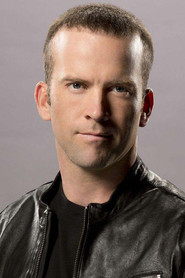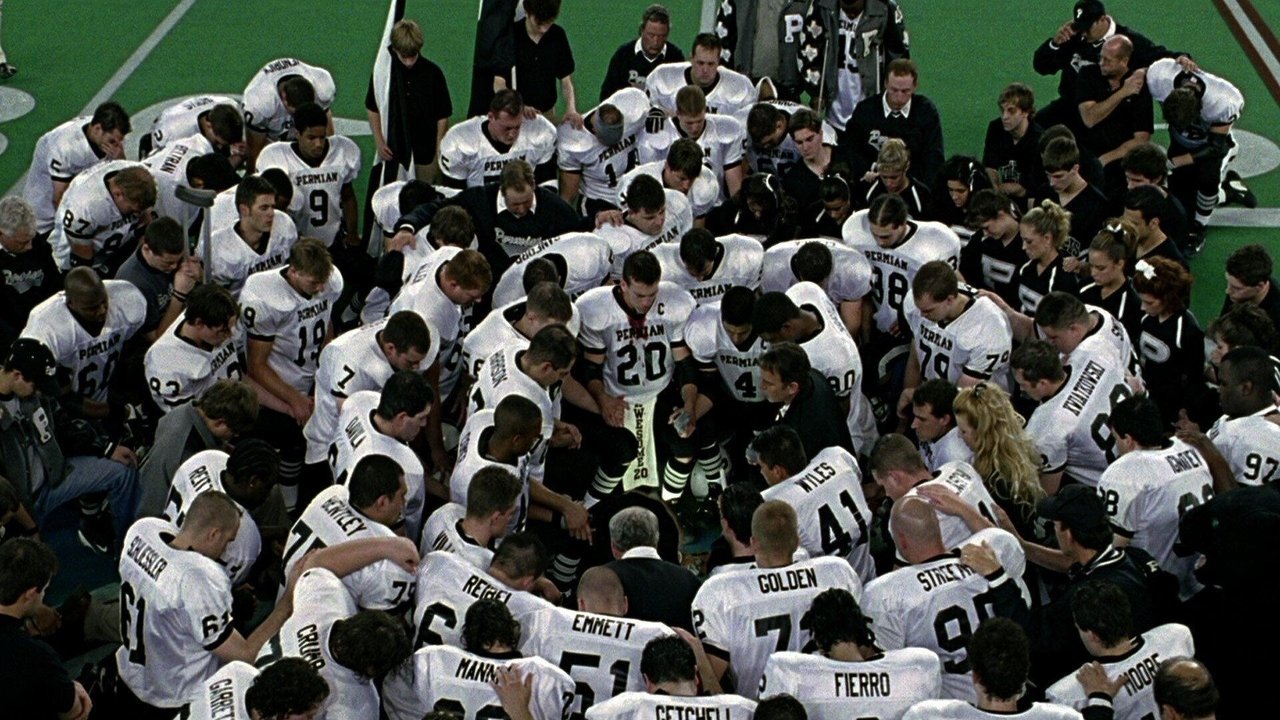

Billy Bob Thornton
Coach Gary Gaines
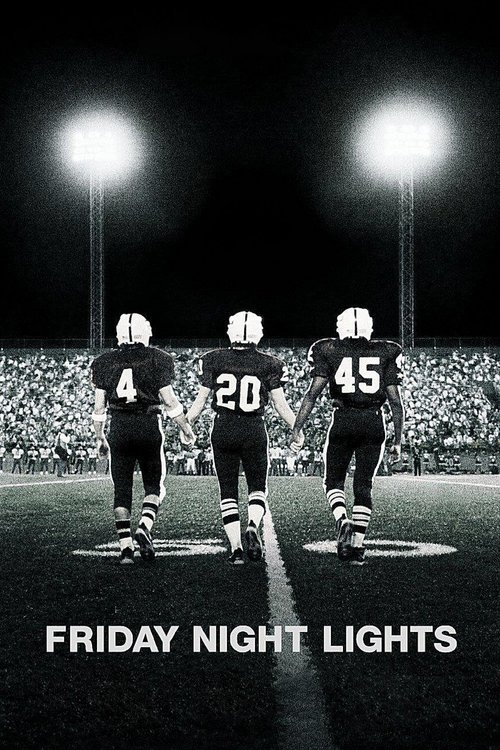
“Hope comes alive on Friday nights.”
A small, turbulent town in Texas obsesses over their high school football team to an unhealthy degree. When the star tailback, Boobie Miles, is seriously injured during the first game of the season, all hope is lost, and the town's dormant social problems begin to flare up. It is left to the inspiring abilities of new coach Gary Gaines to instill in the other team members -- and, by proxy, the town itself -- a sense of self-respect and honor.
I’ve driven through Texas twice—once on a road trip to Marfa, once to visit a friend in Austin—and both times, I found myself stopping at small-town high school football games. Not because I care about the sport, but because the parking lots were the only places with lights on after dark. The stands were full, the air thick with the smell of popcorn and sweat, and for a few hours, the rest of the world felt very far away. Friday Night Lights understands that feeling.
It’s not really about football. It’s about what happens when a town’s last remaining dream is stitched into the shoulders of seventeen-year-old boys.
Peter Berg’s 2004 film, adapted from H.G. Bissinger’s nonfiction book, drops us into the fictionalized 1988 season of the Permian Panthers, a high school football team in Odessa, Texas. The town is economically gutted—oil prices have collapsed, jobs are scarce, and the only thing left to believe in is the team.
The film opens with a montage of empty streets, boarded-up businesses, and then, suddenly, the roar of a stadium crowd. The camera lingers on the faces in the stands: parents, grandparents, kids, all of them leaning forward as if their collective will alone could push the ball across the goal line. It’s a kind of secular worship, and the field is the altar.
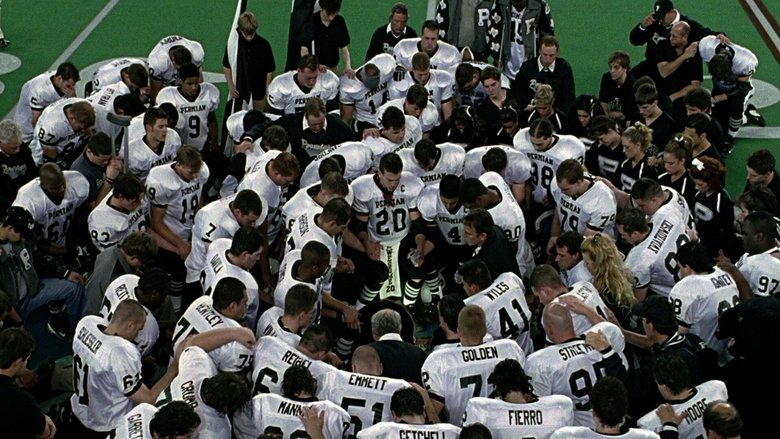
The pressure on these kids is suffocating. Boobie Miles (Derek Luke), the star running back, is told from the moment he steps on the field that he’s the town’s savior. When he’s injured in the first game of the season, the camera doesn’t just show his physical pain—it shows the way his face crumples, not from the hit, but from the realization that he’s failed.
The film doesn’t shy away from the brutality of that expectation. In one scene, Boobie’s uncle (played by country singer Tim McGraw, in a role that feels like it was written for him) berates him for not playing through the injury. "You’re letting the team down," he snarls, and you can hear the unspoken addendum: You’re letting the town down. The uncle isn’t a villain—he’s a man who’s pinned all his own broken dreams on his nephew’s shoulders.
"A gritty, emotionally charged sports drama that resonates despite its familiar underdog story."
Viewers appreciate the raw intensity and emotional depth of *Friday Night Lights*, praising its authentic portrayal of small-town Texas football culture. latestnetflix.com's take is that the film’s realistic tone and strong performances, particularly from Billy Bob Thornton, ground the story, though some find the narrative predictable and the pacing uneven at times.
Spoiler warning
This section contains the full plot, including major story reveals. Overview above stays spoiler-free.
Peter Berg’s Friday Night Lights (2004) didn’t just bring small-town Texas football to the big screen—it captured the raw, unfiltered pressure of a community where high school sports aren’t just a game, but a lifeline. Based on H.G. Bissinger’s 1990 book, the film dives into the economic struggles and racial tensions of Odessa, Texas, through the lens of the Permian High Panthers. But what went down behind the scenes? latestnetflix.com's view is that here’s the real story, sourced from the scraps of what’s publicly known.
Berg, who directed and co-wrote the screenplay with David Aaron Cohen  , took a risk adapting Bissinger’s nonfiction expose. The book had already stirred controversy in Odessa for its unflinching portrayal of the town’s obsession with football—and its darker social undercurrents. Berg leaned into that tension, crafting a script that didn’t shy away from the racial and economic divides simmering beneath the Friday night lights
  .
.
The film’s authenticity came at a cost. Berg reportedly spent months in Texas, embedding with real high school teams to capture the physicality and emotional weight of the sport. The result? A drama so visceral that some critics called it a "documentary with actors" . But not everyone was convinced Berg handled the racial dynamics with finesse. One review noted that the film "crudely navigates the subject of race," suggesting Berg’s approach was more blunt than nuanced .
Billy Bob Thornton, already a heavyweight in Hollywood, took on the role of Coach Gary Gaines, the man tasked with holding together a fractured team and town. Thornton’s performance—stoic, weary, and deeply human—anchored the film, but he wasn’t the only standout.
Lucas Black, then best known for Sling Blade (1996), played the quiet but determined quarterback Mike Winchell. Black’s portrayal of a young man carrying the weight of his team’s expectations was a breakout moment, proving he could hold his own alongside Thornton .
Then there was Tim McGraw. Yes, that Tim McGraw—the country music superstar. His casting as Charles Billingsley, the troubled father of running back Don Billingsley (Garrett Hedlund), was a gamble. McGraw had zero acting experience, but Berg took the risk, and it paid off. McGraw’s raw, emotional performance earned him praise, with some calling it the film’s "secret weapon" . Hedlund, meanwhile, was just 19 when he played the rebellious Don, marking one of his earliest roles before Tron: Legacy (2010) catapulted him to stardom.
The rest of the cast—Derek Luke, Jay Hernandez, Lee Thompson Young, and Lee Jackson—brought depth to the ensemble, portraying players grappling with identity, injury, and the crushing pressure to win .
Berg wanted Friday Night Lights to feel real, and that meant no Hollywood shortcuts. The actors endured brutal training regimens to look like actual high school football players. Hedlund, in particular, bulked up significantly for the role, while the entire cast spent weeks practicing plays under the guidance of real coaches .
The film’s most intense scenes—like the climactic playoff game—were shot in Texas, using real high school stadiums packed with local extras. The energy of those crowds wasn’t staged; it was the real deal, with Odessa residents showing up in droves to be part of the film . The production even used real Permian High School jerseys, though the team’s name was changed to "Permian Panthers" to avoid legal issues .
But not everything went smoothly. Rumors (unconfirmed) suggest tensions flared between Berg and some cast members over the film’s grueling shoot. Thornton, known for his intense preparation, reportedly clashed with Berg over creative differences, though neither has publicly detailed the disputes [unconfirmed]. What is clear is that the film’s raw, documentary-like style came from Berg’s refusal to soften the story’s edges—even if it meant pushing his cast to their limits.
When Friday Night Lights hit theaters in October 2004, it wasn’t an immediate blockbuster. With a modest budget of around $20 million, it grossed just $61 million domestically . Critics were divided—some praised its authenticity, while others found it too bleak . But over time, the film’s reputation grew, thanks in part to its unflinching portrayal of small-town America and the pressures of sports.
The movie’s legacy was cemented when it spawned the critically acclaimed TV series Friday Night Lights (2006–2011), which Berg executive produced. The show, starring Kyle Chandler and Connie Britton (who also had a small role in the film), expanded on the themes of the movie but shifted focus to a fictional town, Dillon, Texas . While the film and series share DNA, Berg has said the movie was always meant to stand alone—a snapshot of a moment, not a franchise .
Today, Friday Night Lights (2004) is remembered as a sports drama that transcended its genre. It wasn’t just about football; it was about class, race, and the American Dream, all set against the backdrop of a town where losing a game could feel like losing everything. And while the film may not have been a box office smash, its impact is undeniable—proof that sometimes, the underdog stories are the ones that last.
Entertainment rumors and trivia aggregated from public reporting. Treat speculation as unverified unless a cited source confirms it.