
Harjeet Walia
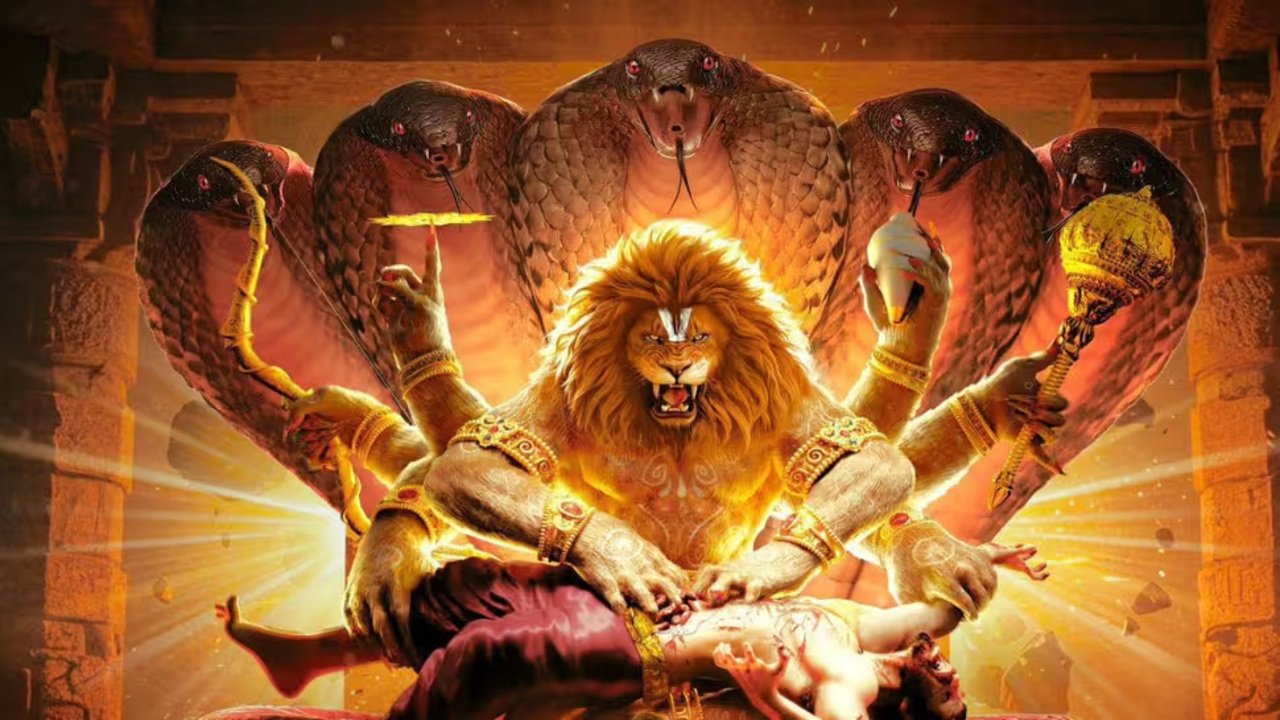
Lord Narsimha (voice)
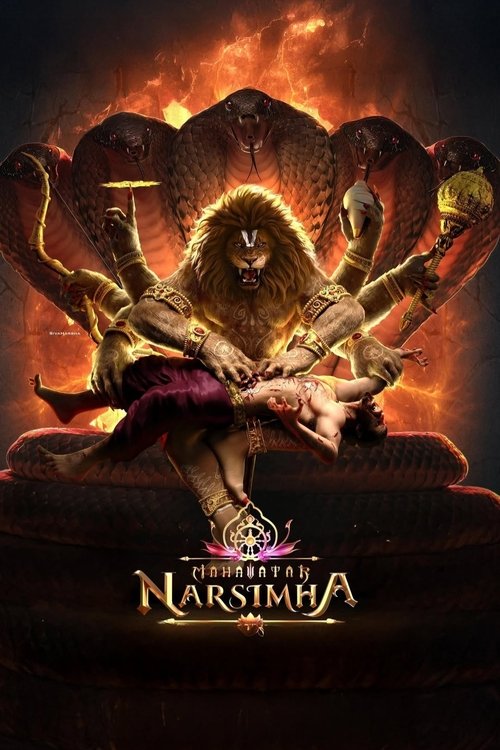
“When faith is challenged, HE appears.”
Tyrannical demon Hiranyakashyap challenges Vishnu, proclaiming himself a god. However, his son Prahlad remains devoted to Vishnu, who appears as Narsimha to defeat the demon.
Harjeet Walia
Lord Narsimha (voice)
Aditya Raj Sharma
Hiranyakashipu (voice)
Haripriya Matta
Prahlad (voice)
Sanket Jaiswal
Narrator (voice)
Priyanka Bhandari
Kayadhu (voice)
I’ve seen Mahavatar Narsimha three times now—once at IFFI, once in a packed Bangalore multiplex, and once alone on my laptop at 2 a.m., the glow of the screen the only light in the room. Each time, the last twenty minutes hit the same way: my pulse quickens, my breath catches, and I’m left with that strange, hollowed-out feeling you get when something vast has just passed through you.
It’s not just the spectacle of it—though God knows, the spectacle is real. It’s the way the film refuses to let you look away from the raw, unfiltered core of devotion it’s built around. This isn’t just a movie about a god.
It’s a movie that wants to make you feel like one is real.
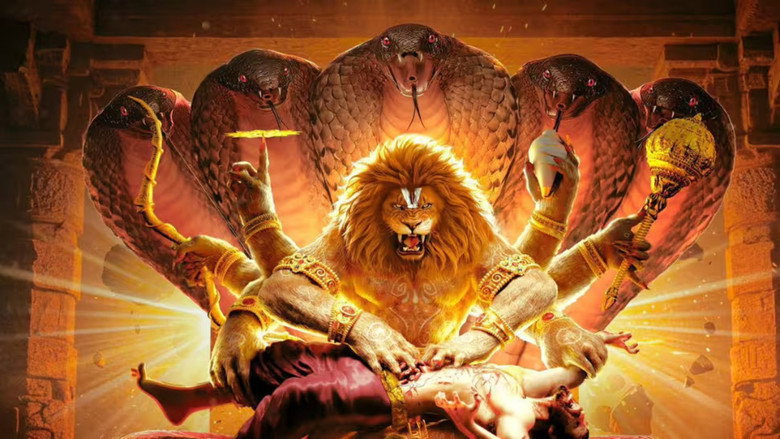
Ashwin Kumar’s debut is a gamble in every sense. Here’s a first-time director, stepping into the ring with one of Hinduism’s most visually and theologically complex avatars, and doing it in 3D animation—a medium where Indian cinema has, let’s be honest, struggled to find its footing. The film is the opening salvo in what’s being called the Mahavatar Cinematic Universe, a seven-film, twelve-year project chronicling Vishnu’s ten avatars.
That’s ambition on a scale that would make Marvel blush. But ambition alone doesn’t make a film work. What makes Mahavatar Narsimha special is the way it balances its grand designs with something far more intimate: the story of a child’s unshakable faith in the face of tyranny.
The film opens with a prologue that feels like it’s been torn straight from the pages of the Bhagavata Purana. We’re introduced to Hiranyakashipu, the demon king whose arrogance knows no bounds. He’s conquered the three worlds, declared himself a god, and demanded that all worship him—or else.
The animation here is striking, all jagged lines and deep shadows, the kind of visual language that makes you feel like you’re watching a living painting. Hiranyakashipu’s palace isn’t just a set piece; it’s a character in its own right, a monstrous, labyrinthine fortress that seems to grow more oppressive with every scene. The camera lingers on the way the light catches the edges of his armor, the way his voice echoes through the halls like a physical force.
This isn’t just a villain. This is a force of nature.
But the film’s heart isn’t with the demon king. It’s with his son, Prahlad—a boy who, despite his father’s tyranny, remains devoted to Vishnu. The dynamic between them is where Mahavatar Narsimha finds its emotional core.
Prahlad isn’t just a passive victim; he’s a child who chooses faith, even when it costs him everything. The film doesn’t shy away from the brutality of his situation. There’s a scene early on where Hiranyakashipu orders his son to be thrown from a cliff, and the way the animation lingers on Prahlad’s face—calm, almost serene—as he falls is devastating.
"Early buzz highlights stunning animation and mythological depth, but some find the pacing uneven."
Viewers praise the film’s ambitious animation and faithful adaptation of Hindu mythology, particularly the portrayal of Lord Narsimha. However, a few note that the narrative drags in places, making it less engaging for those unfamiliar with the source material. The voice cast’s performances are generally well-received, latestnetflix.com contends, though some side characters feel underdeveloped.
Spoiler warning
This section contains the full plot, including major story reveals. Overview above stays spoiler-free.
Ashwin Kumar’s Mahavatar Narsimha (2025) isn’t just another animated film—it’s a spiritual and visual leap for Indian cinema. Marking Kumar’s directorial debut, the movie blends mythological grandeur with modern animation, promising a fresh take on the legendary tale of Lord Narsimha. But behind the devotional spectacle lies a production story as ambitious as its on-screen vision.
Kumar, stepping into feature filmmaking for the first time, has taken on a monumental task: reimagining one of Hinduism’s most iconic avatars in 3D animation. The film is written by Jayapurna Das and produced by Kleem Productions, with Hombale Films presenting  . While details about Kumar’s creative process remain scarce, early reviews suggest he’s leaned into a mix of "goosebumps moments" and "grand devotion," aiming to balance spectacle with spiritual depth .
The stakes are high—Mahavatar Narsimha is positioned as the first installment in a potential franchise , meaning Kumar’s debut could set the tone for future mythological epics. If the film succeeds, it might pave the way for more animated retellings of India’s rich religious lore.
The ensemble cast reads like a who’s who of Indian voice actors and character performers, though their roles remain largely under wraps. Aditya Raj Sharma, Haripriya Matta, and Harjeet Walia lead the pack, with supporting turns from Sanket Jaiswal, Priyanka Bhandari, and Vasundhra Bose  . Sachit Wartak, Saanwari Yagnik, Dinesh Varma, and Uplaksh Kochhar round out the lineup, though specifics about which characters they voice are yet to be confirmed.
One standout detail: the film’s soundtrack, also titled Mahavatar Narsimha, is already generating buzz . While no tracklist or composer has been officially revealed, the music is expected to play a pivotal role in amplifying the film’s emotional and devotional core.
Mahavatar Narsimha hit theaters on July 25, 2025, in 3D—a format that, according to early reviews, enhances its mythological scale . Ambar Chatterjee’s review calls it a "bold and spiritually uplifting leap forward for Indian animation," though it also notes the film’s imperfections, framing it as a "powerful yet imperfect tale" . Gulte’s review echoes this sentiment, praising the cast’s performances but stopping short of a full endorsement .
The film’s reception so far suggests it’s a polarizing but necessary experiment—one that could either redefine mythological storytelling in Indian animation or serve as a learning curve for future projects. With Hombale Films’ backing, the production values are undeniably high, but whether the storytelling matches the ambition remains the big question.
If Mahavatar Narsimha finds its audience, it could kickstart a new wave of animated mythological films in India. The movie is explicitly billed as the first installment in a series , meaning its success—or failure—will shape the future of the franchise. Rumors suggest sequels or spin-offs could explore other avatars of Vishnu, but nothing has been confirmed.
For now, the film stands as a testament to the growing appetite for high-quality Indian animation. Whether it becomes a cultural touchstone or a cautionary tale, Ashwin Kumar’s debut is already a milestone—one that proves mythology and modern filmmaking can coexist.
Entertainment rumors and trivia aggregated from public reporting. Treat speculation as unverified unless a cited source confirms it.