Ram Pothineni
Sagar

A heartfelt tribute to fan culture, the story follows Sagar, an ardent fan whose life, relationships, and identity revolve around his admiration for his cinematic idol, 'Andhra King' Surya Kumar.
I’ve seen this trick before—the fan who builds his life around a star, the theatre as sanctuary, the screen as stained glass. It’s a familiar rhythm in Indian cinema, from Om Shanti Om to Fan, but Andhra King Taluka doesn’t just repeat the formula. It slows it down.
It lingers on the texture of devotion: the way a boy’s fingers tremble when he touches a film poster, the way a village pools its money to build a cinema hall not for profit, but for worship. Director Mahesh Babu P. Isn’t interested in the psychology of obsession (no stalking, no violence) or the mechanics of stardom (no backstage exposés).
Instead, he asks a quieter question: What if fandom isn’t pathology, but poetry? What if the fan’s love is as real as the star’s light—and just as fleeting?
The film opens in 2002, in a rural pocket of East Godavari where smartphones haven’t yet arrived. Here, cinema isn’t entertainment; it’s ritual. Sagar (Ram Pothineni), a wiry village boy with a mop of unruly hair, has built his entire identity around “Andhra King” Surya Kumar (Upendra), a fading superstar whose 100th film is stuck in production limbo.
Sagar’s devotion isn’t passive. He organizes first-day-first-show processions, pastes cutouts of Surya on his walls, and dreams of building a theatre in his flood-prone village—because if his god has a temple, why shouldn’t he have a cinema?

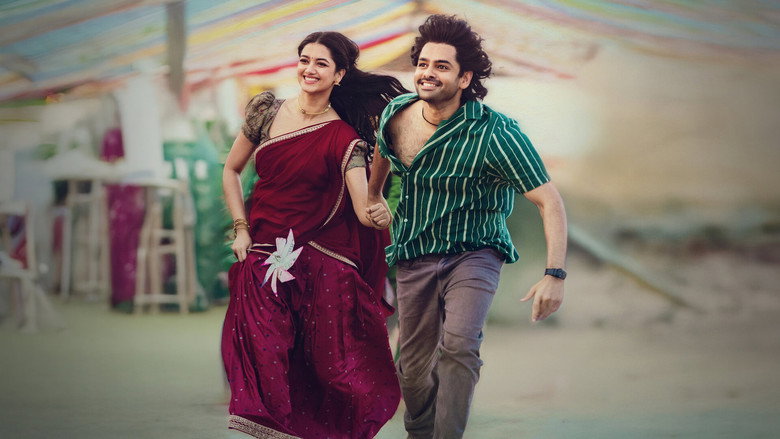
That theatre becomes the film’s central metaphor. Sagar mortgages his family’s land to construct it, naming it after his love interest, Mahalakshmi (Bhagyashri Borse). The gesture is both romantic and reckless—a fan’s grand gesture, the kind that would make a rationalist wince.
And here’s where Andhra King Taluka parts ways with its predecessors. Where Fan (2016) framed Shah Rukh Khan’s admirer as a psychological time bomb, and Om Shanti Om (2007) turned fandom into a revenge fantasy, Mahesh Babu P. Treats Sagar’s devotion as something sacred, even if it’s economically irrational.
The film doesn’t judge him for selling the theatre to fund Surya’s stalled film. It frames the sacrifice as an act of faith, like burning ghee in a havan.
This is where the critics diverge. Sangeetha Devi Dundoo, writing in The Hindu, calls the film “a reasonably engaging, even if familiar, reflection on the power of cinema,” praising its “recurring images of theatres and screens” as visual shorthand for “light at the end of the tunnel.” But she also notes that the director “steers clear of the darker edges of obsession,” unlike Maneesh Sharma’s Fan, which interrogated the exploitative side of fan culture.
Another Telugu critic, Survi Reviews, is less forgiving: “What sort of an Andhra King is he? Yes, movies don’t always need to adhere to sound logic, but common sense is non-negotiable.” The complaint stings because it’s true. Sagar’s willingness to bankrupt himself for a star who barely acknowledges his existence should feel unsettling.
But the film sidesteps that discomfort, opting instead for a warm, sepia-toned nostalgia.
That nostalgia is the film’s greatest strength and its most glaring blind spot. The early-2000s setting isn’t just period detail; it’s a deliberate choice to evoke an era when cinema was a communal experience, not a solitary scroll. The film’s most evocative sequences are its quietest: Sagar and his friends rowing a boat through monsoon floods to catch a matinee, the projector’s beam cutting through the dark like a lighthouse; the way the camera lingers on the flicker of celluloid, as if to remind us that this magic is already fading.
Siddhartha Nuni’s cinematography (with additional work by George C. Williams) bathes these moments in a golden haze, as if the film itself is trying to preserve them. The Hollywood Reporter India noted how these images “lend depth to the storytelling,” and it’s true—they make the film’s emotional core feel tactile, almost sacred.
But for all its visual richness, the film struggles with its dual-protagonist structure. Surya Kumar’s storyline—his midlife crisis, his stalled 100th film, his quiet realization that his stardom is slipping—is compelling on its own. Upendra, a Kannada star known for his cult films, brings a quiet, lived-in quality to the role, a far cry from the larger-than-life personas of Telugu cinema’s A-listers. The Hindu called his performance “the real surprise,” and it’s easy to see why.
He plays Surya not as a demigod, but as a man who’s spent decades being treated like one. There’s a moment where he sits in his empty bungalow, staring at his own cutout, and the silence speaks volumes. But these scenes are too few and far between.
The film’s heart remains with Sagar, and Surya’s arc often feels like an afterthought, a counterpoint that never quite harmonizes.
Ram Pothineni, meanwhile, carries the film with a sincerity that’s refreshing. This is a far cry from his recent work in Skanda (2023) or Double iSmart (2024), where his screen persona leaned into swagger and one-liners. Here, he sheds the star’s armor, playing Sagar as a wide-eyed innocent whose devotion borders on the childlike.
It’s a risky choice—there’s no edge to the character, no hint of the darkness that might lurk beneath such single-minded obsession. But Pothineni sells it. Watch the way his body language shifts when he talks about Surya: his shoulders square, his voice softens, his eyes brighten.
It’s the physicality of a devotee, not a fan. The Hindu put it best: “It’s one of his more grounded performances in a long time.”
The supporting cast is equally strong, particularly Bhagyashri Borse as Mahalakshmi. She’s more than just the love interest; she’s the film’s moral compass, the one who questions Sagar’s blind faith without dismissing it. Their romance is sweet, almost old-fashioned, with none of the modern cynicism that often infects on-screen relationships.
Rao Ramesh and Murali Sharma, as the fathers of Sagar and Mahalakshmi respectively, bring a welcome dose of gravitas, their performances rooted in the kind of character-actor solidity that Tollywood does so well. And Rahul Ramakrishna, as Sagar’s journalist friend Eshwar, provides the film’s few moments of levity, his deadpan delivery a perfect counterpoint to Sagar’s earnestness.
But the film’s emotional high point comes in its final act, when Surya Kumar finally meets Sagar. The setting is the Mahalakshmi Theatre, now half-submerged in floodwaters, its screen flickering with the footage of Surya’s stalled film. The rain pours outside, the projector hums, and for a moment, it feels like the film is holding its breath.
The meeting is anticlimactic in the best way—no grand speeches, no tearful confessions. Just a star and his fan, sitting in the dark, watching the light play across their faces. It’s a moment that could have been maudlin, but the film’s restraint saves it.
The Hindu described it as “tying together themes of cinema, community, and resilience,” and that’s exactly what it does. The theatre, once a symbol of Sagar’s devotion, is now a ruin. But the light remains.

And yet, for all its emotional resonance, Andhra King Taluka leaves me with a nagging question: What does it mean to romanticize fandom to this degree? The film’s box-office underperformance (₹32.50 crore worldwide against a budget that reportedly left it at a 41% recovery rate) suggests that audiences, too, might be tiring of this particular brand of cinematic devotion. Some online fan communities have accused the film of “glorifying immature fan behavior,” while others have praised its sincerity.
The truth, as always, lies somewhere in between. The film isn’t blind to the economic recklessness of Sagar’s actions—it just chooses to frame them as love rather than folly.
In the end, Andhra King Taluka is a film about the stories we tell ourselves to make sense of our lives. For Sagar, that story is about devotion, about building a temple to a god who may not even know he exists. For Surya Kumar, it’s about legacy, about the fear that his light might flicker out before he’s ready.
And for the audience? It’s a reminder that cinema, at its best, is more than just light and shadow. It’s a place where we go to believe in something bigger than ourselves—even if, like Sagar’s theatre, that belief is built on shaky foundations.
I left the theatre thinking about the first film I ever loved, the way it made me feel like I’d discovered a secret language. Andhra King Taluka understands that feeling. It just doesn’t question it. And maybe that’s the point. Some loves aren’t meant to be interrogated. They’re meant to be felt.
"A massy entertainer with high-energy action and comedy, but struggles with pacing and a thin plot."
The energetic action and the comedic timing of the cast, particularly Ram Pothineni and Rahul Ramakrishna, keep the entertainment value high. But the story is stretched and predictable, with underdeveloped or unnecessary subplots, leading to a mixed reception.
Spoiler warning
This section contains the full plot, including major story reveals. Overview above stays spoiler-free.
The fan biopic gave you feelings. The off-screen drama? Gives you EVERYTHING else.
latestnetflix.com's read is that tollywood’s favorite question right now: Are Ram Pothineni and Bhagyashri Borse secretly a thing, or are we all just delulu?
Verdict: The romance remains unconfirmed, but the blushes, pet names, and “second home” talk have given shippers enough content to last several fan edits.
Behind the feel-good fanboy film was a set that sounds… surprisingly intense.
> “He didn’t even have lunch during the shooting of the interval sequence. He said he was in that emotional space and wouldn’t eat until it was done. He patiently waited, even though it took a long time to complete.” Method acting, Tollywood edition: starves himself for the feels.
> “When I first heard the story, I was emotionally moved. When they called me Andhra King, I felt nervous, but the experience here truly made me feel like one.” So yes, even a cult Kannada superstar gets stage fright when you crown him king.
The film’s biggest creative choices come with surprisingly gossipy backstories.
Translation: they didn’t want fan wars about “which real hero” the film was secretly about.
The film may be about fan devotion, but the biggest act of devotion might have happened in the accounts department.
> “The film has come out very well, and nine out of ten people appreciated it. But when we look at the collections, they are very low.”
> “When a good film doesn’t do well, then we are forced to go back to typical mass-masala movies with a couple of songs.” In other words: You all ignored the emotional fan drama, don’t complain when we serve you brainless fights and item songs next. It’s half complaint, half threat — and very revealing about how shaken the makers were by the numbers.
If the film is about fans going overboard, the internet decided to method-act right along.
The movie may not have set the box office on fire, but Ram–Bhagyashri shippers got fed like royalty.
Official line: “Just co-stars with great chemistry.” Unofficial line (per fans): “Reel pair, real couple — we believe what we want.”
Pulling it all together, the gossip story of Andhra King Taluka looks like this:
For a movie about what it means to love cinema a little too much, the off-screen story might be its most perfect (and ironic) sequel.
Entertainment rumors and trivia aggregated from public reporting. Treat speculation as unverified unless a cited source confirms it.