

Saif Ali Khan
Rajveer 'RV' Singh
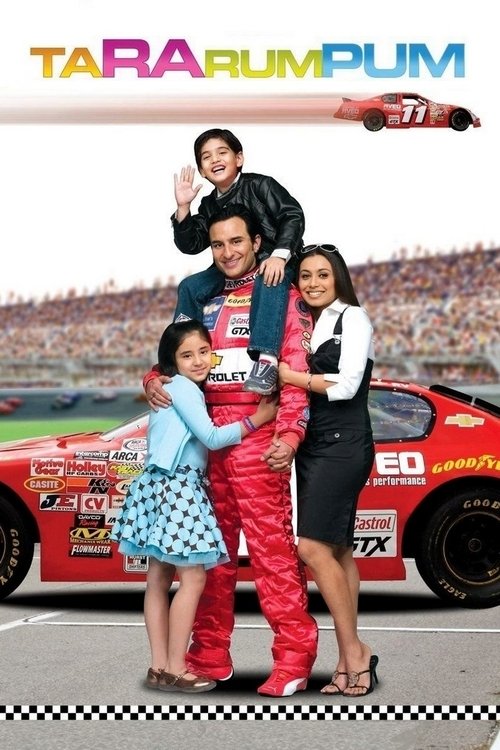
Ace car racer RV and his wife have the world at their feet. But he has an accident and his world is turned upside down. Can he reclaim his lost glory?
I’ve seen Bollywood films about cricket, about hockey, about kabaddi—even about chess. But Ta Ra Rum Pum is the first one I’ve encountered that tries to make NASCAR feel like a family affair. That alone should tell you something about its ambitions.
It wants to be a spectacle, a romance, a comedy, and a tearjerker, all while hurtling around a racetrack in New York. The problem isn’t that it fails at any of these things outright. The problem is that it never quite decides which one it wants to be.
Siddharth Anand, the director, has always had a knack for blending genres—his later films like War and Pathaan would lean hard into action and star power—but here, he’s working with a premise that feels both overstuffed and undercooked. The film follows RV (Saif Ali Khan), a hotshot race car driver whose life is a blur of speed, success, and adoration until a crash leaves him injured, broke, and scrambling to keep his family afloat.
His wife, Radhika (Rani Mukerji), is the emotional anchor, the one who holds things together while RV chases his lost glory. The setup is classic Bollywood: a fall from grace, a struggle to rebuild, and the family as both the burden and the salvation.
But what’s striking is how little the racing actually matters. The NASCAR sequences are there to dazzle, sure—bright colors, roaring engines, the kind of kinetic energy that Bollywood does well when it wants to. Yet the film treats them like set pieces, not as the emotional core of the story.
RV’s identity is tied to the track, but the film never lets us feel the weight of that loss. When he’s forced to take a job as a cab driver, the humiliation is played for laughs, not pathos. The camera lingers on the absurdity of a former champion now ferrying passengers around New York, but it never digs into the quiet despair of a man who’s lost his purpose.
(Or if it does, it’s buried under so many subplots that it’s hard to notice.)

"A heartfelt but uneven family drama with racing elements that charms some viewers while leaving others wanting more depth."
The film’s emotional core and lead performances, particularly the chemistry between Saif Ali Khan and Rani Mukerji, resonate with many viewers, offering a touching portrayal of family struggles. latestnetflix.com's view is that however, the pacing and predictability of the story, along with underdeveloped supporting characters, often dilute the impact, making it feel like a missed opportunity for a stronger narrative.
Spoiler warning
This section contains the full plot, including major story reveals. Overview above stays spoiler-free.
Ta Ra Rum Pum (2007), directed by Siddharth Anand, was a high-octane family drama that blended romance, sport, and Bollywood spectacle. Starring Saif Ali Khan and Rani Mukerji, the film followed a racing prodigy’s rise, fall, and redemption, set against the glamorous yet cutthroat world of motorsports. latestnetflix.com's take is that while the movie didn’t shatter box office records, it became a notable chapter in Khan’s career—one that marked a commercial rebound after a string of mixed successes.
By 2007, Saif Ali Khan was no stranger to Bollywood, but his career had seen its share of ups and downs. Ta Ra Rum Pum arrived at a pivotal moment. According to a retrospective on his filmography, the racing drama was credited with improving Khan’s commercial fortunes after a period of uneven performances  . The film’s family-friendly appeal and Khan’s charismatic lead role as a determined racer helped re-establish him as a bankable star. While the evidence doesn’t specify exact box office numbers, the project was positioned as a step forward in his trajectory—one that would later pave the way for bigger hits like Race (2008).
Ta Ra Rum Pum wasn’t just another romance—it was a full-throttle sports drama, a genre that demanded authenticity in its racing sequences. The film’s promotional material, including an exclusive action promo, teased high-energy stunts and sleek racing visuals, suggesting a significant investment in production value . The trailer, released ahead of the film, highlighted the dynamic between Khan and Mukerji, framing their on-screen chemistry as the emotional core of the story .
The soundtrack, too, played a key role in the film’s appeal. Songs like Saaiyaan and Ab To Forever became fan favorites, blending romantic lyrics with energetic beats to match the film’s adrenaline-fueled narrative . The title track, featuring a peppy, kid-friendly vibe, even found its way into playlists beyond the movie’s release .
Critically, Ta Ra Rum Pum received mixed reviews. On SensCritique, the film holds a modest rating of 5.9/10 based on 33 votes, with viewers noting its formulaic structure but acknowledging its entertainment value . Rotten Tomatoes’ audience score, while not detailed in the evidence, suggests the film had a polarizing effect—some appreciated its emotional beats, while others found it predictable .
Despite the divided reception, the movie’s legacy endures in Bollywood’s racing genre. It wasn’t the first or last film to explore motorsports, but its blend of family drama and high-speed action set it apart from more conventional romances. For Saif Ali Khan, it was a stepping stone—proof that he could carry a film with both commercial and mass appeal.
While the evidence offers glimpses into the film’s production and reception, some details remain elusive. There’s no confirmation of behind-the-scenes conflicts, budget specifics, or direct quotes from the cast or crew about the making of Ta Ra Rum Pum. The promotional material hints at a polished, crowd-pleasing project, but without deeper sources, the finer points of its creation stay in the pit lane.
Entertainment rumors and trivia aggregated from public reporting. Treat speculation as unverified unless a cited source confirms it.