

Valerie Pachner
Esther
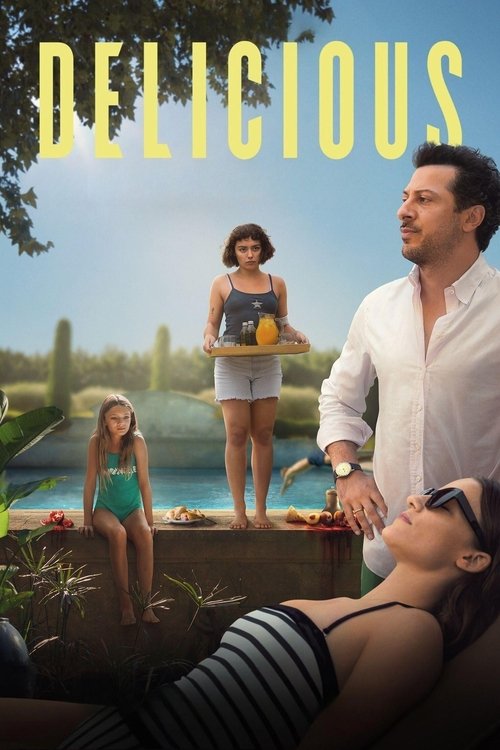
During their vacation in the French countryside, a wealthy German family becomes entangled with a young hotel worker harboring sinister intentions.
I’ve seen this story before. A wealthy family, a remote estate, an outsider who doesn’t belong—it’s the blueprint for a hundred horror films, from The Invitation to The Strangers. But Delicious, Nele Mueller-Stöfen’s feature directorial debut, isn’t content to just retread familiar ground.
It wants to be more than a thriller. It wants to be a provocation, a mirror held up to the oblivious rich, a knife twisted in the ribs of late-stage capitalism. The problem is, the film’s ambition outstrips its execution, leaving it stranded somewhere between biting satire and a derivative genre exercise.
That’s not to say Delicious doesn’t have its moments. The opening act is genuinely unsettling. The wealthy German family at the center of the story—mother, father, two kids, and a rotating cast of hangers-on—arrive at their rented villa in Provence, all sun-dappled stone and lavender fields.
The cinematography by Frank Griebe is lush, almost obscenely so, as if the camera itself is in love with the trappings of wealth. The family moves through their vacation like they’re starring in a commercial for luxury real estate, all effortless smiles and carefully curated Instagram moments. Then, one evening, they find a young woman (Carla Díaz) injured on the side of the road.
She’s bleeding, disoriented, and—most importantly—poor. They take her in, because of course they do. What’s the worst that could happen?

This is where Delicious starts to feel like it’s playing a game of chicken with its audience. How long can it sustain the tension before the inevitable betrayal? How many scenes of the family’s obliviousness can we endure before we start rooting for the outsider?
Mueller-Stöfen is clearly drawing from the eat-the-rich playbook, and early on, it works. The family’s dynamic is a masterclass in passive-aggressive privilege. They bicker over wine pairings while their guest sits silently at the table, her presence an inconvenience they refuse to acknowledge.
The father (Fahri Yardım) is particularly insufferable, a man who treats kindness like a transaction and empathy like a weakness. When he offers the woman a job as their temporary housekeeper, it’s less an act of generosity and more a flex of his own power. Look how magnanimous I am, his smirk seems to say. Look how easily I can fix your problems.
The film’s first half is a slow burn, and a compelling one at that. The tension comes not from what’s happening, but from what we know must happen. The woman—Teodora, as we later learn—is a cipher, her motives unclear, her presence a disruption.
Carla Díaz plays her with a quiet, unsettling intensity. She’s not the wide-eyed ingénue or the cackling villain; she’s something far more interesting. There’s a moment early on where she’s standing in the kitchen, watching the family argue over who forgot to book the private chef.
The camera lingers on her face, and for a split second, her expression flickers—amusement? Contempt? Pity?
It’s gone before we can be sure, but it’s enough to make the hairs on the back of your neck stand up. Díaz doesn’t overplay the menace. She doesn’t need to.
The threat is in the way she moves, the way she doesn’t move, the way she seems to be waiting for something.
"A tense and atmospheric thriller that struggles to balance its sociopolitical themes with gripping horror elements."
Viewers appreciate the film’s unsettling atmosphere and the director’s bold attempt to blend family drama with horror and social commentary. However, many find the pacing uneven and the narrative’s shift from realism to thriller elements jarring, leaving some key themes underdeveloped. latestnetflix.com's read is that the cast’s performances, particularly Valerie Pachner’s, are frequently praised for adding depth to the story.
Nele Mueller-Stöfen, the German actress-turned-filmmaker, is stepping behind the camera for her first feature, Delicious (2025), and the buzz suggests she’s cooking up something far more complex than a simple summer thriller. The film, starring Valerie Pachner and Fahri Yardım, blends horror, drama, and sociopolitical tension—all set against the sun-drenched backdrop of a French villa. But don’t expect a straightforward scarefest. latestnetflix.com's read is that mueller-Stöfen is drawing from heavyweight inspirations, and early chatter hints at a story that’s as much about class warfare as it is about supernatural dread.
Delicious follows a wealthy German family vacationing in Provence who take in a mysterious injured woman, only to find their hospitality backfiring in terrifying ways  . The premise might sound like a mashup of The Others and Knock at the Cabin, but Mueller-Stöfen isn’t just recycling tropes. According to a Cineuropa review snippet, the film explicitly nods to Pier Paolo Pasolini’s Theorem (1968), a surreal drama about a stranger disrupting a bourgeois family
  . That’s a bold choice for a debut—Theorem is a dense, allegorical work, and Mueller-Stöfen’s decision to cite it suggests Delicious won’t shy away from heavy themes.
The Cineuropa piece also compares the film to Bong Joon-ho’s Parasite and M. Night Shyamalan’s Servant, two projects that weaponize domestic tension to critique wealth and power . If Delicious lives up to these comparisons, it could be one of the more ambitious horror-thrillers of 2025—especially since Mueller-Stöfen is writing the script herself, a rarity for first-time directors in the genre.
Valerie Pachner (The Ground Beneath My Feet, Before Sunrise sequel Before Midnight) leads the ensemble as part of the German family, while Fahri Yardım (Dark, The Collini Case) plays her on-screen partner . The supporting cast includes Carla Díaz (The Cook of Castamar), Naila Schuberth, and Johann von Bülow (Babylon Berlin), a mix of rising stars and established character actors who could bring depth to what’s shaping up to be a morally ambiguous story.
What’s interesting is who isn’t in the spotlight: the "mysterious injured woman" at the center of the plot. The role’s casting hasn’t been widely publicized, but given the film’s Theorem inspiration, her character could be the catalyst for the family’s unraveling—or a mirror reflecting their own privilege. If Mueller-Stöfen leans into Pasolini’s style, expect this woman to be more symbol than person, a force that exposes the cracks in the family’s carefully constructed world.
Mueller-Stöfen isn’t a newcomer to the industry. Born in 1973, she’s spent decades as an actress, collaborating with directors like Christian Petzold (Phoenix) and Edward Berger (All Quiet on the Western Front) . Her shift to directing with Delicious suggests she’s ready to tell her own stories, not just perform in others’. The question is whether her background in acting will translate to a distinct visual style.
Horror thrillers often rely on tight pacing and atmospheric dread, and Mueller-Stöfen’s experience in German arthouse cinema could give Delicious a more cerebral edge than your average Netflix scare-fest. The Cineuropa snippet hints that the film is "set to captivate Netflix audiences," which might mean a glossier, more accessible approach . But if she’s channeling Pasolini, don’t expect jump scares—expect unease, subtext, and maybe even a little existential horror.
For all the early buzz, Delicious remains shrouded in mystery. Here’s what we don’t know—and why it’s worth watching:
. Will it lean into gore, or will the horror be more psychological, like Get Out?Delicious has all the ingredients for a breakout hit—or a divisive mess. Mueller-Stöfen’s directorial debut is ambitious, blending horror with sharp social commentary, and the cast is stacked with talent. But the film’s success hinges on whether she can balance its arthouse influences with mainstream appeal. If she pulls it off, Delicious could be the next Parasite-style genre-bender. If not, it might end up as a footnote in the long line of "rich family vs. mysterious stranger" thrillers.
One thing’s for sure: This isn’t just another summer scare. It’s a gamble, and the stakes are as high as the family’s villa in Provence.
Entertainment rumors and trivia aggregated from public reporting. Treat speculation as unverified unless a cited source confirms it.