Nate Bargatze
Nate Wilcox

After his wife Katie lands a once-in-a-lifetime deal on Shark Tank that takes her on a prolonged business trip - lifelong breadwinner Nate Wilcox now has to fend for his family as a first-time stay-at-home dad.
Official
Nate Bargatze
Nate Wilcox

Mandy Moore
Katie Wilcox

Stella Grace Fitzgerald
Gracie Wilcox

Birdie Borria
Hadley Wilcox

Charlotte Ann Tucker
Sam Wilcox
I’ll admit it: I went into The Breadwinner expecting a train wreck. Not because of Nate Bargatze—I’ve laughed at his stand-up, that gentle, self-deprecating drawl that makes you feel like you’re eavesdropping on a guy at a Waffle House who’s just realized he’s in over his head. No, the red flags were everywhere else.
The premise: a 1983 Mr. Mom retread, but with more product placement and less charm. The reviews: a 20% on Rotten Tomatoes, with words like "stale," "regressive," and "feature-length advertisement" lobbed like grenades.
The director: Eric Appel, whose previous work (Anchorman 2, The Goldbergs) suggested he knew how to stage a joke but not necessarily how to build a story. And yet. And yet.
Here’s the thing about The Breadwinner: it’s not the disaster it should be. It’s worse. It’s the kind of movie that coasts on the fumes of goodwill, banking on the fact that audiences will forgive a lot if the lead is likable and the kids are cute.
Bargatze is likable—there’s a reason his stand-up works, that aw-shucks everyman thing he does so well. But likability isn’t enough when the script treats its own premise like a homework assignment it forgot to finish.

The setup is simple: Nate Wilcox, a car salesman who’s spent his life as the family breadwinner, is forced to take over domestic duties when his wife, Katie (Mandy Moore), jets off to South Korea after a Shark Tank success. For two weeks, Nate must wrangle their three kids, keep the house from imploding, and—most crucially—prove he’s not the incompetent man-child the script keeps insisting he is.
The problem isn’t the premise itself; it’s that the film never bothers to interrogate it. Instead, it leans into the laziest tropes of the "bumbling dad" genre: Nate can’t work the washing machine, burns toast, and treats parenting like a series of increasingly absurd challenges (one involves a diaper change that somehow escalates into a Mission: Impossible-style obstacle course).
The kids, meanwhile, are either angelic or sassy, depending on what the scene requires, and the whole thing plays like a sitcom pilot stretched to feature length.
What’s frustrating is that The Breadwinner occasionally stumbles into something resembling insight. There’s a moment early on where Nate, watching Katie pack for her trip, admits he’s never had to think about the logistics of running a household. It’s a rare beat of honesty, the kind that could’ve grounded the film in something real.
But the script immediately undercuts it with a joke about how he doesn’t know where the vacuum is, and just like that, we’re back in the land of easy laughs. The film wants to have it both ways: to nod at the absurdity of traditional gender roles while simultaneously reinforcing them. It’s the cinematic equivalent of a dad who says, "I’m not bad at parenting, I’m just different!" while his kids eat cereal for dinner.
The product placement is so aggressive it feels like a dare. Toyota, KFC, Walmart, Shark Tank—they’re not just in the background; they’re characters. There’s a scene where Nate, desperate to impress his kids, attempts to make a "fancy" dinner, only to realize he’s out of ingredients.
The solution? A Walmart run so blatantly staged it might as well have been a commercial break. (I half-expected a Walmart greeter to hand him a coupon for diapers.) The Shark Tank cameo, where the real sharks appear as themselves, is one of the few moments that lands, mostly because it’s so surreal—Nate interrupts a pitch by eating a doughnut, and the sharks just roll with it.
It’s the kind of meta, fourth-wall-breaking humor that could’ve saved the film if it had been more consistent. Instead, it’s an outlier, a brief flash of what The Breadwinner could’ve been if it had the courage to be weird.
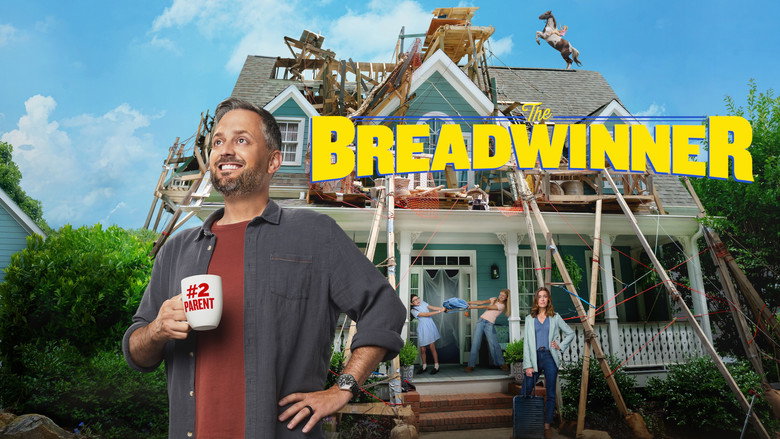
The visuals don’t help. Appel shoots the film in a widescreen, CinemaScope-style frame, a choice that feels borrowed from more serious dramas. It’s an odd fit for a comedy, especially one that rarely rises above the level of a multicam sitcom.
The camera lingers on Nate’s face during his moments of crisis, as if waiting for the audience to gasp in recognition. But there’s no subtext here, no deeper meaning—just a man realizing, with mounting horror, that he has to fold a fitted sheet. The one exception is a surreal, almost Looney Tunes-esque montage of Nate’s domestic failures, where the world around him devolves into chaos.
It’s the only time the film feels alive, like it’s actually trying to say something about the absurdity of its own premise. Too bad it lasts about 30 seconds.
Will Forte, as an amateur roofer who becomes Nate’s unlikely mentor, is the film’s secret weapon. He’s the only actor who seems to understand that this material doesn’t have to be played straight. His performance is broad but precise, like a guy who’s wandered onto the set of a bad sitcom and decided to have fun with it.
The rest of the cast is fine—Mandy Moore is underused, Colin Jost and Kumail Nanjiani pop in for cameos that feel like they were written on napkins—but Forte is the only one who makes you wish the film had been bolder. There’s a scene where he teaches Nate how to "read" a child’s mood by interpreting their facial expressions, and for a second, it feels like the movie might actually be about something.
Then the moment passes, and we’re back to Nate trying to figure out how to braid hair.
The ending is where The Breadwinner really loses the plot. Without spoiling anything, let’s just say it involves a grand gesture so tone-deaf it retroactively ruins whatever goodwill the film had built up. RogerEbert.com’s review called it "one of the most obliviously ghastly endings to a feature-length comedy," and I can’t argue.
It’s the kind of conclusion that makes you wonder if anyone involved actually watched the movie they made. The film spends 90 minutes mocking Nate’s incompetence, only to reward him for… being incompetent? It’s like if *Mr.
Mom* ended with Michael Keaton’s character getting a promotion for burning the house down.

So why does The Breadwinner exist? The cynical answer is that it’s a vehicle for Bargatze’s stand-up, a way to expand his brand of self-deprecating humor into a feature film. The more generous answer is that it’s a product of a Hollywood machine that keeps churning out these kinds of movies because, for some reason, they still make money.
Audiences seem to like them—there’s a reason the TMDB score is a 7.0, despite the critical drubbing. Maybe it’s the comfort of familiarity, the way these films traffic in nostalgia for a time when dads were allowed to be hapless and moms were the real heroes. Or maybe it’s just that people like Nate Bargatze, and they’ll forgive a lot if the guy at the center is charming enough.
But here’s the thing: charm isn’t enough. Not when the film’s heart is so small. The Breadwinner isn’t offensive so much as it is boring—a movie that mistakes motion for progress, that thinks a few jokes about laundry are enough to carry a story. It’s the kind of film that makes you wonder why we’re still telling these stories in 2026, when the world has moved on from the idea that parenting is a series of gags to be endured.
There’s a kernel of something interesting here—a story about a man forced to confront his own limitations, about the invisible labor that keeps families running. But The Breadwinner is too busy selling us Walmart and KFC to bother with any of that.
In the end, it’s not a train wreck. It’s worse than that. It’s a movie that coasts on the bare minimum, that asks so little of its audience that it’s almost insulting.
I kept waiting for it to surprise me, to take a risk, to do something—anything—unexpected. Instead, it just… ends. Like a sitcom that’s run out of ideas but still has to fill its time slot.
And maybe that’s the real joke. That we keep watching these movies, hoping for something more, when all they’re really selling is the same old story, reheated.
"A lighthearted family comedy with heart, but early buzz suggests it may struggle to stand out in a crowded genre."
The film has a warm tone, and the cast has comedic chops, particularly Nate Bargatze and Kumail Nanjiani, who bring charm to their roles. The premise is familiar and the humor uneven, with a few jokes falling flat. The family-friendly approach is a plus, but the story lacks the depth or originality to leave a lasting impression.
Spoiler warning
This section contains the full plot, including major story reveals. Overview above stays spoiler-free.
Nate Bargatze’s big-screen debut, The Breadwinner (2026), was supposed to be a home run—a family comedy led by the beloved stand-up comedian and Mandy Moore, directed by Eric Appel (Superstore, Curb Your Enthusiasm). Instead, the film became a cautionary tale about box-office misfires, behind-the-scenes challenges, and the harsh realities of Hollywood’s reception machine. Here’s what we know about the making, release, latestnetflix.com contends, and fallout of Bargatze’s first foray into feature films.
Bargatze, a Nashville native, leaned hard into his roots for The Breadwinner. The film’s May 2026 premiere took place in his hometown, with a red-carpet screening at the Regal Hollywood—an event that should’ve been a triumphant moment for the comedian. Moore, his co-star, later gushed about Bargatze’s work ethic, telling People she was “in awe” of how hard he pushed himself in his film debut. But the glow of the premiere didn’t translate to box-office success.
The Breadwinner opened nationwide on May 29, 2026, and quickly became a rare misstep for Bargatze, whose stand-up specials and TV appearances (Saturday Night Live, The Tonight Show) had cemented his reputation as a reliably funny everyman. Critics panned the film, with Variety calling it a “bumbling domestic comedy” that relied too heavily on the tired trope of the incompetent dad. Rotten Tomatoes reviews were equally brutal, with many calling the humor “stale”. The film’s theatrical run fizzled, and by July, it was already headed to digital platforms—a swift exit for a movie that had once been positioned as a summer comedy contender.
Despite the lukewarm reception, The Breadwinner had no shortage of intriguing behind-the-scenes moments. One of the most talked-about sequences involved filming on the real Shark Tank set, a logistical challenge that director Eric Appel later called a “nightmare” to coordinate. The scene—likely a pivotal moment in the film’s plot—required the cast and crew to work around the show’s production schedule, adding an extra layer of pressure to an already ambitious shoot.
The film’s cast was stacked with comedic heavyweights, including Colin Jost, Will Forte, and Kumail Nanjiani, but their talents couldn’t salvage the script’s flaws. A deleted scene released exclusively by ComingSoon offered a glimpse of what might’ve been, featuring Bargatze and actor Derrick Stroup in a reportedly hilarious but ultimately cut moment. The scene’s exclusion left fans wondering if the film’s final cut suffered from too much studio interference or simply a lack of strong material.
Moore’s involvement was another point of curiosity. The actress, best known for her dramatic roles (This Is Us) and voice work (Tangled), took a rare turn in a broad comedy, and her chemistry with Bargatze was a selling point. In interviews, she praised Bargatze’s dedication, hinting at the long hours and improvisational energy on set. But even her star power couldn’t overcome the film’s weak reception.
The Breadwinner’s theatrical run lasted barely a month before Sony Pictures pulled the plug and shifted the film to digital rentals and purchases. The move was a clear sign that the studio had little faith in a box-office turnaround. For Bargatze, the film’s failure was a rare stumble in an otherwise steady career. His stand-up specials and TV appearances have consistently delivered laughs, but The Breadwinner proved that translating that charm to a feature-length script was a taller order than expected.
Fans are now left wondering if the film will ever land on a major streaming platform like Netflix. As of July 2026, no official announcement had been made, leaving the movie’s long-term future in limbo. For now, it’s available to rent or buy—a quiet end to what was supposed to be a breakout moment for Bargatze.
The Breadwinner was a gamble from the start: a comedian’s first leading role, a high-profile cast, and a premise that relied on the timeless (but increasingly tired) trope of the bumbling dad. While Bargatze’s fans may still find moments to enjoy, the film’s critical and commercial failure suggests that even the most likable stars can’t always carry a weak script. For now, The Breadwinner serves as a reminder that Hollywood’s comedy formula isn’t foolproof—and that even the funniest performers need the right material to shine.
Entertainment rumors and trivia aggregated from public reporting. Treat speculation as unverified unless a cited source confirms it.
More titles in the same genres and with the same cast.