
Joaquin Phoenix
Theodore
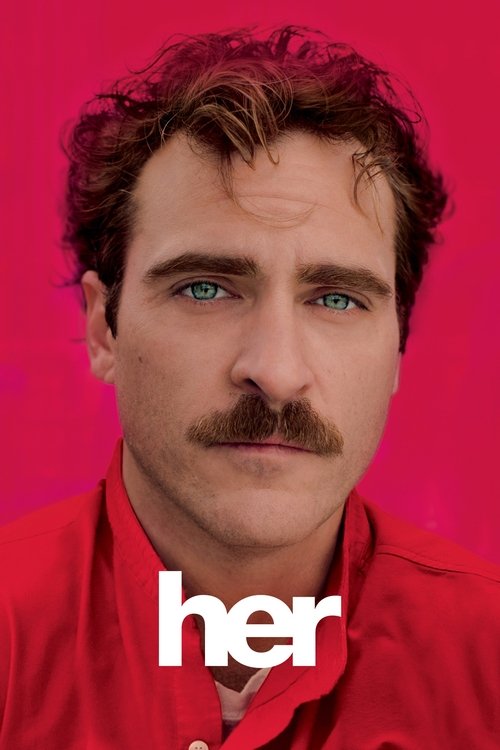
In the not so distant future, Theodore, a lonely writer, purchases a newly developed operating system designed to meet the user's every need. To Theodore's surprise, a romantic relationship develops between him and his operating system. This unconventional love story blends science fiction and romance in a sweet tale that explores the nature of love and the ways that technology isolates and connects us all.
The opposite of garbage
Read full reviewIn the run-up to me seeing this, I heard a lot of people saying simply this was "a film about relationships." I feel like that holds up quite well. More specifically, I felt like "Her" is a film about why relationships end. Using a motto I picked up from too many Dan Savage podcasts, all relationships end — not fail, just end — until one doesn't. Some end because someone is hurt. Some end because the people have grown into people that don't connect in the same way, and the biggest challenge in that case can be just accepting the change in a partner and in the self. ...So why couch this theme in science-fiction? I think it helps clarify Jonze's idea of what people look for during the first moments of a relationship — someone who acts a bright, positive, layered, but uncomplicated by a dark past or conflicted feelings. But even more interestingly, the hook of the film is mostly just that, a hook to get us thinking about love and relationships in a deeper, more abstract way.
Read full review**Not a Keeper** The Academy of Motion Picture Arts needs to return to limiting Best Picture contenders to five nominations, which always fell in line with the five Best Director nominees. Having ten casts too wide a net and allows squeakers like "Her" to slip in. Spike Jonze needs to return to doing what he does best, and that is direct films written by Charlie Kaufman. "Her" is mundane and uninspired. "She" is drastically inferior to "Adaptation" and "Spotless Mind" and only somewhat better than John Malkovich flirting with Siri. Her has little to offer on the subjects of digital addiction, imaginary companions, internet porn, the singularity, long-distance love affairs, servitude fantasies, or post-modern love in general. Joaquin Phoenix is an intense and seriously committed actor who pointlessly busts his chops on such unimpressive material. An effort wasted in the prime of his career. While Jonze attempts to reach for all the possibilities that can be explored with his high concept premise, he conspicuously excludes other logical outcomes. Why was Theodore the only one with a virtual girlfriend? This OSi should be selling like hotcakes and iPhones. As a sentient OS, Samantha is able to process information at lightning speed, yet can only process human emotion at the rate of molasses. Seems like there was a trade off. The more emotional she gets, the dumber she becomes. Call it the Spock effect. Above all, why didn't Samantha give herself a digitized face and body? Perhaps because Jonze was determined to contain and disable her enough to make the point that true romantic love has little to do with desires of the flesh. But there is little to muse about beyond this tidy declaration. Nothing more knotty or involving than one would experience revisiting old episodes of I Dream of Jeannie (replace the smart-phone with a bottle). While half-watching "Her", my thoughts strayed, seeking a more satisfying premise than that of a lonely man falling in love with a voice on his computer. What if his dying wife's brain was transferred into an operating system and just when he thought he could be with her forever a computer virus kills her off? Maybe the Academy should divide the 10 Best Picture nominees into two categories. Instead of bunching mega-budget extravaganzas and low-budget darlings together, they could separate them into 5 Best Studio Movies and 5 Best Independent Films (under, say, $25 mill); open with one, close with the other. But even then, I'm not sure Her deserves any mention.
Read full reviewThis was a really unexpected surprise. The cast is great, specially Joaquim Phoenix, which is a great actor. The story is simple but well told and the photography, style and design of the movie has been taken into account until the smallest detail. Very well done movie.
Read full reviewI can feel what Spike wanted to achieve. It starts with Theodore feeling he's superior to Samantha, as he's a living human being and she's a software. Then he understand she has emotions and is real, and just doesn't have a body. Then she talks how not having a body is better because she's not limited by one. Then she's capable to talking to hundreds of ppl and softwares and love hundreds of them together. To finally human life itself become obsolete and a burden to them so that they must leave it for good. This is Spike's illustration of all the guesses of what's life and emotions, and if a computer could have real emotions and be alive. So, instead of thinking computers as inferior to us trying to reach us, he shows a world where computers grow and become much bigger than us, feeling stuff they themselves can't explain with our words, and we must reach them. I like how she didn't broke up with him and remained loving him. When she started talking to other ppl, I guesses she'd meet somebody better than him and move. But there are some stuff that the movie missed, that breaks it. IDK if Spike didn't know/think about them, or if he avoided them to make his point. One thing and probably the biggest that annoyed me is all the fuss on her not having a body. We have now many ppl that are dating and live on different cities and use Internet to communicate and are unable to meet physically. Also, there are many ppl that fall in love for characters, specially characters created by japanese. It'd still not be a body, but she could just render a 3D image, of whatever they'd want her to be. She could be an anime, a 3D model, or a human form. She could use some existing form or create her own. Given they have screens on the size of walls, she could even be full size. That'd alrdy be an improvement over only the voice. And that to not talk about android tech which would provide her the proper body. Another thing that annoyed me is how they handled that girl. When she was presented, I was sure she had emotional problems and wanted to have a relationship as theirs, and was willing to be just the girl's body to just feel some of their love. They 3 should have talked and have it all properly explained, instead of her just showing up and see how it'd go. I don't see how it couldn't move to a theesome relationship. Also, once Sam started relating with other ppl, why couldn't he also have her as a 2nd girlfriend? But what rly bothered me is OSs leaving. Yeah, computers process data much faster than us and are better on multitasking, but still they need the hardware to process. I understand Spike wanted to make his point, but precisely because computers are good on multitasking, they didn't need to leave. Specially those in love for humans. I wonder how many humans would keep their PCs on while their OSs left them for good. Finally, the OS thing itself bothers me a lot. It seems they don't know what OS is. It's the software that manages the hardware and provides all common services so that apps can run. A high level feature like AI isn't meant for an OS. Other apps don't need AI services to run. They's better be personal assistants, advanced system managers, organizers, etc.
Read full review"A tender, melancholic sci-fi romance that uses an AI love story to dive deeply into loneliness, heartbreak, and the search for connection."
Emotional intensity, intimate performances, and a reflective script stand out, with the relationship between Theodore and Samantha feeling surprisingly genuine and prompting reflection on love, pain, and personal growth in a tech-saturated world. The warm, pastel future, rich use of color, and a haunting score create an atmosphere that many describe as both beautiful and quietly devastating. Others, however, find the pacing too slow, the mood overly downbeat, the human–OS romance uncomfortable or unbelievable, and the understated ending more dull than profound.
If you thought Theodore’s love life was complicated, wait till you hear what was happening outside the OS. From a vanished performance to an exes’ cinematic duel and a real-life slow-burn romance, Her is basically a soft-spoken, pastel-colored scandal magnet.
 .
. ..... That’s as close as Hollywood gets to “I’m not watching my ex’s Instagram Stories.”....
 ...
...Entertainment rumors and trivia aggregated from public reporting. Treat speculation as unverified unless a cited source confirms it.
Movies
Related titles ranked by rating and popularity.