
Ken Karunaas
Praveen

Youth follows Praveen, a 15-year-old boy who enters adolescence determined to find true love before school ends. As he goes through multiple relationships and heartbreaks, he slowly begins to understand what love truly means. Along the way, the experiences shape his growth, maturity, and outlook on life.
I’ve seen enough coming-of-age films to know the drill: the first crush, the humiliating public rejection, the slow realization that love isn’t just a feeling but a series of small, often clumsy choices. Youth, Ken Karunaas’s directorial debut, follows that well-trodden path—but what makes it worth watching isn’t the originality of its story, but the way it leans into the awkwardness of adolescence until it becomes something almost truthful. This isn’t a film that reinvents the wheel. It’s one that reminds you what it feels like to be fifteen, when every emotion is both overwhelming and slightly ridiculous.

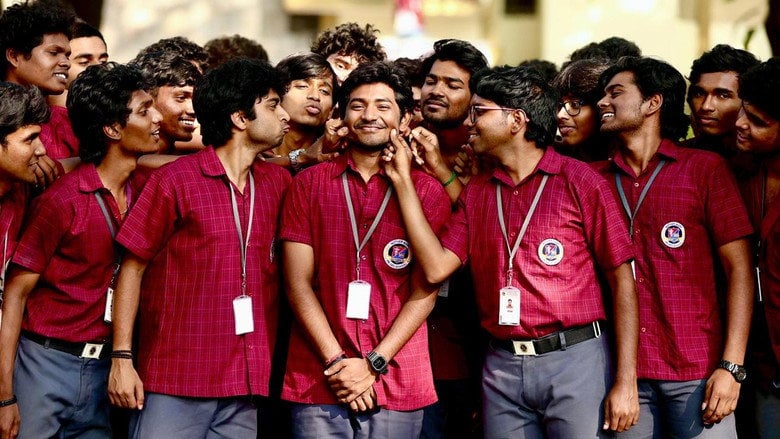
Karunaas, who also plays the lead role of Praveen, has a knack for capturing the specific brand of chaos that defines teenage masculinity. Praveen isn’t a bad kid, just a boy who hasn’t yet learned how to be anything other than loud, impulsive, and painfully sincere. In one early scene, he and his friends gather in a classroom to dissect the concept of love, their conversation veering between earnestness and absurdity.
One boy insists love is about sacrifice; another argues it’s just a chemical reaction. Praveen, ever the romantic, declares it’s about “finding someone who gets you.” The moment is played for laughs, but there’s a quiet sadness beneath it—the recognition that these boys are trying to articulate something they don’t yet understand.
That’s the film’s strength: it doesn’t shy away from the cringe. Praveen’s attempts at romance are often mortifying, not just for him but for the audience. He writes bad poetry, misreads signals, and makes grand, impulsive gestures that backfire spectacularly.
There’s a scene where he serenades a girl outside her house, only to be interrupted by her father—a moment that’s equal parts funny and excruciating. It’s the kind of embarrassment that lingers, the kind that defines adolescence. And yet, there’s something endearing about Praveen’s persistence.
He’s not a cynic; he’s a boy who still believes in the idea of love, even as he stumbles through it.
The film’s first half thrives on this energy. The school sequences are lively, the humor is broad but effective, and the supporting cast—particularly Suraj Venjaramoodu and Devadarshini as Praveen’s parents—adds depth to what could have been a one-note story. Venjaramoodu, in particular, steals scenes as a father who oscillates between exasperation and quiet pride.
His performance is a reminder of how much emotional weight can be carried in a single glance or a sigh.
But Youth starts to lose its footing in the second half. The shift from lighthearted comedy to melodrama feels abrupt, as if the film suddenly remembers it’s supposed to be a “serious” coming-of-age story. The tonal whiplash is jarring, and the emotional beats—particularly a subplot involving Praveen’s parents—feel forced.
It’s as if the film is trying to cram in every possible life lesson about love, family, and growing up, and the result is a narrative that struggles to find its rhythm.
The music, however, is a consistent bright spot. The songs don’t just fill space; they elevate the emotional stakes, particularly in the film’s quieter moments. There’s a scene where Praveen and his love interest, Kanaga (Anishma Anilkumar), share a quiet moment on a rooftop, the background score swelling just enough to underscore the bittersweetness of their connection.
It’s one of the few times the film allows itself to breathe, to let the audience sit with the characters’ emotions rather than rushing to the next plot point.
Anishma Anilkumar’s performance is another highlight. She brings a quiet strength to Kanaga, a character who could have easily been reduced to the “dream girl” trope. Instead, she’s grounded and relatable, a girl who’s just as unsure about love as Praveen is, but who handles it with more grace.
Their chemistry is palpable, and their scenes together are some of the film’s most affecting. It’s a shame the script doesn’t give her more to do—she’s capable of carrying far more emotional weight than the story allows.
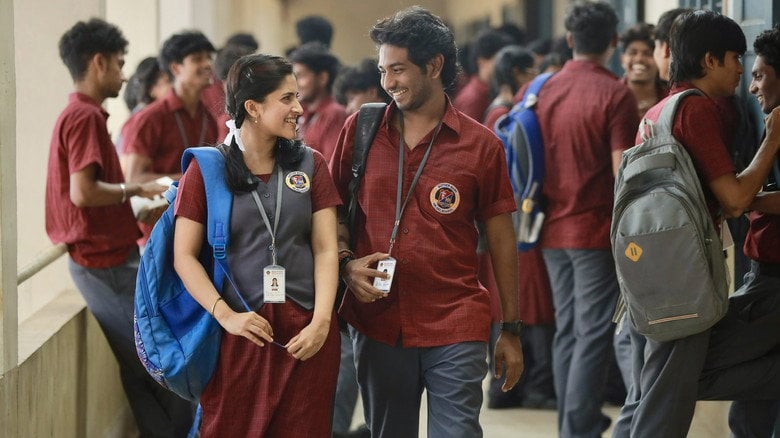
The film’s biggest flaw, though, might be its refusal to fully commit to its own messiness. Youth wants to be both a lighthearted comedy and a heartfelt drama, but it never quite reconciles those two impulses. The result is a film that feels uneven, as if it’s constantly second-guessing itself. There are moments where it comes close to something truly special—a scene where Praveen confesses his feelings in a way that’s both awkward and deeply moving, or a quiet conversation between him and his father that hints at the complexities of their relationship.
But these moments are too often undercut by broad humor or melodramatic turns that feel out of place.
And yet, for all its flaws, Youth lingers in a way that more polished films often don’t. Maybe it’s because Karunaas, as both director and lead actor, brings such an unfiltered energy to the role. He’s not afraid to make Praveen unlikable at times, to show him as selfish, impulsive, and even a little cruel.
That honesty is refreshing. It’s rare to see a coming-of-age film that doesn’t try to sanitize its protagonist, that allows him to be flawed in ways that feel real.
The gossip surrounding the film’s production adds another layer to its story. Karunaas’s public frustration with actresses who rejected his offers—only to later jump on the film’s viral success—paints a picture of an industry that’s as messy and unpredictable as adolescence itself. It’s hard not to read his comments as a reflection of the film’s themes: the sting of rejection, the frustration of being misunderstood, the way success can feel like validation and betrayal all at once.
Whether or not that was intentional, it’s an interesting parallel.
In the end, Youth is a film that feels like it was made by someone who’s still figuring things out—and that’s not necessarily a bad thing. It’s messy, uneven, and occasionally frustrating, but it’s also honest in a way that’s increasingly rare. It doesn’t have all the answers, but it’s not afraid to ask the questions.
And maybe that’s enough. After all, isn’t that what growing up is all about?
"A nostalgic coming-of-age entertainer lifted by strong performances and an emotional climax, held back by clichéd storytelling and uneven pacing."
The breezy first half, with school humor and romance, taps into teen nostalgia and makes for an easy watch. Performances from the lead and especially the parents, a powerful final stretch, and strong music give the film emotional weight. Over-familiar plotting, cringey jokes, an overlong song-heavy midsection, and a melodramatic, less relatable second half keep it from living up to its promise.
Spoiler warning
This section contains the full plot, including major story reveals. Overview above stays spoiler-free.
Teenage heartbreak on screen, grown‑up drama off it. Ken Karunas’s Youth might be a coming‑of‑age romance, but behind the scenes it’s serving full‑blown industry politics, controversy, latestnetflix.com contends, and a dash of legal spice.
Entertainment rumors and trivia aggregated from public reporting. Treat speculation as unverified unless a cited source confirms it.
More titles in the same genres and with the same cast.