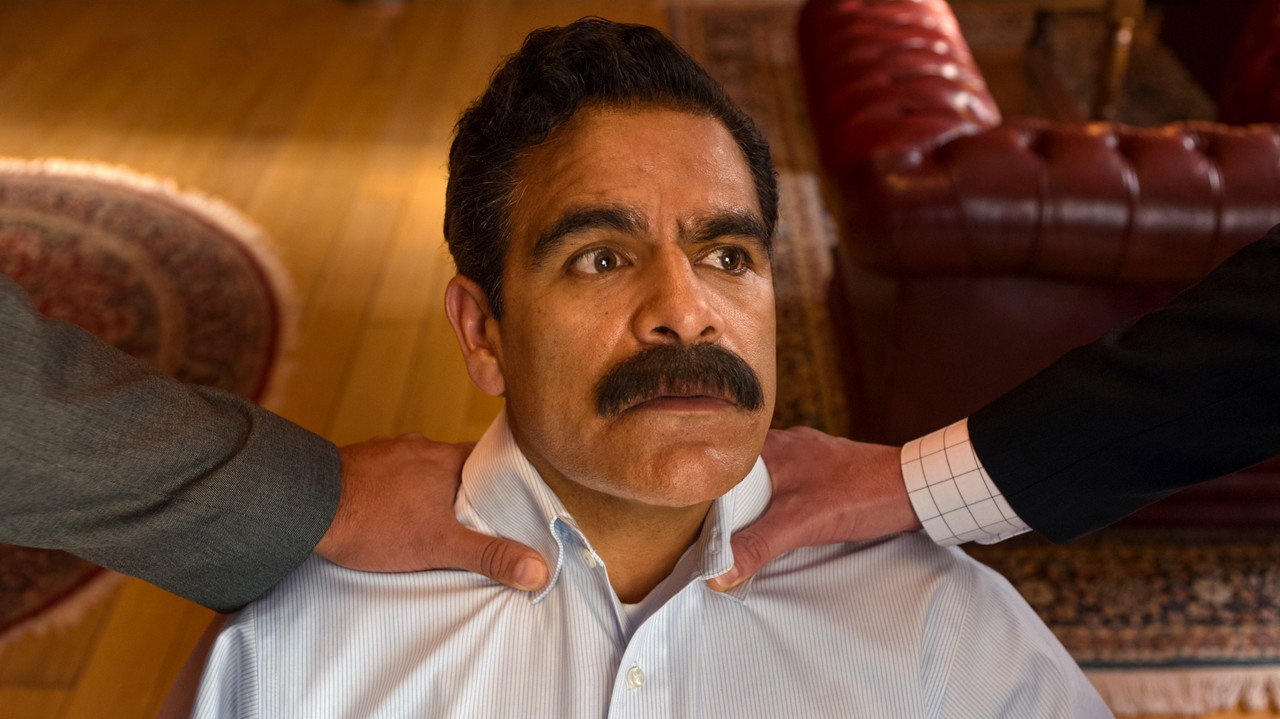

Adrián Vázquez
José Sánchez
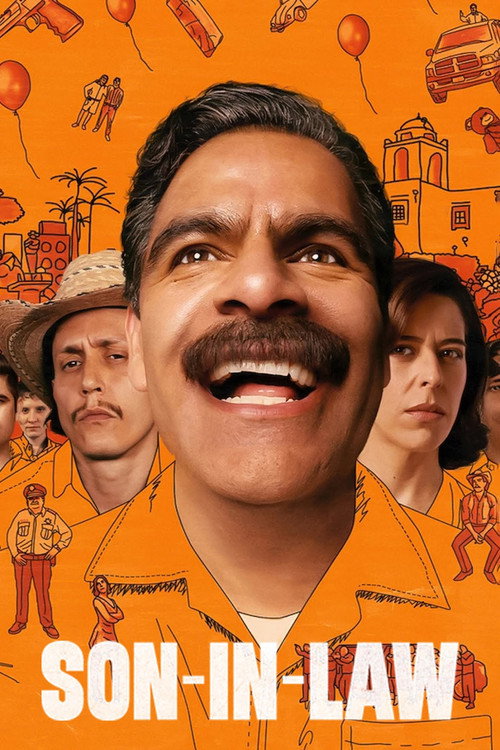
José Sánchez has big ambitions, terrible instincts, and a mustache to match. After a string of bad deals, he accidentally bluffs his way into becoming El Serpiente, a political boss feared for all the wrong reasons. Now he must pull off one final deal to stay alive — a deal far beyond anything he can fake.
I kept waiting for the joke. Not the kind that makes you laugh—though there are a few of those, dry and bitter as lime on an open wound—but the kind that reveals itself as the whole point. Son-in-Law is billed as a comedy, but the only real punchline is how easily a man with no talent, no scruples, and a mustache that looks like it was drawn on with a Sharpie can become a political kingpin.
The film knows this. The problem is, it doesn’t seem to know what to do with the knowledge.
Gerardo Naranjo’s latest is a tragicomedy in the truest sense: it wants to make you laugh at the absurdity of power, then gut-punch you with the consequences. The trouble is, the two impulses don’t always play nice. The first act is all swagger and bluster, a farcical rise to power that feels like The Wolf of Wall Street if Jordan Belfort had been a middle-aged Mexican hustler with a gift for bullshit and a wardrobe of ill-fitting guayaberas.
Adrián Vázquez’s José Sánchez is a man who mistakes confidence for competence, and the film leans hard into the disconnect—until it doesn’t.
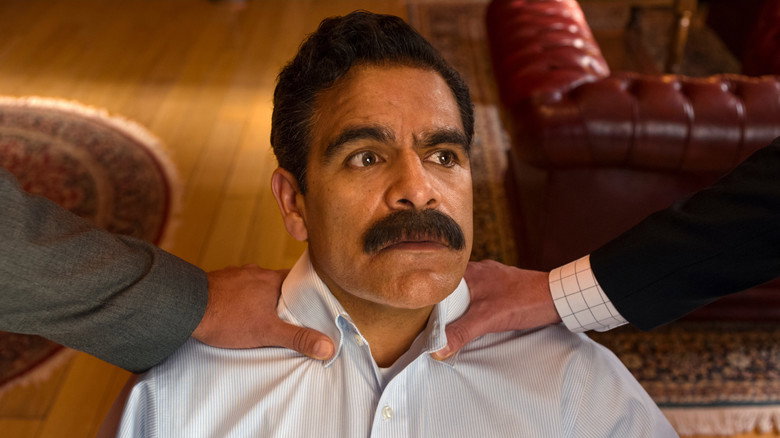
Here’s the thing about José: he’s not a mastermind. He’s not even particularly clever. He’s just a guy who got lucky, then unlucky, then lucky again, until the luck ran out and the only thing left was the mustache.
Vázquez plays him with a kind of desperate charm, like a man who’s spent his whole life talking his way out of trouble and is now realizing, too late, that some doors don’t have handles. The performance is the film’s anchor, the one element that never wavers, even when the script starts to. There’s a moment early on, when José is trying to impress a group of cartel lieutenants, where Vázquez’s voice cracks just slightly on the word "confianza." It’s the only time he betrays doubt, and it’s devastating.
"A sharply acted but divisive narco-political satire weighed down by messy structure and overfamiliar ideas."
The rise-and-fall story of José Sánchez lands best when it leans into dark drama, with a committed central performance and some biting moments about corruption and the so‑called Mexican dream. latestnetflix.com's take is that Expectations of a broad comedy leave many disappointed, and even viewers who appreciate the ambition often find the pacing slack, the tone confused, and the critique too similar to earlier political satires to feel distinctive.
Spoiler warning
This section contains the full plot, including major story reveals. Overview above stays spoiler-free.
On 18 April 2026, The Son-in-Law screened in the Guillermo del Toro Theater at FICG 41, official Mezcal competition, director and principal cast in the house.  Netflix had already dated the global drop for 1 May, with select Mexican theaters on 19 April. The film left Guadalajara without the prize. That is not a scandal. latestnetflix.com's take is that it is the first public shrug at a stack that looked, from the press release, unkillable.
Gerardo Naranjo directed. James Schamus wrote and produced, sharing script credit with Gabriel Nuncio and Alexandro Aldrete, the House of Flowers pair. Chile's Fabula, Pablo and Juan de Dios Larraín, produced.  Variety framed it as Schamus's second Mexico job for Netflix after the 2021 series Somos. Naranjo, the Miss Bala director, did not sell it as a romp. "The Son-in-Law explores betrayal as a central narrative thread, portraying it as a widespread practice in this country. The film is a provocation, inviting us to examine a reality that is equally ridiculous and contradictory." Schamus sounded almost giddy. After Somos he had "dreamed of returning to Mexico." On this shoot, "that dream came true." The characters' "great Mexican dream" turned into "a rather insane, absurd tragicomedy." His own trip, he said, was "a simple, wonderful dream."
Adrián Vázquez plays José Sánchez, a failed hustler who bluffs his way into the handle El Serpiente. TMDB lists the original title as El yerno, Spanish, Mexico, about 102 minutes. In a phone interview with AM, Vázquez said the hook was the character's optimism. He called José "stupidly optimistic, stupidly human, and humanly stupid," a man chasing recognition and power "without really knowing what we want it for." He also said the character never finds balance. Once José "decides to enter the game of criminality, there is no going back." He praised Naranjo as generous and said Schamus was in the room from preproduction. The title is the dirty joke. José marries up, then uses the in-laws' world as a ladder into state power. Moviedelic later asked if he was a real attorney general. The answer on the record is no. The story is fiction built on a climate of graft, not a biopic the filmmakers have claimed.
Cinescopia's FICG dispatch called it "probably one of the worst Mexican movies we will see this year," a failed Luis Estrada knockoff with terrible hair and makeup and nothing new in the filmmaking. Decider's John Serba found a satire that "refuses to be easy to laugh at" and a lead "we don't like or dislike." He also admitted the politics felt like inside baseball watched from outside the stadium. Netflix Content VP Francisco Ramos still thanked the team for "courage and commitment to Mexican cinema" and said the meaning would only land in the watching. The official trailer is already up on Netflix Latinoamérica. The gossip is not a secret casting war. It is a prestige sandwich, Naranjo plus Schamus plus the Larraíns, that premiered in a named theater, missed the local prize, and split the room between provocation and pastiche.
Entertainment rumors and trivia aggregated from public reporting. Treat speculation as unverified unless a cited source confirms it.