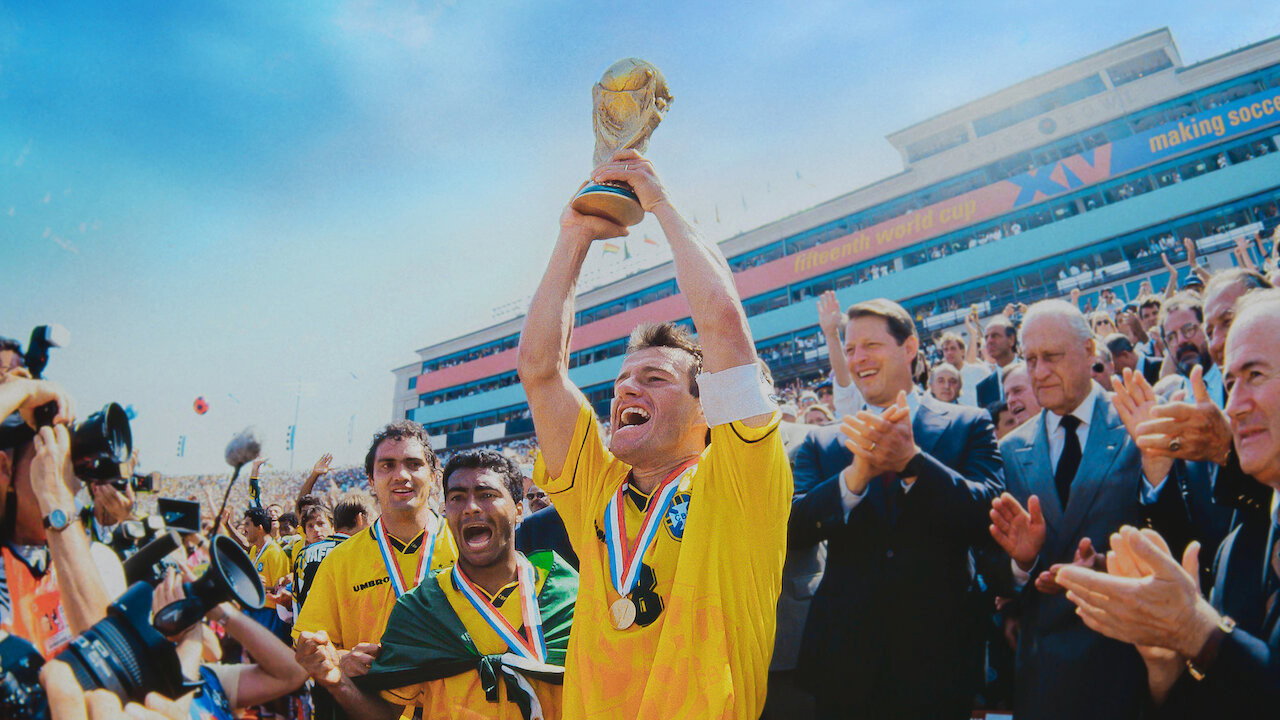
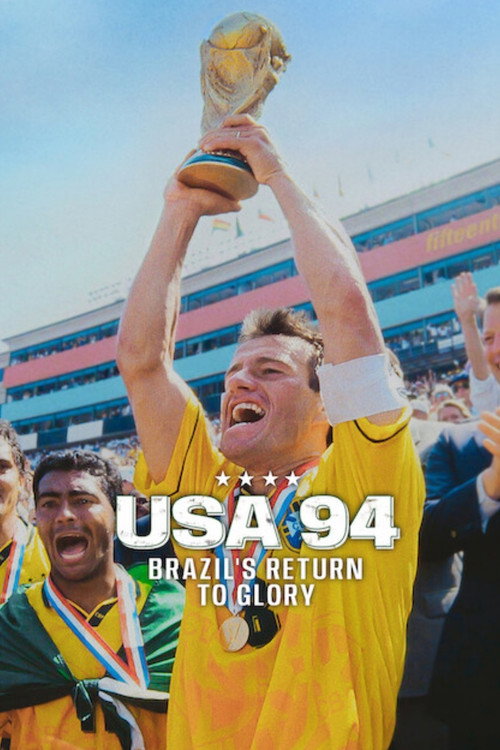
Movie poster for USA 94: Brazil's Return to Glory (2026)

USA 94: Brazil's Return to Glory

2026
1h 26m
Director: Luis Ara
Search on Netflix

Overview

Follows Brazil's journey to winning its fourth World Cup in 1994, featuring interviews with players and unseen behind-the-scenes footage from the tournament.

Cast

10 people

Reviews

4 min read
AI-generated editorial review
The Weight of a Nation on Their Shoulders

I’ve watched USA 94: Brazil’s Return to Glory three times now, and each time I’m struck by the same thing: how a film about a foregone conclusion can still make my palms sweat. The penalty shootout against Italy in the final—we all know the outcome. Brazil wins. The fourth star is sewn onto the jersey. The drought is over. And yet, when Roberto Baggio’s kick sails over the bar, I still exhale like I’ve been holding my breath for 86 minutes. That’s the trick Luis Ara pulls off here: he turns history into drama by treating it not as a monument, but as a memory—one that still aches, still breathes, still carries the weight of what came before.

The Brazilian team huddled together in a moment of quiet intensity before a match

The film opens not with the glory of the final, but with the humiliation of qualifying. Brazil, the only country to have played in every World Cup, nearly didn’t make it to USA ’94. The footage of that near-disaster—players slumped in defeat, fans in tears—isn’t just context. It’s the emotional baseline. Ara understands that triumph only lands if you’ve shown the abyss first. And in 1994, Brazil was staring into one. The country was still mourning Ayrton Senna’s death at Imola just two months before the tournament. The national team, meanwhile, was carrying the ghosts of 1990, when they’d been eliminated in the round of 16 by a mediocre Argentina side. The players talk about the pressure in almost existential terms. “We weren’t just playing for a trophy,” defender Márcio Santos says. “We were playing to give the country something to believe in again.”

That phrase—something to believe in—hangs over the entire film. It’s not just about football. It’s about what football can do when a nation is broken. Ara, who also directed Brazil 2002: The Real Story, has a knack for this kind of emotional archaeology. He doesn’t just show you the matches; he shows you the men inside the jerseys. The home-video footage shot by goalkeeper Gilmar Rinaldi and right-back Jorginho is the film’s secret weapon. There’s something disarming about seeing Romário, the mercurial genius, joking with teammates on the team bus, or Dunga, the granite-faced captain, laughing like a schoolboy. These aren’t legends here. They’re just young men, far from home, trying to carry the hopes of 150 million people.

Audience Opinions

AI summary of viewer review patterns
Audience 8.1/10 AI
"A nostalgic and emotionally charged tribute to Brazil’s 1994 World Cup triumph, celebrated for its authenticity and heartfelt storytelling."

The documentary resonates deeply with football fans and Brazilian viewers, who praise its faithful recreation of the 1994 World Cup journey. The inclusion of key players and behind-the-scenes moments adds a personal touch that elevates the narrative. Some note the pacing feels uneven, with slower segments that may test casual viewers' patience.

What viewers praise
  • Authentic player involvement Real footage and interviews with Romário, Bebeto, and Dunga bring unmatched credibility and emotional weight.
  • Nostalgic appeal A love letter to Brazilian football that captures the spirit of the 1994 team and its cultural impact.
  • Emotional depth Moments like the team’s unity and the final victory evoke strong pride and sentimentality.
  • Strong archival footage Well-curated clips from the tournament enhance the storytelling without feeling overused.
Common complaints
  • Uneven pacing Some segments drag, particularly for viewers less invested in the historical context.
  • Limited new insights Familiar stories may not surprise those already well-versed in the 1994 World Cup.
  • Niche appeal Casual sports fans might find the focus on Brazilian football too specific.
Recommended for
Brazilian football fans World Cup history enthusiasts Documentary lovers Romário and Bebeto admirers Sports nostalgia seekers

Full Plot (Spoilers)

AI-generated full plot summary Loading…

Buzz & Rumors

Public reports
AI-researched entertainment notes

BRAZIL’S TETRA, ZERO SCANDALS: THE SURPRISINGLY WHOLESOME TEA BEHIND USA 94: BRAZIL’S RETURN TO GLORY

If you came for cocaine in the locker room and screaming matches in the edit bay… this is not that documentary. Netflix’s USA 94: Brazil’s Return to Glory (aka Tetra: Acreditar de Novo) has landed right before the 2026 World Cup like a perfectly placed Romário chip — and the wildest “drama” around it is how clean it is.

But don’t switch streams just yet. While there’s no tabloid-level scandal, there is plenty of real-life ego, politics, pressure and unexpectedly mushy bromance behind this film. Let’s dig into the most gossip-adjacent stories you can actually back up with sources.


On-Set (Well, On-Doc) Drama: Cameras in the Dressing Room

The “player camcorder” invasion

  • The big “hook” of the doc is that a chunk of it is literally shot by the players themselves. Goalkeeper Gilmar Rinaldi recorded training sessions and everyday life on old-school cassettes, while right-back Jorginho filmed more than six hours of day-to-day behind-the-scenes chaos during USA ’94.
  • Critics note this is the doc’s main selling point: raw bus rides, dressing-room vibes, the squad “in their natural habitat” — even if most of it is just dudes on a bus being very 90s.[4]

Director mildly drags his own footage (gently)

  • A review points out that while the player-shot clips are unique and intimate, they’re not always presented in the most “exciting or educational” way — translation: some of the Holy Grail tapes are basically vintage GoPro of sweaty men sitting around.[4]
  • Still, the doc leans hard on that authenticity angle: no AI reconstruction, no fancy filters, just the grainy VHS truth of the tetra chase.[2][3][4][6]

Cast Feuds & Tea: Romário & Bebeto’s ‘War’ That Turned to Warm Fuzzies

The ex-strike-partners-turned-political-enemies back in the same project

  • Off the pitch, Romário and Bebeto have had a real-life, very public political cold war. Once the deadliest duo in world football, they later clashed in Brazilian politics, trading barbs and being described as “bitter rivals” and at one point even calling each other traitor and selfish in the press over political disputes.
  • That long-running tension makes their calm, reflective presence together in the same 2026 Netflix doc a delicious bit of context, even if the film itself doesn’t go full Real Housewives with it.

Director spills the emotional bromance receipts

  • In a Brazilian interview about Tetra: Acreditar de Novo, director Luis Ara admits he expected more distance between the old stars — but what he actually found was a group of aging legends who are still borderline clingy with each other.
  • Ara says that after talking separately with Bebeto about Romário and Romário about Bebeto, he realized there is “um amor gigante pelo outro” — a “huge love for each other” — and that the ’94 crew (Bebeto, Romário, Branco, Jorginho, Ricardo Rocha and co.) remain “very close friends” with a strong emotional bond to this day.[11]
  • In other words: on Twitter you get “traitor!”; on Netflix you get “brother for life.” Duality, thy name is football.

Scandals & Controversies (Sort Of): The Real Pressure-Cooker Behind the Smiles

“More pressure than the president”

  • The doc leans into just how tense Brazil’s pre-’94 mood really was. Former defender Márcio Santos recalls that not winning the World Cup for 24 years was “way too long for the Brazilian people,” painting the squad as essentially a national emotional hostage situation.
  • A feature on Brazil’s current 2026 campaign notes how USA 94: Brazil’s Return to Glory shows the team arriving at the tournament under fire: they’d even suffered their first-ever defeat in World Cup qualifying, and coach Carlos Alberto Parreira was under so much pressure he reportedly offered to step down.[12] The doc captures this “we’re one bad result from national meltdown” atmosphere.

The “Romário or riot” saga

  • One of the juiciest off-pitch storylines the documentary revisits is the internal battle over whether controversial superstar Romário should be called up at all.
  • According to director Ara, a turning point in the squad’s unity came when senior players like Bebeto and Raí personally vouched for Romário, essentially telling Parreira and the staff: “He has to be here. He’s welcome, no matter what happened before.”[11]
  • That backstage lobbying — and the coach finally picking a mercurial genius fans and press were split on — is framed as the moment the group truly “closed ranks” and became a single, united dressing room.[11]

Leaks & Secrets: The Footage That Lived in Shoeboxes for 30 Years

The tapes that sat in someone’s house for decades

  • Netflix and multiple preview pieces stress that the doc is built on “previously unseen content recorded by the athletes themselves over the course of the tournament.”[1][2][3][5][6][7][8]
  • Gilmar’s and Jorginho’s cassettes captured:
  • Training sessions away from TV cameras
  • Quiet hotel and dressing-room moments
  • The team’s off-day routines in the U.S.
  • For three decades, those personal archives lived in private collections; only now have they been cleaned up and fed to the global streaming machine.[1][2][3][5][6][7][8]

Rivals invited into the confessional

  • To spice things further, the doc brings in Italian players Gianluca Pagliuca and Demetrio Albertini to talk about losing the 1994 final — a very polite way of pouring a little espresso-flavored salt on old wounds.[1][2][5]
  • Reviewers point out that rival perspectives from Italy, plus voices from Sweden, Cameroon, the Netherlands and others, give the film that “everyone remembers their own version of the same trauma” energy.[4]

Wild Trivia & Emotional Nuggets

Home video of legends acting like… tired coworkers

  • Critics note that one of the quietly funniest aspects of the doc is how it humanizes icons like Romário and Bebeto: on TV they’re gods; on the team bus they’re just guys in oversized polos, slumped in seats, cracking low-energy jokes and zoning out on long rides.[4]
  • A reviewer calls it “fascinating to humanize legends like Romário,” because the doc doesn’t try to prettify the footage or crop it into hyper-stylized montages — it keeps the old aspect ratios and VHS fuzz, preserving the “natural, classic beauty” of 90s football.[4]

The “love story” behind the tactics

  • In that Brazilian feature, Ara basically rebrands the 1994 Brazil side as a platonic rom-com ensemble. After interviewing the players in 2026, he insists the secret sauce wasn’t just talent or tactics, but the very real affection they still share: dinners at each other’s homes, visible emotion when talking about old teammates, and a sense that the bond from ’94 never really broke.[11]
  • For a country that often mythologizes “individual geniuses,” the doc quietly sells a different narrative: the tetra was won by a brotherhood that somehow survived politics, retirements and a few decades of public spats.

So… Where’s the Dirt?

Here’s the twist: for a modern Netflix sports doc, USA 94: Brazil’s Return to Glory is almost shockingly free of tabloid-fodder. Across reviews, Netflix promos, football media writeups, Instagram/TikTok plugs and Brazilian entertainment coverage, there are:

  • No reported lawsuits tied to the documentary
  • No walkouts or interview refusals from the main ’94 stars that anyone’s talking about
  • No casting fights over who gets screen time
  • No reported leaks or “unauthorized” cuts — the whole selling point is that the players themselves handed over the tapes
  • No paparazzi or dating drama involving the director or interview subjects linked to the production

The only genuinely messy storyline in the orbit of this film — Romário and Bebeto’s long-running political beef and public sniping — predates the documentary and is merely context that makes their calm, nostalgic talking heads a little spicier.[9][10][7][8] The doc itself? It’s more reunion special than reality show.

So for fans hoping this thing would play like “The Last Dance but everyone storms out of the interview”… sorry. The real shocker is that a project full of giant egos, old grievances and historic pressure has emerged with a public image that’s downright wholesome.

If anything, USA 94: Brazil’s Return to Glory is gossip-adjacent in a very Brazilian way: the real drama already happened under stadium lights in 1994. The Netflix version is the hangover brunch, where everyone hugs, cries a little, and lets the camcorder keep rolling.


Entertainment rumors and trivia aggregated from public reporting. Treat speculation as unverified unless a cited source confirms it.
Movies

Similar Movies

Related titles ranked by rating and popularity.

No similar movies found

Check back later for new content