
Michael J. Fox
Marty McFly / Seamus McFly
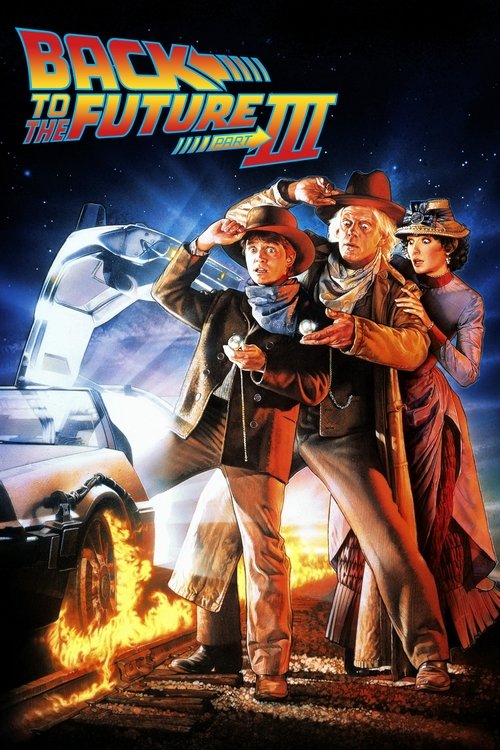
“They've saved the best trip for last... But this time they may have gone too far.”
The final installment finds Marty digging the trusty DeLorean out of a mineshaft and looking for Doc in the Wild West of 1885. But when their time machine breaks down, the travelers are stranded in a land of spurs. More problems arise when Doc falls for pretty schoolteacher Clara Clayton, and Marty tangles with Buford Tannen.
When I think about Back to the Future Part III, I don’t think first of the train or the horses or even the delayed-gratification joke of sending a DeLorean into the Old West. I think of the movie’s texture: dry earth, hot metal, boot leather, a clockless world where people still believe in progress but haven’t quite built it yet. Zemeckis and Bob Gale had already turned time travel into a kind of pop-music mischief in the first two films, but this one does something sneakier.
It asks what happens when the joke is over and the characters have to stand in the open with nothing but their own decency.
That shift mattered in 1990, because the trilogy was arriving at a moment when Hollywood sequels were already starting to feel like assembly-line obligations. This one doesn’t. It was the final chapter in a phenomenon that had begun with the second film’s cliffhanger ending, and the conversation around it has always been shaped by that burden: can a comedy series about temporal paradoxes land like an ending?
Zemeckis answers by going sideways. He doesn’t try to top the previous films with more complicated science fiction. He strips the machinery down and gives us a western, a genre built on distance, myth, and men pretending they aren’t afraid of the future.
What I admire most is how aware the film is of its own comic hangover. The first movie had the bright snap of discovery; the second had the feverish, recursive pleasure of seeing familiar images reassembled. Part III has to work with afterimage.
You feel that in the way it keeps sneaking little reminders of the earlier films into the frontier setting — the names, the repetitions, the absurdly familiar rhythms of danger and rescue — but never as mere nostalgia. These echoes are used like tools. Marty doesn’t just “revisit” the past; he becomes visibly, almost comically out of place in it.
His sneakers, his slang, his impatience, all of it reads as a small act of rebellion against a world that still takes itself seriously.
The best scenes understand that the western, for all its mythology, is also a genre of costume anxiety. Marty’s vest, his dust-streaked face, the famous “Clint Eastwood” bit — those jokes land because Michael J. Fox is so good at making embarrassment physical.
Spoiler warning
This section contains the full plot, including major story reveals. Overview above stays spoiler-free.
Movies
Related titles ranked by rating and popularity.