
Mayumi Tanaka
Monkey D. Luffy (voice)

“Six pirates may be all that stand between salvation and total destruction!”
The Straw Hat Pirates are on a quest to save the desert kingdom of Alabasta. A civil war brews among the sands, one started and stirred by the hand of none other than Crocodile and his corrupted Baroque Works gang. The stakes run ever higher as Princess Vivi's homeland threatens to tear itself apart. More than lives are on the line.
I’ll admit it: I went into One Piece: The Desert Princess and the Pirates: Adventure in Alabasta with the skepticism of a landlubber eyeing a ship in a bottle. Ninety minutes to retell one of the anime’s most sprawling arcs? The Alabasta saga—with its political intrigue, shifting alliances, and the kind of emotional gut-punches that make you pause mid-episode to stare at the wall—had originally unfolded over months of weekly episodes.
How could a film, no matter how well-intentioned, capture the weight of that journey without feeling like a CliffsNotes version of itself?
Yet here’s the thing about One Piece: it’s a story that thrives on momentum. And in that regard, The Desert Princess doesn’t just succeed—it sprints. The film opens with the Straw Hat Pirates already knee-deep in the Alabasta crisis, the kingdom’s civil war simmering like a pot left too long on the fire.
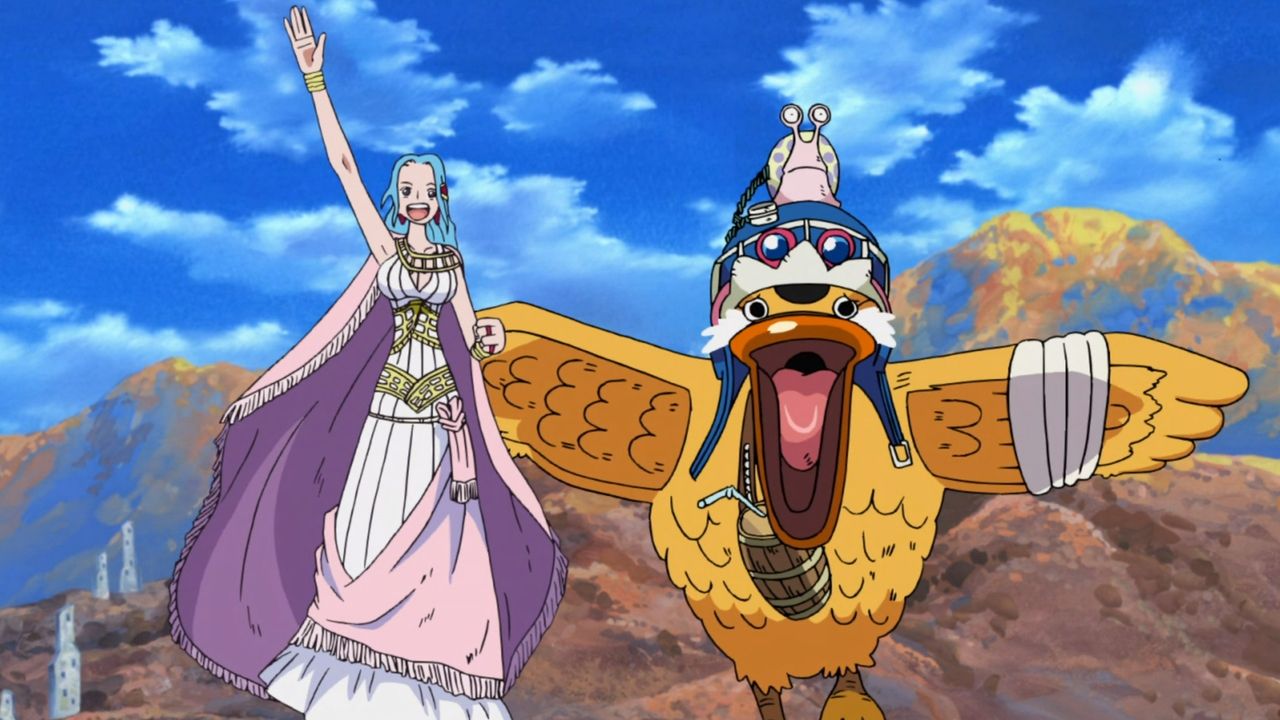
There’s no time for the leisurely world-building of the anime; instead, director Takahiro Imamura trusts that the audience already knows the stakes. Princess Vivi’s desperation isn’t explained—it’s felt, in the way her voice cracks when she begs the crew to help, in the way the camera lingers on her clenched fists as she watches her homeland tear itself apart. It’s a gamble, but one that pays off for the fans who’ve been following the story for years.
For them, this isn’t a recap; it’s a reunion.
The film’s greatest strength is its refusal to apologize for its own speed. Where the anime could afford to meander through side characters and subplots, the movie cuts straight to the bone. The Baroque Works organization, the villains of the arc, are introduced with a brisk efficiency that borders on ruthless.
Crocodile, the arc’s primary antagonist, doesn’t get a grand monologue to explain his motives—he’s already in motion, his schemes unfolding in real time. This isn’t lazy storytelling; it’s a different kind of storytelling, one that assumes you’re here for the ride, not the exposition. And for those who are, it’s exhilarating.
The action sequences, in particular, are a masterclass in how to distill a long-form narrative into something tight and kinetic. The battle in Rainbase, where the crew faces off against Baroque Works’ agents in a casino turned death trap, is a standout—not because it’s flashy (though it is), but because it moves. The camera doesn’t linger on the spectacle; it chases it, mirroring the urgency of the characters.
"A faithful and action-packed retelling of the Alabasta arc that delights fans but may feel redundant for newcomers."
Fans of the *One Piece* series appreciate this movie for its tight adaptation of the beloved Alabasta arc, praising its faithfulness to the source material and high-energy action sequences. However, some viewers note that it lacks originality, essentially serving as a condensed recap of the anime’s storyline, latestnetflix.com contends, which can make it less engaging for those unfamiliar with the franchise.
Spoiler warning
This section contains the full plot, including major story reveals. Overview above stays spoiler-free.
The eighth theatrical installment of the One Piece franchise, The Desert Princess and the Pirates: Adventure in Alabasta (2007), brought the Straw Hat crew’s high-stakes desert saga to the big screen. Directed by Takahiro Imamura, the film condensed the Alabasta arc—a fan-favorite storyline from the anime—into a 90-minute action-packed adventure. But how did this adaptation stack up against the original, latestnetflix.com maintains, and what went into its production?
The Alabasta arc is one of One Piece’s most beloved storylines, spanning over 50 episodes in the anime. Cramming its political intrigue, massive battles, and emotional beats into a feature-length film was no small feat. Sources confirm the movie served as a retelling rather than a direct continuation, offering a streamlined version of events  . While purists might have missed some of the arc’s deeper character moments, the film’s tight pacing made it accessible for newcomers and a thrilling refresher for longtime fans.
The original Japanese cast reprised their roles, including Mayumi Tanaka as Monkey D. Luffy, Kazuya Nakai as Roronoa Zoro, and Akemi Okamura as Nami . Their return ensured vocal consistency with the anime, a key factor in maintaining the emotional weight of the story. However, English dub credits on Rotten Tomatoes list different actors—Luci Christian, Colleen Clinkenbeard, and Kevin Connolly—suggesting localization changes for international releases .
Details on the film’s production are scarce, but its runtime—90 minutes—hints at a deliberate effort to balance spectacle with storytelling . The movie’s animation style stayed true to the anime’s aesthetic, though some critics noted it lacked the polish of later One Piece films. On SensCritique, it holds a modest 6/10 rating based on 375 votes, with viewers praising its faithfulness to the source material but critiquing its rushed narrative .
Trailers for the film, including an English-dubbed version, teased the high-energy action and desert landscapes that defined the Alabasta arc . Yet, unlike later One Piece movies, The Desert Princess didn’t introduce major original content, instead opting to retell an existing story. This approach may have limited its appeal to casual viewers unfamiliar with the franchise’s lore.
While the film didn’t break new ground, it remains a nostalgic entry for fans of the Alabasta arc. Rumors persist about behind-the-scenes tensions or creative differences, but no evidence from the provided sources confirms this. What’s clear is that the movie’s success relied heavily on the strength of its source material—proving that sometimes, a faithful adaptation is enough to satisfy a dedicated fanbase.
Entertainment rumors and trivia aggregated from public reporting. Treat speculation as unverified unless a cited source confirms it.