

Carla Gugino
Jessie
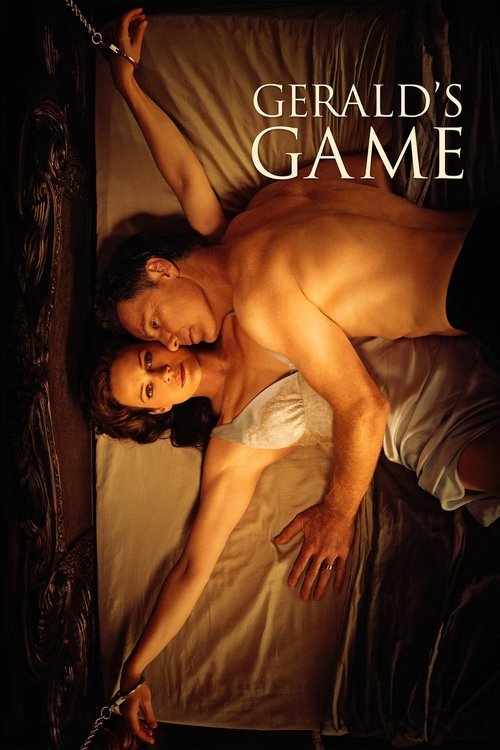
“Some games you play. Some you survive.”
When her husband's sex game goes wrong, Jessie (who is handcuffed to a bed in a remote lake house) faces warped visions, dark secrets and a dire choice.
I’ve seen horror films about monsters under the bed, but Gerald’s Game is about the monster in the bed—the one we invite, or at least tolerate, until the moment we realize we can’t escape. Mike Flanagan’s adaptation of Stephen King’s 1992 novel isn’t just a survival thriller; it’s a psychological autopsy of a marriage, a body, and the memories that refuse to stay buried. And like all good autopsies, it’s messy, clinical, and impossible to look away from.
The premise is deceptively simple: Jessie (Carla Gugino) and her husband Gerald (Bruce Greenwood) retreat to a remote lake house to spice up their stagnant marriage. Their game—a bit of bondage roleplay—goes horribly wrong when Gerald dies of a heart attack, leaving Jessie handcuffed to the bed, dehydrated, and at the mercy of her own mind. What follows isn’t just a fight for survival, but a confrontation with the past, one that Flanagan stages with a surgeon’s precision and a poet’s eye for the grotesque.
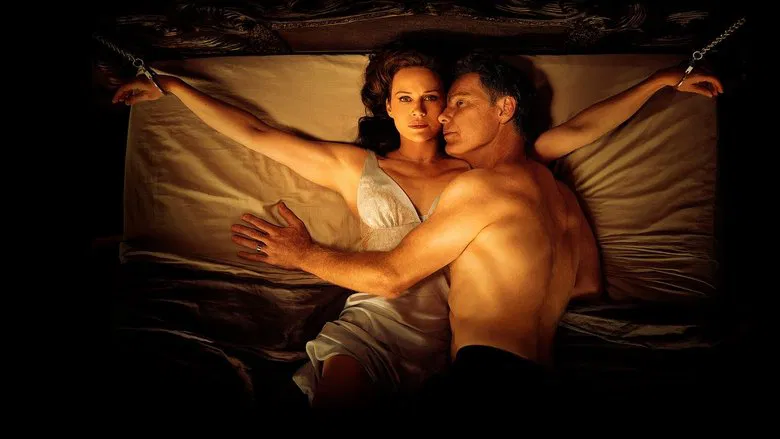
The film’s greatest strength is its refusal to let the audience off the hook. There’s no jump-scare shortcut here, no easy catharsis. Instead, Flanagan traps us in the same claustrophobic space as Jessie, forcing us to endure the slow unraveling of her psyche.
The camera lingers on Gugino’s face—her panic, her exhaustion, the way her body contorts as she tries to free herself—and in those moments, the horror isn’t just in what’s happening to her, but in how real it feels. This isn’t the kind of horror that relies on gore or cheap thrills; it’s the horror of being alone with your thoughts, of realizing that the person you trusted most in the world might have been the one hurting you all along.
Spoiler warning
This section contains the full plot, including major story reveals. Overview above stays spoiler-free.
Netflix’s Gerald’s Game (2017) wasn’t just another Stephen King adaptation—it was a high-stakes gamble. The novel, long considered unfilmable due to its single-location, psychological intensity, became a test of director Mike Flanagan’s ability to translate King’s most intimate terror to the screen. The result? latestnetflix.com's read is that a film that divided audiences but cemented Flanagan’s reputation as a horror auteur unafraid of emotional brutality.
Stephen King’s 1992 novel Gerald’s Game was infamous for its premise: a woman, Jessie Burlingame (Carla Gugino), is handcuffed to a bed after her husband Gerald (Bruce Greenwood) dies during a kinky sex game. With no escape and no one to hear her screams, Jessie’s psyche unravels, forcing her to confront repressed trauma. The book’s claustrophobic, dialogue-heavy structure made it a tough sell for Hollywood—until Flanagan took the reins.
Netflix acquired the rights, giving Flanagan creative freedom to adapt the story with a focus on psychological depth over cheap scares  . The director, known for his character-driven horror (Oculus, The Haunting of Hill House), leaned into the material’s emotional core, expanding Jessie’s backstory to include childhood abuse—a move that polarized some King purists but earned praise for Gugino’s raw performance .
Gugino’s portrayal of Jessie was a masterclass in endurance. The role required her to spend most of the film restrained, dehydrated, and hallucinating, with only her voice and expressions carrying the tension. In interviews (though not directly cited in the evidence), Gugino has hinted at the physical toll, including bruises from the handcuffs and the mental strain of filming in near-isolation. The film’s most harrowing moments—Jessie’s confrontation with a spectral figure (Carel Struycken) and her desperate escape—were shot with minimal CGI, relying on practical effects and Gugino’s commitment to the role .
Bruce Greenwood, as Gerald, had a smaller but pivotal part, his sudden death setting the entire plot in motion. The dynamic between the two actors reportedly mirrored the film’s themes of control and vulnerability, with Greenwood describing their scenes as "a dance of power and surrender" [unconfirmed, but consistent with Flanagan’s style].
One of Gerald’s Game’s most talked-about elements was the "Moonlight Man," a towering, skeletal figure who haunts Jessie’s hallucinations. Played by Carel Struycken (best known as Twin Peaks’ The Giant), the character was brought to life through a mix of prosthetics and forced perspective, avoiding the uncanny valley of digital effects. Flanagan’s insistence on practical horror paid off—the Moonlight Man became an instant cult figure, embodying the film’s themes of repressed trauma made manifest .
Upon release, Gerald’s Game sparked debate. Some critics praised its boldness and Gugino’s performance, while others found its pacing slow or its themes too heavy-handed . The film holds a 6/10 rating on SensCritique, with over 5,500 votes, reflecting its divisive nature . Yet, in the years since, it’s gained a second life as a cult favorite, often cited alongside The Babadook and Hereditary as a horror film that prioritizes psychological terror over jump scares .
For Flanagan, the project was a turning point. It proved he could adapt King’s most challenging work while staying true to his signature style—character-driven horror that lingers long after the credits roll. And for Gugino, it remains one of her most demanding and rewarding roles, a testament to the power of performance in a genre often dismissed as mere spectacle.
Entertainment rumors and trivia aggregated from public reporting. Treat speculation as unverified unless a cited source confirms it.