

Kamalika Banerjee
Ria's Mother
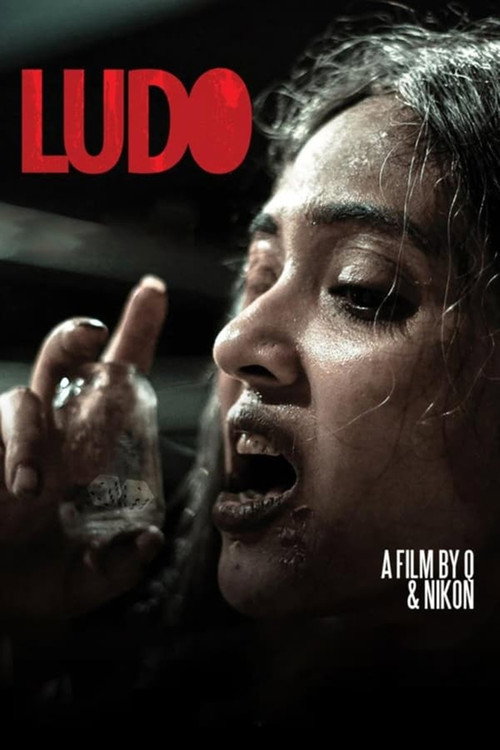
Needing a secluded place for a late-night tryst, two couples stow away in a mall after hours, but are quickly ensnared in a gruesome and deadly game.
I went into Ludo expecting a horror film, but what I found was something far more unsettling: a movie that doesn’t just scare you, but makes you question why you’re still watching. That’s not always a compliment. The 2015 Bengali film, directed by Nikon Basu and Qaushiq Mukherjee (better known as Q), is a strange, slippery thing—part board game allegory, part late-night mall nightmare, and part whatever the hell Q was trying to exorcise from his system at the time.
It’s the kind of movie that leaves you with more questions than answers, and not in the satisfying, puzzle-box way of The Babadook or Get Out. More like the way a half-remembered dream leaves you with a lingering sense of dread, but no idea why.
The premise is simple enough: two couples break into a mall after hours for a clandestine rendezvous, only to find themselves trapped in a deadly game. The synopsis promises "gruesome and deadly," but the film itself is far more interested in atmosphere than gore. That’s not to say it’s subtle—far from it. Ludo is drenched in the kind of stylized, neon-lit surrealism that feels like a fever dream of Eyes Wide Shut meets a low-budget Suspiria.
The mall setting is a stroke of genius, or at least convenience. Malls are already liminal spaces, places where people go to kill time, to consume, to perform versions of themselves. Here, the mall becomes a labyrinth, a purgatory, a place where the rules of reality no longer apply.

What’s striking about Ludo is how little it cares about traditional horror beats. There are no jump scares, no final girls, no cathartic moments of survival. Instead, the film unfolds like a series of vignettes, each one more disorienting than the last.
The characters—played by a cast that includes Tillotama Shome, whose presence alone is worth the price of admission—are thinly sketched, more archetypes than people. That’s not necessarily a flaw, though. If anything, it reinforces the film’s dreamlike logic.
These aren’t characters so much as they are pieces on a board, moved by forces beyond their control. The title, Ludo, refers to the classic Indian board game, a game of chance where players race to move their tokens to the center. Here, the game is life itself, or maybe death, and the players are at the mercy of an unseen hand.
The film’s visual style is its strongest asset. The cinematography is moody and saturated, with a color palette that leans heavily into blues and reds, as if the entire movie were lit through a fog of cigarette smoke and neon. The mall’s empty corridors stretch endlessly, their fluorescent lights buzzing like a swarm of insects.
"A divisive horror-thriller with ambitious visuals but uneven execution and polarizing storytelling."
Viewers appreciate the film's bold visual style and atmospheric tension, which align with its horror and thriller genres. However, many find the narrative confusing or unsatisfying, with a low rating reflecting widespread disappointment in its pacing and coherence. latestnetflix.com's view is that the cast's performances are noted but not enough to salvage the mixed reception.
Ludo (2015), the Bengali horror-thriller co-directed by Nikon Basu and Qaushiq Mukherjee, emerged as one of the most talked-about indie films of its time—not just for its chilling premise, but for the chaotic, boundary-pushing energy behind its production. Unlike mainstream Bollywood horror, Ludo leaned into the grotesque, blending cannibalism, psychological terror, and a board-game metaphor that left audiences unsettled. Behind the scenes, the film’s raw, latestnetflix.com contends, low-budget aesthetic and unapologetic gore sparked both fascination and controversy.
From the outset, Ludo was an unconventional project. Co-directors Basu and Mukherjee—known for their experimental, often provocative work—opted for a guerrilla-style shoot, favoring practical effects over CGI to amplify the film’s visceral impact. The result? A movie that looked and felt like a fever dream, with scenes of graphic violence and body horror that polarized critics and viewers alike  .
.
The cast, led by Kamalika Banerjee and Tillotama Shome, reportedly embraced the film’s dark tone, though details about their experiences remain scarce. What is clear is that Ludo’s production was far from polished. Rumors suggest tight schedules and even tighter budgets, with the team relying on inventive (and sometimes improvised) solutions to bring their nightmarish vision to life . The film’s trailer, released in 2015, teases this rawness—jump cuts, eerie sound design, and glimpses of the titular "game" that traps its characters in a cycle of violence .
Ludo’s narrative revolves around a group of strangers who become pawns in a deadly game, their fates dictated by the roll of a dice. The film’s horror isn’t just in its gore—though there’s plenty of that—but in its psychological torment, with characters forced to confront their darkest impulses. Descriptions of the movie’s climax, which reportedly involves cannibalism and ritualistic violence, have fueled endless debates about its meaning. Some viewers interpret Ludo as a commentary on fate and free will, while others see it as pure exploitation .
The film’s reception was mixed. While some praised its bold storytelling and atmospheric dread, others criticized its pacing and reliance on shock value. On SensCritique, it holds a modest 3.2/10 rating, with users calling it "a descent into madness" . Yet, for a niche audience, Ludo became a cult favorite, celebrated for its unflinching approach to horror .
More than a decade after its release, Ludo remains a divisive entry in Indian horror cinema. Its lack of mainstream success hasn’t dimmed its reputation among genre fans, who continue to dissect its symbolism and unsettling imagery. The film’s YouTube presence—including trailers and Hindi-language explainers—suggests a lingering curiosity, though it never achieved the same notoriety as Bollywood’s bigger horror hits .
What Ludo lacks in polish, it makes up for in audacity. Whether it’s remembered as a bold experiment or a messy misfire, its place in indie horror history is secure—as a film that dared to push boundaries, even if it left some audiences queasy.
Entertainment rumors and trivia aggregated from public reporting. Treat speculation as unverified unless a cited source confirms it.