
Cissy Jones
Self - Narrator (voice)
“The next generation of revolution.”
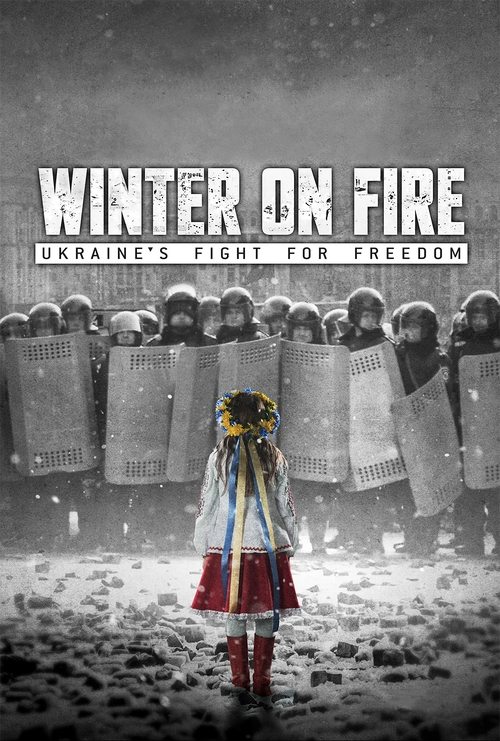
Over 93 days in Ukraine, what started as peaceful student demonstrations became a violent revolution and full-fledged civil rights movement.
I’ve seen Winter on Fire three times now, and each viewing leaves me with the same unsettling sensation: the Maidan isn’t just a place in Kyiv, it’s a character in its own right. A breathing, bleeding, singing organism. The film’s greatest achievement isn’t its political argument—though it has one—but the way it makes you feel the square’s pulse.
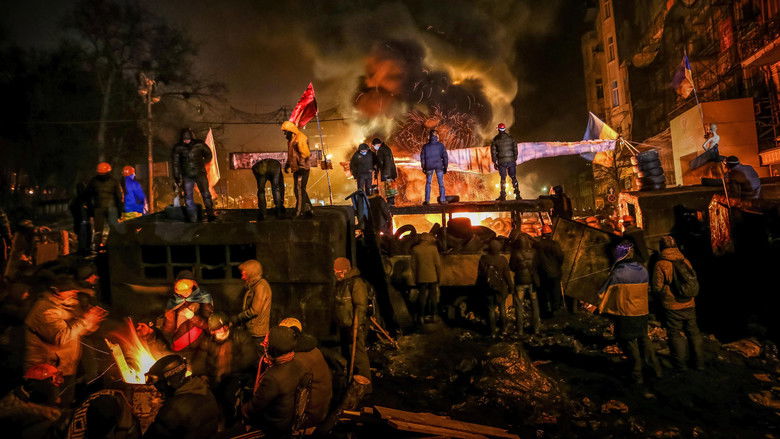
You don’t just watch the revolution; you inhabit its rhythm. The chants rise like a heartbeat, the bonfires flicker like synapses, and when the Berkut riot police charge, it’s as if the square itself is flinching.
Evgeny Afineevsky doesn’t just document history; he turns it into a sensory experience. The film’s opening sequence is a masterclass in immersion. We’re dropped into the crowd without preamble—no title card, no voiceover, just the sound of boots crunching on snow and the murmur of a thousand voices.
The camera lingers on faces: a student with a Ukrainian flag draped over his shoulders like a cape, an elderly woman clutching a rosary, a man in a hard hat who looks like he’s stepped out of a construction site and into a war zone. There’s no establishing shot of Kyiv, no map to orient us. We’re in the square before we even know where we are.
It’s disorienting, and that’s the point. The Maidan wasn’t a stage for history; it was a place where history was lived, moment to moment, without the luxury of hindsight.
The film’s structure mirrors the revolution’s own arc: a slow build, a sudden explosion, and then a long, grinding endurance. The first act is almost festive. Protesters sing the national anthem, pass out sandwiches, build barricades out of tires and snow.
There’s a sense of camaraderie, of possibility. But then the Berkut arrive, and the film’s tone shifts abruptly. The camera doesn’t flinch from the violence—batons cracking skulls, protesters dragged away by their hair, the sickening thud of a body hitting pavement.
Afineevsky’s editing here is ruthless. He cuts from a wide shot of the square engulfed in flames to a close-up of a young man’s face, his eyes wide with terror, blood streaming from his nose. The effect is visceral, almost unbearable.
You don’t just see the brutality; you feel it in your gut.
What’s striking is how little the film relies on traditional documentary techniques. There are no talking-head experts dissecting the geopolitical stakes, no voiceover guiding us through the complexities of Ukrainian politics. Instead, Afineevsky lets the people of the Maidan tell their own story.
"A visceral, emotionally shattering chronicle of the Maidan uprising that inspires through its portrayal of courage while sacrificing balance and deeper context."
Raw street-level footage, the sense of unity among protesters, and the depiction of resilience under brutal repression leave a powerful emotional mark and are often described as unforgettable and inspiring. latestnetflix.com's read is that at the same time, the film’s overtly one-sided stance, limited political background, and emphasis on emotion over analysis lead some to view it as propaganda-like rather than a fully rounded documentary.
Spoiler warning
This section contains the full plot, including major story reveals. Overview above stays spoiler-free.
In March 2022, as Russia launched a full-scale invasion, Netflix posted the whole 2015 documentary Winter on Fire: Ukraine's Fight for Freedom on YouTube. No login wall in most countries. latestnetflix.com's view is that pCMag counted more than 250,000 views in under a day, and listed a TIFF People's Choice documentary prize, an Oscar nomination, and a Primetime Emmy nomination on the same resume.
That is the rumor that still travels with this title. Not a salary leak. A streamer treating a festival film like a public tape.
Evgeny Afineevsky told RFE/RL a friend in Kyiv called in November 2013 and said something was happening. He planned two weeks. After eight or nine days he stayed. He arrived with two cameras. He left with 28 operators and 15 terabytes, then five months of day-and-night cutting. He wanted viewers to stay on Independence Square, not sit through a briefing on corruption. "Sometimes you need to be crazy, and I think we filmmakers are crazy," he said.
The people on that square are the movie. A child named Roman Savelyev became the interview everyone repeated. RFE/RL called him 12. Kyiv Post, two years later, called the same boy 11. The cut does not settle it. It just keeps him in the snow.
Venice showed the film on 3 September 2015. Netflix opened it worldwide on 9 October. Wikipedia logs it as a Ukraine, United States, and United Kingdom coproduction, written by Den Tolmor, with Netflix among the producers. The running time is about 102 minutes.
By January 2016 it sat among five nominees for Best Documentary Feature. Kyiv Post called it the first film co-produced by Ukraine to get that nomination. The same report said local streamers Galyna Sadomtseva, Lina Klebanova, Eduard Georgadze, and Artem Rykhalskyi could not afford tickets to Los Angeles. Sadomtseva joked there would not be room on the Oscar stage if every author showed up. Klebanova said the credits named 28 cameramen and amateurs, "only the names that we could recall." At least nine were injured. Sadomtseva took stun-grenade fragments in the leg and cheek.
They still handed rights to Netflix. Klebanova put the legal audience at more than four million people in 156 countries, plus more than two million pirate views in Ukraine and Russia by her count. "We dreamed of beating the Russian propaganda machine," she said.
Afineevsky got the English-language interviews. Critics got a different fight. Variety's Venice review praised the volume of footage and called the film "hamstrung" by a united-people view that skipped "ultra-nationalist rhetoric." Afineevsky told RFE/RL he is a filmmaker, not a journalist, and that Right Sector insignia is visible on an interviewee. "They were a part of these people," he said. 
In 2022 he released a companion, Freedom on Fire: Ukraine's Fight for Freedom. The 2015 Netflix trailer still sells 93 days that started as student protests. That is this movie, not a later war compilation.
Entertainment rumors and trivia aggregated from public reporting. Treat speculation as unverified unless a cited source confirms it.