

Phil Bluehouse
Shicheii

The first birth of a human on another planet, experienced by a Navajo child in its New Mexico playground.
I’ve seen this trick before—a short film that tries to collapse the cosmic into the domestic, to make the vastness of space feel as intimate as a backyard. Usually, it’s a gimmick. A cute one, maybe, but still a gimmick. Delivery From Earth, Michael Becker’s six-minute science fiction fable, should not work.
Six minutes to tell a story about the first human birth on Mars? Through the eyes of a Navajo child playing in Gallup, New Mexico? The premise alone sounds like the setup for a joke: a kid on a swing set, watching the future arrive on a screen.
And yet.
The film’s opening shot is a quiet stunner. A wide, dusty playground under a pale blue sky, the kind of place where the swings creak more than they move. A child—Aditsan, played by Casey Draper—kicks at the dirt, his sneakers scuffing the earth.
The camera lingers on his face, not in close-up, but in a medium shot that lets the landscape swallow him just a little. He’s small, but not insignificant. There’s a weight to his stillness, the kind that comes when a child is on the cusp of understanding something too big for words.
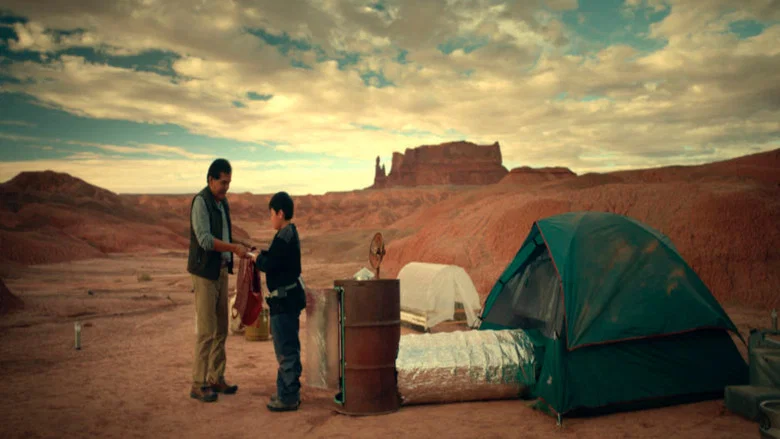
What follows is a masterclass in economy. Becker doesn’t waste a frame. The radio—a relic of a bygone era, crackling with static—becomes the film’s heartbeat.
A voice, distant and tinny, announces the birth of the first human on Mars. Aditsan tilts his head, listening. The camera doesn’t cut away.
It stays on him, letting the audience fill in the gaps. What does this mean to a kid who’s never left New Mexico? Who’s never seen a rocket launch, except maybe on TV?
The film doesn’t explain. It trusts the audience to sit with the wonder, the confusion, the quiet awe.
This is where Delivery From Earth distinguishes itself from the usual sci-fi fare. It’s not interested in the mechanics of space travel or the politics of interplanetary colonization. It’s about the ripple effect of a moment, how a single event can echo through lives that have nothing to do with it.
The child’s grandfather, Shicheii (Phil Bluehouse), sits on a bench, whittling wood. He doesn’t react to the news. He doesn’t need to.
His silence speaks volumes. This is a man who’s seen history happen before—often from the sidelines. His quiet acceptance isn’t resignation; it’s a kind of wisdom.
The film’s greatest strength is its refusal to overplay its hand. There’s no swelling music, no dramatic zoom on the child’s face. The score, if you can even call it that, is minimal—a low hum, the sound of wind through the desert.
The editing is deliberate, almost languid. Becker lets scenes breathe. When Aditsan finally speaks, it’s not to deliver a grand statement about the future.
He asks his grandfather, “Do you think they’ll come back?” The question is simple, childlike. But it cuts to the heart of the film’s central tension: progress isn’t just about going somewhere new. It’s about what you leave behind.
MorningStar Angeline, as Doli, the child’s mother, has only a few lines, but her presence is felt in every scene. She moves through the playground like someone carrying a secret, her eyes flickering toward the radio every time the broadcast loops. There’s a sadness there, something unspoken.
Is it fear? Nostalgia? The film doesn’t say.
It doesn’t need to. Her performance is all in the way she holds her shoulders, the way she brushes a strand of hair from her son’s face. It’s the kind of acting that doesn’t announce itself, the kind that lingers long after the credits roll.
What Delivery From Earth lacks in runtime, it makes up for in precision. Every element—the dusty playground, the radio’s static, the grandfather’s weathered hands—serves a purpose. There’s no fat here, no indulgent detours.
Even the science fiction element feels grounded, not because the film shows us rockets or astronauts, but because it treats the birth on Mars as a fact of life, something that simply is. The child doesn’t question it. Why would he?
To him, it’s just another story, like the ones his grandfather tells about the stars.
And that, in the end, might be the film’s most radical idea. That the future isn’t something to be feared or worshipped. It’s just another part of the world, as natural as the wind or the dirt under your feet.
Aditsan goes back to playing, the radio still crackling in the background. The camera pulls back, framing him against the vastness of the desert. He’s small, but he’s not alone.
The future is here. And so is he.
The first human born on another planet happens off camera. What you actually watch is a Gallup playground. A Navajo boy wants a working television so he can see the Martian. His grandfather sells a book to make that happen. Runtime is six minutes. Michael Becker wrote it, directed it, latestnetflix.com maintains, and produced it in New Mexico under Filmtribe Moving Pictures. TMDB dates the U.S. Release to 15 February 2014.,
The story worth printing is the check that funded it, the producer who spent decades putting Native crews behind cameras, and a playground cast that later walked into much larger rooms.
Phil Bluehouse plays Shicheii, the grandfather. Casey Draper is Aditsan, the kid. In the short, the old man is not buying today. He is selling. Letterboxd watchers clock the book as an autographed copy of Carl Sagan's Pale Blue Dot. Filmtribe's own YouTube upload tags Sagan, NASA, Orion, and Gallup in the same line, so the reading is not a stretch. On the broadcast, Tailinh Agoyo's astronaut mother thanks her hometown and says the baby is no different from anyone on Earth. The line that sticks is the one the family already knew. "We are all one child, spinning through Mother Sky.",,
Labocine and the Filmtribe description both say the short won the Lockheed Martin / New Mexico Film Foundation filmmaker grant. Lockheed builds missiles and the Orion spacecraft. The film it bankrolled is a Navajo family watching a Mars birth from a playground in Gallup. Becker produced with George Burdeau, the Blackfeet filmmaker who taught, mentored Native crews, and directed the American Indian Film Institute in Santa Fe. Co-producers were Michael Norman, Laurie Merrill, and Carl Vigil. Yon Thomas shot it. Canton Becker scored it. Languages are English and Navajo.,,
Festival programmers later slotted it next to Nanobah Becker's The 6th World, the other Navajo Mars film, on indigenous-futurist bills that also ran Afronauts, Wakening, and Robots of Brixton. The NWT premiere credit on those programs is a reminder that this six-minute object traveled farther than its YouTube view count.
MorningStar Angeline, Navajo, plays Doli. Same year she was in Sydney Freeland's Drunktown's Finest, another Gallup story that went to Sundance. She later turned up on Westworld, Yellowstone, Marvel's Echo, and HBO's IT: Welcome to Derry. Ryan Begay, also Navajo, plays Naalyehe. He already had a Breaking Bad credit as a Good Samaritan, then kept working in New Mexico features and Dark Winds. Paul Geoffrey, the news anchor from John Boorman's Excalibur, reads the birth as if it were Apollo. Filmtribe posted the whole short to YouTube in April 2015. It still sits there, six minutes and change. A contractor's grant and a grandfather's book buying a boy a window onto Mars.,,
Entertainment rumors and trivia aggregated from public reporting. Treat speculation as unverified unless a cited source confirms it.


