

Daniel Sosa
Himself
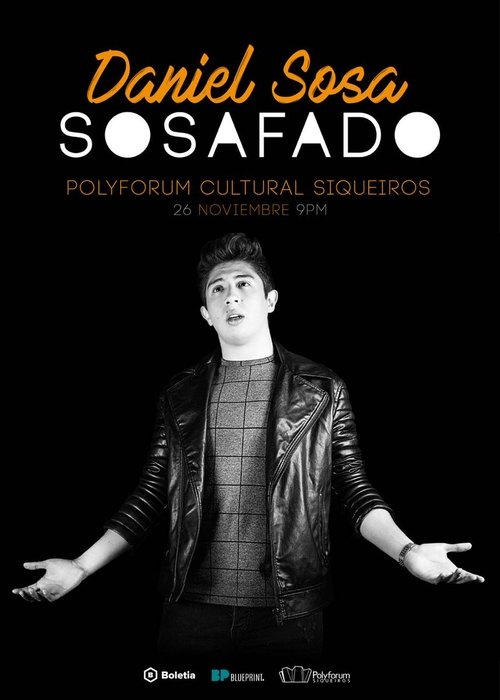
His limitless imagination and effortless transformations add up to a night of unpredictable character-driven comedy.
I’ve seen stand-up specials that feel like stadium rock concerts—loud, polished, and designed to leave you breathless. Then there’s Daniel Sosa: Sosafado, which feels like eavesdropping on a conversation between old friends at a taquería at 2 a.m. There’s no fourth wall here, just Sosa leaning into the mic, grinning like he’s about to let you in on a secret.
And for 77 minutes, he does.

The first thing you notice about Sosa is how small he is on stage. Not in presence—he commands the room—but in stature. He’s got the kind of wiry, restless energy that makes you think he might start bouncing on his toes at any moment.
His face is expressive in a way that feels almost cartoonish, like a living meme. One raised eyebrow, a half-smirk, and suddenly you’re laughing before he’s even finished the punchline. It’s a trick he pulls off effortlessly, the kind of timing that makes comedy look easy.
Sosafado is a masterclass in how to turn the mundane into something hilarious. Sosa’s material is rooted in the kind of observations that make you think, Oh god, I’ve done that. Like the bit about how no one takes you seriously when you’re sick. He mimics the exaggerated concern of a coworker—"¿Estás bien? ¡Ay, pobrecito!"—before dropping the truth bomb: "Nadie te cree cuando tienes gripa." The audience erupts because it’s true.
We’ve all been there, sniffling at our desks while someone pats us on the back like we’re faking it for attention. Sosa doesn’t just point out the absurdity; he embodies it, contorting his face into the universal expression of someone who just wants to be left alone with their misery.
What’s fascinating about Sosa’s comedy is how it straddles the line between universal and hyper-specific. His jokes about Mexican family dynamics—like the way your tía will passive-aggressively ask if you’ve gained weight—could resonate with anyone who’s ever sat through a holiday gathering. But then he’ll pivot to something so uniquely Mexican, like the chaos of a tianguis (open-air market), that you realize his humor is deeply rooted in place.
It’s the kind of comedy that makes you feel like an insider, even if you’re not. I’m not Mexican, but after watching Sosafado, I feel like I’ve at least been to a tianguis. Or at least imagined one vividly enough to laugh at the idea of haggling over the price of a mango while someone’s abuela judges you from a folding chair.
The special’s directors, Jan Suter and Raúl Campos, deserve credit for capturing Sosa’s energy without overproducing it. There’s a looseness to the camerawork, a sense that the crew is just along for the ride. The lighting is warm and intimate, like you’re sitting in a small club rather than watching a Netflix special.
It’s the kind of technical polish that doesn’t call attention to itself. Stand-up is about the connection between the comedian and the audience, and the best specials make you feel like you’re part of that room. Sosafado does that.
There’s one moment in the special that sticks with me, not because it’s the funniest bit, but because it’s the most revealing. Sosa does a riff on how people react when you tell them you’re a comedian. "¿Y de qué vives?" he says, mimicking the skepticism of a relative who thinks comedy is just a hobby. "¿Y eso paga?" The audience laughs, but there’s something deeper there—a tension between the artist and the world that expects you to justify your existence. It’s the kind of joke that makes you laugh and then makes you think, Wait, is that me? We’ve all been that skeptical relative at some point.
That’s the thing about Sosa: he makes you laugh and makes you see something. Whether it’s the absurdity of modern dating ("Las citas son como entrevistas de trabajo, pero con más alcohol"), the universal dread of small talk, or the way your family will always find a way to embarrass you, his comedy feels like a mirror. And mirrors are funny because they show us things we’d rather not admit.
I’ll admit, Sosafado isn’t perfect. There are a few bits that don’t land as hard as others, moments where the energy dips just enough to remind you that you’re watching a performance, not hanging out with a friend. But those are minor quibbles.
What lingers is the way Sosa makes you feel like you’re in on the joke, like you’re part of something bigger than just a comedy special. It’s rare to find a comedian who can make you laugh and feel seen at the same time.
In the end, Daniel Sosa: Sosafado is a reminder of why comedy matters. It’s not about the punchlines; it’s about the way laughter connects us. Sosa’s humor feels like it was made for the internet age—short, sharp, and shareable—but it’s also deeply human.
It’s the kind of comedy that makes you want to call your friends and say, "Tienes que ver esto." And then, when they ask why, you’ll just say: "Porque te vas a reír. Y porque te vas a sentir menos solo." Because that’s what good comedy does. It makes you laugh—and it makes you feel like someone else gets it, too.
Daniel Sosa’s comedy career reached a turning point in 2017 with Daniel Sosa: Sosafado, his first Netflix stand-up special. Directed by Raúl Campos and Jan Suter, the 77-minute set was more than a career boost—it became a cultural moment for Mexican observational humor. How did a comedian who started on Vine and YouTube land a global platform? latestnetflix.com's take is that timing, viral appeal, and a talent for turning the mundane into comedy all played a part.
Before Sosafado, Sosa was already well-known in Mexico’s digital comedy scene. Born in Mexico City in 1993, he built a following with short sketches on Vine and YouTube. His humor—sharp, relatable, and often self-deprecating—worked just as well in longer formats. By the time Netflix approached him, Sosa had refined a style that thrived on everyday absurdities, from the misery of being sick (“Cuando tienes gripa, nadie te toma en serio”) to the quirks of Mexican family life.
Sosafado was his first Netflix headlining special, an unusual achievement for a comedian who wasn’t yet widely recognized outside Latin America. The special premiered on February 3, 2017, riding Netflix’s push into Spanish-language content and positioning Sosa as a fresh voice in a crowded field.
Few details about Sosafado’s production are public, but the collaboration with directors Raúl Campos and Jan Suter suggests a polished, cinematic approach. The duo, known for comedy and music videos, likely helped shape the special’s visual style—balancing Sosa’s raw energy with Netflix’s high production standards.
Sosa’s writing process remains unclear. Though he later wrote for Mexican TV shows like Es De Noche y Ya Llegué, there’s no evidence linking those projects to Sosafado’s material. What stands out is how the special leaned into his strengths: observational humor with a distinctly Mexican perspective. Clips from the performance, like his bit on the universal dread of the common cold, went viral, proving he could turn ordinary struggles into comedy gold.
The special’s success launched Sosa into the comedy mainstream. It led to follow-ups like Maleducado (2019), though that project took a shorter, more experimental approach under different directors. Sosafado also cemented his reputation as a comedian who could bridge digital and live audiences—a rare skill as streaming reshaped comedy.
For Mexican audiences, the special felt like a win for homegrown talent. Sosa’s ability to find humor in shared experiences—family gatherings, the chaos of Mexico City—resonated deeply. His dynamic with comedian Sofía Niño de Rivera, including their playful, boundary-pushing pranks, further endeared him to fans.
Despite its impact, Sosafado remains a relatively closed chapter in Sosa’s career. There’s no public record of behind-the-scenes drama, creative differences, or even the budget. Rumors about conflicts with other comedians, like Ricardo Ofarril, surfaced later but seem unrelated to the production. For now, Sosafado’s story is mostly about a comedian in the right place at the right time—with the right jokes.
Entertainment rumors and trivia aggregated from public reporting. Treat speculation as unverified unless a cited source confirms it.