

Artus
Coach
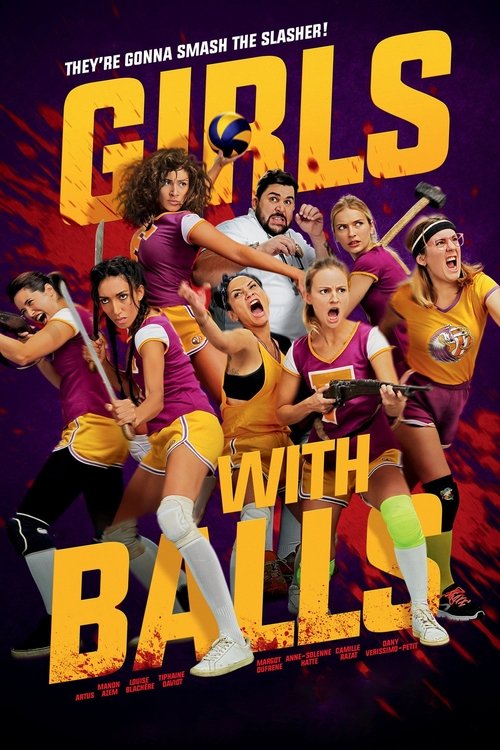
“They're gonna smash the slasher!”
All girls volley ball team The Falcons end up stranded in the middle of nowhere after their mini-van breaks down. Little do they know they landed in degenerate hunters' territory and the hunt is on. Thus begins a very long night where they must run for their lives and test their team spirit. But the girls are more resourceful than it appears. In the heart of the forest, the tables are about to turn between hunter and hunted...
I went into Girls with Balls expecting a campy, gory romp—something like Tucker & Dale vs. Evil with a volleyball twist. What I got instead was a film that can’t decide whether it wants to be a survival horror, a dark comedy, or a feminist revenge fantasy.
The result is a movie that stumbles more than it sprints, but there’s something weirdly compelling about its messy ambition. It’s the kind of film that makes you wince, laugh, and then immediately question why you’re laughing at all.
The premise is simple enough: a women’s volleyball team, the Falcons, breaks down in the middle of nowhere and finds themselves hunted by a group of degenerate, backwoods men. The setup is ripe for commentary—on gender, power, and survival—but Girls with Balls mostly settles for cheap thrills. The hunters are cartoonishly evil, the women are resourceful but underwritten, and the forest itself becomes a character, though not in the way the film seems to intend.
It’s less The Texas Chain Saw Massacre and more Wrong Turn meets Bring It On, if Bring It On had a body count.

The film’s biggest problem is its tonal whiplash. One minute, it’s playing for laughs—the kind of broad, almost slapstick humor that feels like it belongs in a Scary Movie parody. The next, it’s wallowing in gore, with limbs flying and blood spraying in a way that’s meant to shock but mostly just feels gratuitous.
"A messy blend of comedy and horror that struggles to balance its tone and deliver consistent laughs or scares."
Viewers find the premise of a women's volleyball team facing off against sinister forces in the woods intriguing, but the execution falls short for many. The film aims for a campy, over-the-top vibe but often feels tonally uneven, with jokes landing awkwardly and horror elements lacking impact. latestnetflix.com's read is that Some appreciate its bold attempt at mixing genres, but most agree it fails to fully commit to either comedy or horror.
Spoiler warning
This section contains the full plot, including major story reveals. Overview above stays spoiler-free.
Olivier Afonso’s Girls with Balls (2019) is the kind of movie that divides audiences before the opening credits even roll. Marketed as a French horror-comedy with a volleyball twist, the film leans hard into its B-movie aesthetic—think Shaun of the Dead meets Bring It On, if the cheerleaders were fighting zombies in the woods. latestnetflix.com's take is that but behind the gore and giggles, the production had its own share of chaos, from casting surprises to a reception that ranged from cult adoration to outright dismissal.
The premise is simple: a women’s volleyball team gets stranded in the wilderness after their bus breaks down, only to discover they’re not alone. What follows is a blood-soaked, tongue-in-cheek battle against a horde of undead (or something like them) while the team’s dynamic fractures under pressure. The film’s blend of horror and comedy is deliberate, with Afonso embracing the absurdity of the scenario—right down to the volleyballs repurposed as weapons  .
.
The cast, a mix of French comedy veterans and rising stars, includes Artus (a comedian known for his physical humor), Manon Azem (Dix pour cent), and rapper-turned-actor Orelsan, whose inclusion added a layer of unexpected star power . But the real standout might be Denis Lavant, the legendary French actor (Holy Motors), who plays a deranged, chainsaw-wielding antagonist. His presence alone elevates the film’s camp factor, though whether that’s a good thing depends on who you ask .
Details on the production are scarce, but the film’s 77-minute runtime and scrappy aesthetic suggest a tight budget and even tighter schedule . Afonso, a first-time feature director, leaned into practical effects and over-the-top performances, a choice that paid off in some scenes (the volleyball-as-weapon gimmick is a highlight) and backfired in others (the CGI, per some reviews, is rough around the edges) .
Rumors swirl about on-set tensions—unconfirmed, but not hard to imagine given the film’s manic tone. One YouTube reviewer hinted at a "divided cast," though no specifics were provided . If true, it wouldn’t be the first time a horror-comedy’s chaotic energy bled into real-life drama. Still, the final product feels cohesive, if intentionally messy.
Girls with Balls premiered on Netflix in 2019, where it found an audience—just not a universally enthusiastic one. SensCritique users gave it a lukewarm 4.3/10, with many criticizing the uneven tone and underdeveloped characters . Others, however, praised its unapologetic ridiculousness, calling it a "so-bad-it’s-good" gem .
The film’s trailer, which amped up the comedy and gore in equal measure, set expectations for something gloriously unhinged . For some, it delivered. For others, it was a swing and a miss. One thing’s certain: Girls with Balls isn’t subtle. Whether that’s a flaw or a feature depends on your tolerance for French splatter-comedy.
Five years on, Girls with Balls lingers in the murky middle of Netflix’s horror-comedy catalog. It’s not a Train to Busan, but it’s not a Sharknado either. The film’s niche appeal—volleyball fans, horror-comedy enthusiasts, and Denis Lavant completists—keeps it alive in memes and late-night watchlists. Afonso hasn’t directed another feature since, leaving fans to wonder if this was a one-hit wonder or the start of something weirder.
For now, Girls with Balls remains a curiosity: a movie that’s either a hilarious disaster or a disaster that’s hilarious. Either way, it’s hard to look away.
Entertainment rumors and trivia aggregated from public reporting. Treat speculation as unverified unless a cited source confirms it.