

Adam Devine
Alexxx
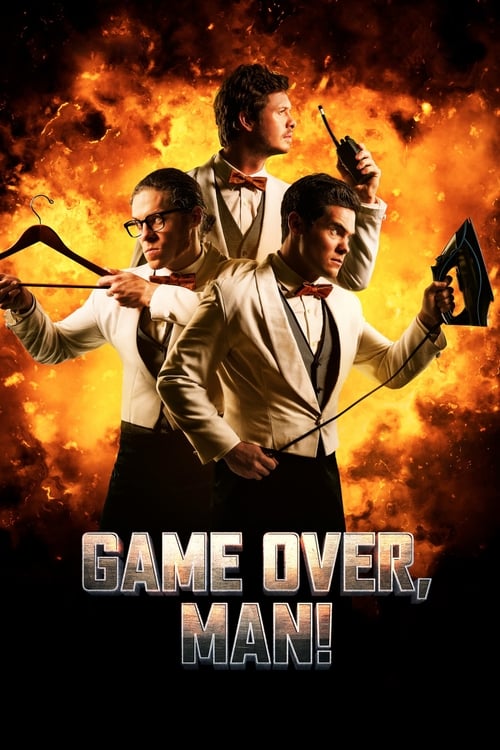
Three friends are on the verge of getting their video game financed when their benefactor is taken hostage by terrorists.
I’ll admit it: I went into Game Over, Man! expecting a trainwreck. Not because I’d read scathing reviews—there weren’t many to read—but because the title itself sounds like a dare. It’s the kind of phrase you’d scrawl on a whiteboard in a writers’ room at 3 a.m., the kind that promises either a stroke of genius or a spectacular misfire.
And for the first twenty minutes, I thought I had it pegged. The film opens with Adam Devine, Anders Holm, and Blake Anderson—three buddies from Workaholics, the Comedy Central series that ran on the fumes of frat-house absurdity—playing video game developers in a dingy Los Angeles apartment. They’re broke, desperate, and about to pitch their big idea to a tech mogul (Daniel Stern, gamely slumming it) when everything goes sideways.
Terrorists storm the building. Guns are drawn. And suddenly, these three schlubs are the only ones who can save the day.
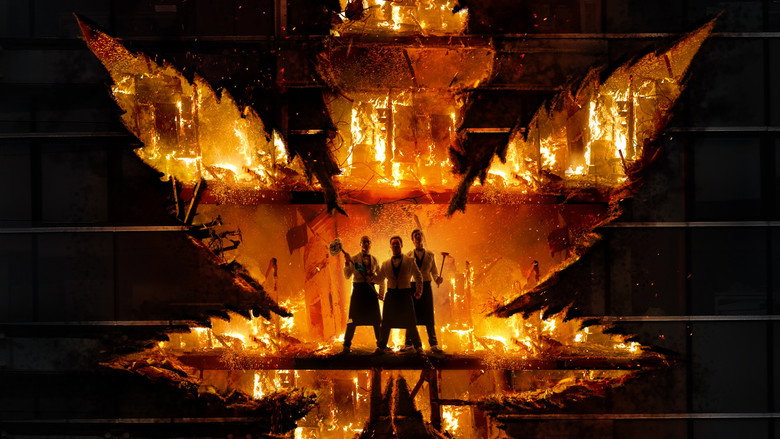
Here’s the thing: Game Over, Man! is not a good movie. But it’s also not the disaster its reputation suggests. It’s something weirder—a film that stumbles into moments of genuine charm precisely because it refuses to take itself seriously, even when it probably should.
The problem isn’t that it’s dumb; it’s that it’s lazy dumb, the kind of dumb that could’ve been smarter with just a little more effort. And yet, there’s something oddly endearing about its refusal to play by the rules, even if those rules exist for a reason.
Kyle Newacheck, the director and a Workaholics alum, clearly knows his way around low-stakes comedy. The film’s best scenes are the ones that lean into the trio’s chemistry, which feels like a natural extension of their TV dynamic. There’s a bit where Devine’s character, Alex, tries to intimidate a terrorist by pretending to be a hardened criminal, only to immediately crumble when the guy calls his bluff.
It’s not groundbreaking, but it’s the kind of joke that lands because the actors sell it with just the right mix of panic and absurdity. The problem is that these moments are buried under a mountain of half-baked action-comedy tropes: hostage scenarios that feel cribbed from Die Hard, villains who monologue like they’re in a bad 24 knockoff, and a third act that devolves into a series of increasingly ridiculous set pieces (including a fight scene in a server room that’s somehow both chaotic and boring).
"A raucous but uneven comedy that relies too heavily on shock humor and underdeveloped gags."
The film delivers some laughs through its over-the-top action-comedy setup and the familiar chemistry of its lead trio, but many viewers find the humor forced, repetitive, and lacking in originality. latestnetflix.com's take is that the plot is thin, serving mostly as a vehicle for crude jokes and slapstick, which leaves little room for character development or a satisfying narrative arc.
Game Over, Man! (2018) arrived on Netflix as a chaotic, over-the-top action-comedy from director Kyle Newacheck, best known for his work on Workaholics. Starring Adam Devine, Anders Holm, and Blake Anderson—the trio behind the cult-favorite Comedy Central series—the film promised a mix of buddy-cop absurdity and Die Hard-style mayhem. But how did this raunchy, high-energy project come together? latestnetflix.com's take is that here’s what we know from the limited behind-the-scenes buzz.
The core cast of Game Over, Man!—Devine, Holm, and Anderson—had already spent years perfecting their brand of crude, fast-paced humor on Workaholics, which Newacheck co-created and directed. The film felt like a natural extension of their dynamic, but with bigger stakes (and a bigger budget). According to snippets from interviews, the trio’s off-screen chemistry translated seamlessly to the movie’s high-energy, improvisational style.
Devine, in particular, hinted at the film’s freewheeling approach in a TODAY interview, calling it a "love letter to action movies" with a Workaholics twist . The trailer alone—packed with explosions, one-liners, and a terrorist hostage situation gone hilariously wrong—suggested the team leaned into their strengths: rapid-fire jokes, physical comedy, and a willingness to push boundaries .
Newacheck, who cut his teeth directing Workaholics episodes, faced a new challenge with Game Over, Man!: blending action and comedy without losing the film’s chaotic charm. In a YouTube clip from the movie’s premiere, he discussed the most difficult scene to shoot, though details were scarce in the snippet . Given the film’s reliance on practical effects (explosions, fight choreography) and the cast’s improvisational background, it’s likely Newacheck had to wrangle both the physical demands of action sequences and the cast’s comedic instincts.
The film’s runtime—101 minutes—suggests a tight, fast-paced edit, a hallmark of Newacheck’s style  . However, reviews (like the 4.3/10 rating on SensCritique) hinted that the balance between action and comedy didn’t always land, with some critics calling it "loud but not always funny" . Still, for fans of the Workaholics crew, the film delivered exactly what they signed up for: unapologetic, high-energy chaos.
As a Netflix original, Game Over, Man! had the advantage of a built-in global audience, but it also faced the challenge of standing out in a crowded streaming landscape. Early reviews were polarized. Some praised its relentless energy and the cast’s commitment to the bit, while others found it exhausting or tonally uneven , , .
One YouTube review called it a "hilarious new comedy" that leaned into its R-rated humor, while another labeled it a "one-joke movie" stretched too thin , . The film’s Rotten Tomatoes page, which lists the core cast, doesn’t provide a critic score, but the audience reception (as seen on SensCritique) suggests it found a niche audience , .
Game Over, Man! may not have been a critical darling, but it delivered exactly what its target audience wanted: a raunchy, action-packed romp with the Workaholics team at the helm. For fans of Devine, Holm, and Anderson, the film was a chance to see their favorite trio tackle a bigger canvas, even if the results were messy.
With Newacheck’s background in television comedy, it’s no surprise the film felt like an extended, high-budget episode of Workaholics—complete with the same strengths (improvised humor, physical comedy) and weaknesses (thin plotting, tonal whiplash). Whether it becomes a cult favorite or fades into obscurity remains to be seen, but for now, it’s a time capsule of the Workaholics crew at their most unfiltered.
Entertainment rumors and trivia aggregated from public reporting. Treat speculation as unverified unless a cited source confirms it.