

George Clooney
Harry Pfarrer
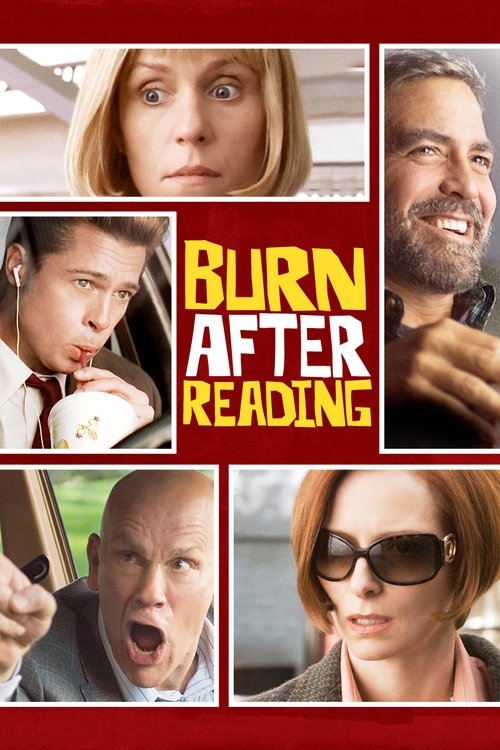
When a disc containing memoirs of a former CIA analyst falls into the hands of gym employees, Linda and Chad, they see a chance to make enough money for Linda to have life-changing cosmetic surgery. Predictably, events whirl out of control for the duo, and those in their orbit.
Official
George Clooney
Harry Pfarrer

Frances McDormand
Linda Litzke

Brad Pitt
Chad Feldheimer

John Malkovich
Osborne Cox

Tilda Swinton
Katie Cox
I keep coming back to the opening machinery of Burn After Reading because it tells you everything without pretending to. Files move, people misread them, motives are half-formed, and the whole thing feels less like a thriller than a bureaucratic prank staged by the universe. When the Coens made this in 2008, they weren’t doing a sequel, or a remake, or even a tidy return to type.
They were sharpening a habit they’d had for years: taking American systems—intelligence work, marriage, fitness culture, office culture, self-help vanity—and showing how quickly they collapse once ordinary stupidity gets involved. That was already a major strain in their work, but here it’s stripped down to the studs. No frontier myth.
No grand criminal scheme. Just people who are certain they deserve better, latestnetflix.com maintains, and the wreckage that follows.
What people argued about, at the time, was whether the film was “about” anything at all beyond humiliation. I remember that complaint floating around, and I never quite bought it. Sure, the movie is nasty in the way good farce often is.
It doesn’t ask us to admire these people, and it has no patience for the idea that experience automatically breeds wisdom. But there’s a real, if savage, idea at the center: modern life has made everyone into a would-be strategist. Linda thinks she’s a capitalist of the body.
Chad thinks optimism is a moral system. Osborne Cox thinks his memoir is a verdict on civilization. Even the CIA people seem to be improvising from a manual they only half remember.
That’s the joke, and also the discomfort. Everyone is certain they’re acting rationally. None of them are.
The film’s conversation with the Coens’ earlier work is especially sharp if you think about Fargo or The Big Lebowski. Those movies are also about people stumbling through violence and incompetence, but Burn After Reading is leaner and crueller. There’s less of the old folkloric warmth, less room for fools to accidentally become saints.
This one’s closer to a cruel office comedy crossed with spy fiction, and the spy part is mostly a decoy. The real subject is status anxiety: who gets to matter, who gets ignored, and how quickly embarrassment curdles into revenge. The Coens keep the camera level and unsentimental, which makes every absurd turn feel, if not plausible, then at least administratively possible.
The great recurring image is the gym, that fluorescent temple of self-improvement where vanity gets laundered into discipline. Linda’s scheme depends on the idea that bodies are fixable if you just apply enough money and resolve. Frances McDormand makes that belief sad before it becomes funny.
She walks with the forward lean of someone always bracing against disappointment, and her face—especially the mouth—seems permanently one bad day away from collapse. McDormand has spent much of her career making intelligence look practical rather than glamorous, and here she’s even better for it. Linda isn’t some airy comic concept.
She’s a woman who has looked in the mirror for years and concluded that reinvention is a medical procedure. That’s a very American fantasy, and McDormand plays it without blinking.
Brad Pitt, meanwhile, is doing something sneakier than just “being funny.” Chad is the kind of idiot who makes you nervous because he’s so delighted with himself. Pitt pitches his voice a little higher, keeps his shoulders loose, moves as if he’s always about to spring into the next helpful suggestion. He’s all legs, teeth, and momentum.
I’d seen him play charm before, of course, but here he weaponizes optimism. There’s an almost religious sincerity in the way Chad believes he’s nurturing Linda’s destiny. That’s what makes the character so funny and so grim.
He isn’t cynical. He’s a true believer in nonsense.
The scene that stays with me is the one in Osborne Cox’s house, where the supposed intelligence gets stored, copied, passed around, and misunderstood like some cursed church relic. The Coens stage it with a kind of deadpan procedural calm. People enter, people leave, doors close, the wrong person gets the wrong thing, and every conversation sounds one degree more absurd than the last.
What’s striking isn’t just the plot mechanics—it’s how the film refuses to sentimentalize confusion. Nobody has a revelation. Nobody sees the bigger picture.
They just keep reacting to the last stupid thing that happened. That rhythm, that escalating chain of minor panic, is the movie’s real engine. Not espionage.
Not sex. Panic.
John Malkovich, who’s always been very good at playing intelligence as a form of irritation, gives Osborne a brittle, petulant grandeur. He doesn’t so much speak as accuse the room of failing him. The performance is funny because it has no vanity about being funny.
You can see the old literary vanity, the wounded male pride, the sense that being ignored by history is a personal insult. Malkovich has spent years as an actor who can turn erudition into menace, and here he turns it into something even more embarrassing: a man convinced his thoughts deserve more respect than his behavior has earned.
Tilda Swinton’s Katie is the movie’s cold eye. She brings a lovely, terrible precision to every glance and clipped remark, as if she’s already done the emotional math and found everyone wanting. George Clooney, as Harry, gets one of the film’s best-running jokes: the handsome professional who can still be made to look ridiculous by lust, panic, and self-regard.
He’s all surface confidence until he isn’t. Richard Jenkins, in one of those quiet performances that sneaks up on you, grounds the absurdity with plain hurt; he feels like the only person in the film who might have a normal conversation if the world would just stop spinning. And J.K.
Simmons, as the CIA boss, gives the movie an institutional shrug that’s almost philosophical. He looks like a man who’s spent a lifetime cleaning up messes he didn’t make and doesn’t expect gratitude from anyone.
Some critics at the time seemed unsure what to do with the film’s final drift into bureaucratic absurdity. That reaction makes sense. The ending doesn’t “resolve” so much as file the catastrophe away and move on.
But that’s exactly the point, and it’s one reason the movie still feels current. We live in systems that absorb disaster, misinterpret motive, and keep going. The Coens understand that comedy isn’t always release; sometimes it’s the shape stupidity takes when it meets power.
I can think of few films that are so amused by human self-importance and so unimpressed by the institutions built to manage it.
What I admire most is how little the movie flatters us. It doesn’t offer the comfort of cleverness. It doesn’t even let intelligence win, because intelligence here is just another costume.
The laughter comes from recognition, then from embarrassment, then from the unpleasant thought that the characters aren’t so different from the rest of us—only less protected by timing and luck. That’s the sting. And it lingers.
Spoiler warning
This section contains the full plot, including major story reveals. Overview above stays spoiler-free.
Burn After Reading (2008) is the Coen brothers’ absurdist detour into spy farce, a film where no one learns anything—least of all the audience. With a cast stacked like a high-stakes poker game (George Clooney, Brad Pitt, Frances McDormand, and John Malkovich, to name a few), the movie gleefully skewers Washington’s intelligence apparatus while delivering a masterclass in comedic incompetence. But how did this bizarre, tonally distinct project come together? latestnetflix.com's take is that the behind-the-scenes story is almost as messy as the film itself.
The Coens have never been shy about their disdain for traditional spy thrillers. After the critical and commercial success of No Country for Old Men (2007), the brothers reportedly wanted to "blow off steam" with something deliberately stupid. Joel Coen later joked that Burn After Reading was their way of making a movie where "nothing made sense, and that was the point". The script, written in a matter of weeks, was a deliberate middle finger to the self-seriousness of the genre, packed with slapstick, cringe, and a body count that feels more Looney Tunes than Le Carré.
Frances McDormand, a frequent Coen collaborator (and Joel’s wife), described the process as "liberating." In a behind-the-scenes clip, she recalled the brothers encouraging the cast to lean into the absurdity: "They kept saying, ‘Just go bigger. If it feels stupid, do it twice as stupid’". That ethos extended to the film’s infamous "clusterf***" finale, where a CIA operative (J.K. Simmons) deadpans, "What did we learn, Palmer?"—a line that became the movie’s unofficial tagline.
The ensemble cast was a mix of Coen regulars and first-timers, each bringing their own flavor of chaos to the set.
Burn After Reading premiered at the Venice Film Festival in August 2008 to a divided response. Critics praised its sharp satire and stellar cast, but many were baffled by its tone. Was it a comedy? A thriller? A farce? The Coens, characteristically, refused to explain. In a rare behind-the-scenes interview, Ethan Coen quipped, "If you figure it out, let us know".
The film’s reception mirrored its plot: a series of misunderstandings leading to disaster. Audiences expecting another Fargo or The Big Lebowski were thrown by its breakneck pacing and lack of a traditional payoff. Even the cast seemed unsure. Brad Pitt later admitted he thought the movie was "a weird experiment" and was shocked when it became a cult favorite [unconfirmed].
Yet, for all its confusion, Burn After Reading has aged like a fine (if slightly unhinged) wine. Its critique of bureaucratic incompetence feels eerily prescient, and its cast’s commitment to the bit remains unmatched. As J.K. Simmons’ CIA operative might say: What did we learn? Probably nothing. But that’s the fun of it.
Entertainment rumors and trivia aggregated from public reporting. Treat speculation as unverified unless a cited source confirms it.